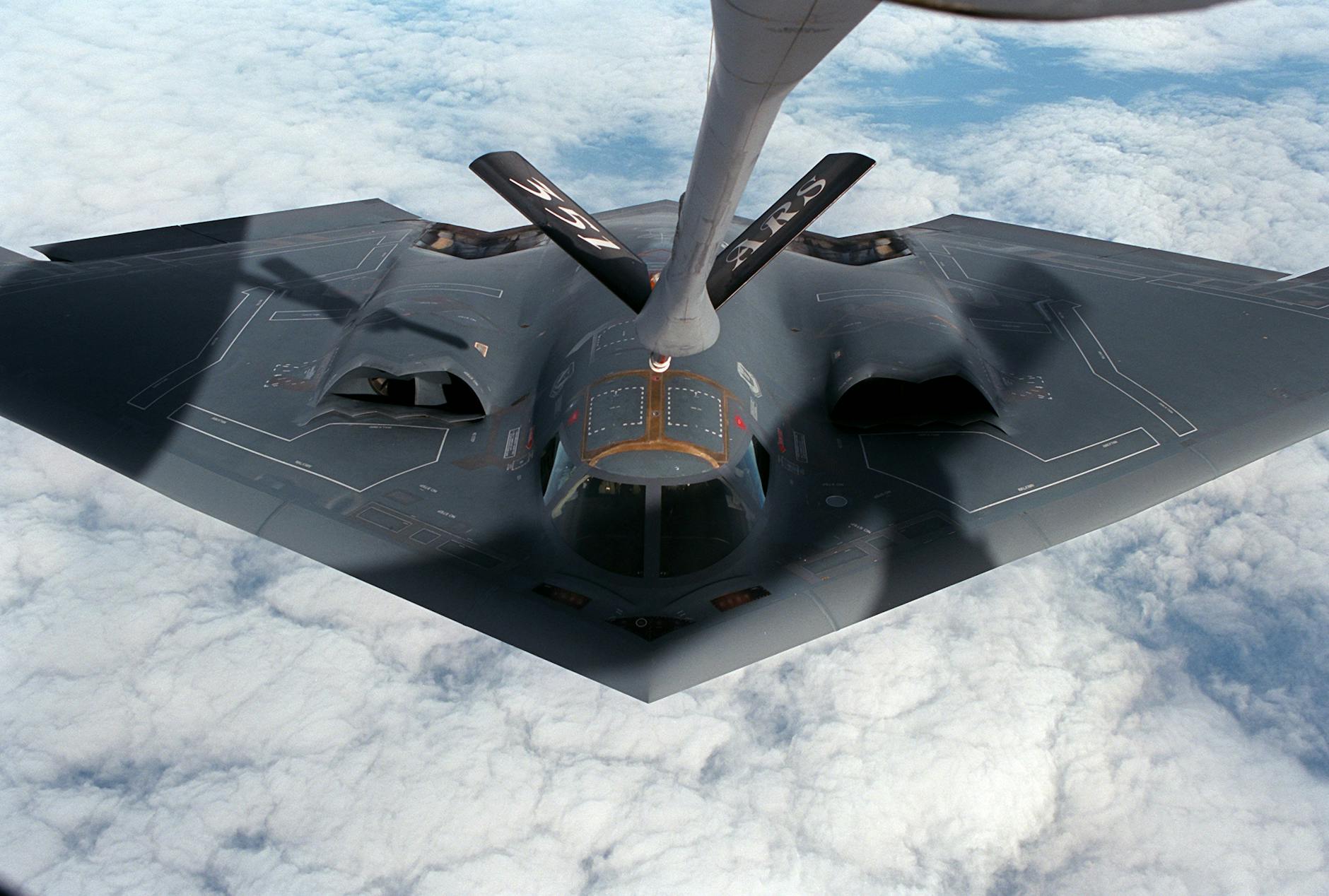
The United States deployed B-2 Spirit stealth bombers against Iran’s hardened underground ballistic missile facilities in late February and early March 2026, confirming what defense analysts had long predicted would be necessary to reach Tehran’s most protected military assets. As part of Operation Epic Fury, a joint U.S.-Israeli campaign, four B-2A Spirit bombers flew approximately 14,000-mile round-trip missions from Whiteman Air Force Base in Missouri to strike what Iran calls its “missile cities” — deeply buried tunnel complexes in mountainous terrain operated by the Islamic Revolutionary Guard Corps Aerospace Force. Satellite imagery confirmed the destruction at Tabriz North Missile Base, where cave entrances were visibly collapsed following the strikes. The decision to send the B-2, the world’s only operational deep-strike heavy-lift stealth platform, signaled a significant escalation in the campaign’s intensity.
These aircraft dropped dozens of 2,000-pound GBU-31 JDAM bombs, likely the GBU-31(V)3 variant equipped with BLU-109 bunker-buster warheads designed specifically to penetrate hardened and underground targets. The Pentagon reported that Iranian missile attacks dropped by 90 percent following the B-2 strikes, a staggering reduction that underscored why these particular aircraft were deemed essential. Three Americans were killed during Operation Epic Fury. This article examines the operational details of the B-2 strikes, the specific weapons employed, the broader strategic context of Operation Epic Fury, and what the campaign reveals about America’s capacity — and willingness — to strike deeply fortified targets. It also addresses the political and accountability questions that follow any major military operation conducted under executive authority.
Table of Contents
- Why Were B-2 Spirit Stealth Bombers Needed to Hit Iran’s Underground Bunkers?
- What Weapons Did the B-2s Use and What Are Their Limitations?
- Operation Epic Fury — The Broader Campaign by the Numbers
- The Strategic Tradeoff — Stealth Bombers Versus Other Strike Options
- Accountability Questions and Congressional Oversight Concerns
- The B-2’s Track Record in Combat Operations
- What Operation Epic Fury Signals for Future Conflicts
- Conclusion
- Frequently Asked Questions
Why Were B-2 Spirit Stealth Bombers Needed to Hit Iran’s Underground Bunkers?
iran spent decades building what it calls “missile cities” — hardened tunnel complexes carved into mountainous terrain, designed to survive conventional airstrikes and protect ballistic missiles along with their Transporter Erector Launcher vehicles. These facilities, operated by the IRGC Aerospace Force, represent some of the most formidable underground military infrastructure in the Middle East. Standard fighter-bombers carrying conventional munitions simply cannot penetrate deep enough to destroy what is inside. The B-2 Spirit, with its ability to carry heavy penetrating ordnance while evading advanced air defense systems, was the only aircraft in the U.S. inventory capable of reaching these targets.
By comparison, the F-35 Lightning II can carry precision-guided munitions and operates with stealth, but its internal payload capacity is far smaller than the B-2’s. The B-1B Lancer, which conducted follow-on deep strikes starting around March 3, can carry a massive weapons load but lacks the B-2’s stealth characteristics, making it less suitable for initial strikes against intact air defense networks. The B-2 occupies a unique niche: it combines stealth with heavy-lift capability, allowing it to deliver large bunker-buster weapons against the most defended targets without being detected on approach. The four B-2s that flew this mission — callsigns PETRO41, PETRO42, PETRO43, and PETRO44 — launched from Whiteman Air Force Base, the only permanent home station for the B-2 fleet. The round-trip distance of roughly 14,000 miles required extensive aerial refueling and crew endurance, but it also meant the bombers did not need to be staged at forward bases in the Middle East, reducing the political and logistical complications of basing arrangements with allied nations. On their return, all four aircraft diverted to Dyess Air Force Base in Texas due to weather conditions at Whiteman, a routine but telling reminder that even the most sophisticated military operations remain subject to ordinary constraints.
What Weapons Did the B-2s Use and What Are Their Limitations?
The primary weapon employed was the GBU-31 JDAM, a 2,000-pound GPS-guided bomb. Reporting indicates the likely variant was the GBU-31(V)3, which pairs the JDAM guidance kit with the BLU-109 warhead — a hardened penetrator case designed to punch through reinforced concrete and earth before detonating. The BLU-109 can penetrate approximately six feet of reinforced concrete, making it effective against many hardened structures. Each B-2 can carry up to 16 of these weapons internally, meaning the four-aircraft sortie could have delivered as many as 64 individual bunker-buster bombs. However, there are limits to what even bunker-buster munitions can accomplish against the deepest underground facilities. Iran’s most protected sites are reportedly buried under hundreds of feet of rock and reinforced concrete — depths that exceed the penetration capability of the BLU-109.
For those targets, the United States would need the GBU-57 Massive Ordnance Penetrator, a 30,000-pound bomb that only the B-2 can carry and that is designed to reach targets buried far deeper. Whether GBU-57s were used during operation epic Fury has not been publicly confirmed. If Iran’s deepest facilities survived the initial strikes, it may be because the weapons employed, while devastating against moderately hardened targets, were insufficient against the most extreme fortifications. The satellite imagery showing collapsed cave entrances at Tabriz North Missile Base suggests the strikes were effective at sealing access points, even if they did not necessarily destroy everything inside the tunnels. This is a well-known military approach: if you cannot penetrate a bunker directly, you can render it operationally useless by destroying its entrances and exits. The missiles and launchers inside may survive, but they cannot be moved or fired if the tunnels are sealed shut.
Operation Epic Fury — The Broader Campaign by the Numbers
The B-2 strikes were one component of a much larger operation. Within the first 72 hours of Operation Epic Fury, U.S. forces struck over 1,700 targets across Iran. The campaign was not limited to underground missile facilities — it also targeted Iran’s naval capabilities, with more than 30 Iranian naval vessels sunk during the broader operation. The combined effect was severe: the Pentagon reported a 90 percent reduction in Iranian missile attacks following the initial strikes, a figure that, if accurate, represents one of the most decisive suppression-of-enemy-capabilities outcomes in recent military history. F-22 Raptors played a critical supporting role, working alongside the B-2s to suppress Iranian air defenses during the opening 72 hours.
This is standard doctrine for stealth operations — even though the B-2 is designed to evade radar, degrading the enemy’s air defense network reduces risk and increases the bombers’ ability to operate freely. After the initial stealth strikes created openings in Iran’s defense network, B-1B Lancers conducted follow-on deep strikes starting around March 3, taking advantage of the degraded air defense environment to deliver additional firepower against remaining targets. In a display of force that underscored the scale of the commitment, a dozen B-2 Spirit bombers performed what was described as the most powerful elephant walk in U.S. Air Force history. An elephant walk — where multiple aircraft taxi in close formation — is both a readiness exercise and a deliberate signal of capability. Given that the Air Force operates only 20 B-2s in total, putting a dozen on the taxiway simultaneously represented a commitment of more than half the entire fleet, a striking demonstration of how seriously the Pentagon took the Iranian threat.

The Strategic Tradeoff — Stealth Bombers Versus Other Strike Options
The decision to deploy B-2s rather than relying solely on cruise missiles, carrier-based aviation, or other standoff weapons involves significant tradeoffs. Cruise missiles like the Tomahawk can strike targets from great distances without risking pilots, but they carry relatively small warheads — typically around 1,000 pounds — that are insufficient against deeply hardened targets. Carrier-based F/A-18s can deliver precision munitions but lack stealth and cannot carry the heavy penetrating weapons needed for underground bunkers. The B-2 resolves these limitations but introduces others. The aircraft costs approximately $2 billion per unit, making every sortie a calculation of strategic risk.
The United States has only 20 B-2s, and losing even one would represent an irreplaceable reduction in a capability no other platform can replicate. The 14,000-mile round-trip missions from Missouri also require extensive tanker support and crew endurance, creating a long logistical chain that must function flawlessly. By contrast, submarine-launched cruise missiles can be fired from much closer to the target with no risk to pilots and minimal logistical exposure. The tradeoff ultimately comes down to physics: nothing else in the American arsenal can deliver 40,000 pounds of penetrating munitions through defended airspace to a buried target. When Iran’s most hardened missile facilities were designated for destruction, the B-2 was the only tool for the job. Whether the strategic benefits justified the risks — including the three American lives lost during the operation — is a question that will be debated in congressional hearings and policy analyses for years to come.
Accountability Questions and Congressional Oversight Concerns
Any military operation of this scale raises immediate questions about authorization, oversight, and accountability. Operation Epic Fury was conducted under executive authority, and the scope of the campaign — over 1,700 targets struck in 72 hours, with American casualties — is the kind of sustained combat operation that tests the boundaries of the War Powers Resolution. Members of Congress from both parties have historically demanded timely notification and consultation before major military engagements, and the speed with which Epic Fury escalated may have outpaced the normal oversight process. The three American deaths during the operation add urgency to these accountability questions.
Families of service members and the public deserve a clear accounting of how those casualties occurred, what risk mitigation was in place, and whether the operational tempo contributed to the losses. The military’s track record on post-operation transparency has been inconsistent — the Pentagon sometimes takes months or years to release full after-action assessments, particularly when operations involve classified stealth platforms like the B-2. There is also the question of proportionality and long-term strategic consequences. Striking over 1,700 targets and sinking more than 30 naval vessels represents a devastating blow to Iran’s military infrastructure, but it does not eliminate Iran’s ability to retaliate through proxy forces, cyber operations, or accelerated nuclear development. Critics have warned that campaigns of this intensity, while producing impressive short-term metrics like the 90 percent reduction in missile attacks, can generate long-term blowback that is harder to measure and slower to materialize.

The B-2’s Track Record in Combat Operations
The Iran strikes were not the B-2’s first combat deployment against hardened targets. In October 2024, B-2s struck underground weapons storage facilities associated with the Houthis in Yemen, marking one of the first confirmed uses of the aircraft against buried targets in recent years. That operation served as something of a dress rehearsal for the far larger and more complex Iranian campaign.
📨 Get Free Accountability Coverage Alerts
Free · No spam · Unsubscribe anytime
The B-2 also saw extensive use during the opening nights of Operation Allied Force over Serbia in 1999, the initial strikes of Operation Enduring Freedom in Afghanistan in 2001, and Operation Iraqi Freedom in 2003 — always in the role of first-night, high-value target striker. What distinguishes the Iran deployment is the sheer scale of hardened underground targets. Iran’s tunnel infrastructure is far more extensive and better engineered than anything the B-2 has previously been tasked with destroying. The results at Tabriz North — collapsed cave entrances confirmed by satellite imagery — suggest the mission succeeded at its primary objective, but the full extent of damage to Iran’s underground missile capability may not be known for months.
What Operation Epic Fury Signals for Future Conflicts
The deployment of B-2s against Iran’s underground bunkers has implications well beyond the current conflict. China and North Korea both operate extensive underground military facilities, and the demonstrated ability to strike such targets with stealth bombers recalibrates the strategic calculations in Beijing and Pyongyang. The B-2’s eventual successor, the B-21 Raider, is already in flight testing, and the lessons learned from Operation Epic Fury will almost certainly influence how that aircraft and its weapons are optimized for future contingencies.
The broader takeaway is that the era of assuming underground facilities are invulnerable is over, though significant limitations remain. Nations that have invested heavily in burying their most valuable military assets now face evidence that the United States possesses both the capability and the willingness to go after those targets with specialized weapons delivered by stealth platforms. Whether that deters future adversaries or accelerates an arms race in deeper, more resilient bunker technology is one of the defining strategic questions coming out of this campaign.
Conclusion
Operation Epic Fury’s use of B-2 Spirit stealth bombers against Iran’s hardened underground missile facilities represents one of the most significant combat deployments of stealth aviation in history. Four B-2s flew 14,000-mile round trips from Missouri, delivered dozens of bunker-buster bombs against deeply buried IRGC missile complexes, and contributed to a reported 90 percent reduction in Iranian missile attacks. The broader campaign struck over 1,700 targets in 72 hours and sank more than 30 naval vessels, demonstrating an overwhelming application of American military power.
Three Americans lost their lives in the operation. The questions that remain are not primarily military but political and strategic. Congressional oversight of the operation’s authorization, a full accounting of American casualties, and an honest assessment of whether the short-term tactical gains translate into lasting strategic advantage are all essential next steps. The B-2 proved it can do what no other aircraft can, but whether the mission it was sent on serves American interests over the long term is a judgment that belongs to the public and their elected representatives, not solely to the Pentagon.
Frequently Asked Questions
What is the B-2 Spirit stealth bomber?
The B-2 Spirit is a flying-wing heavy bomber manufactured by Northrop Grumman. It is the world’s only operational deep-strike heavy-lift stealth platform, capable of penetrating advanced air defense systems while carrying up to 40,000 pounds of ordnance. The U.S. Air Force operates 20 B-2s, all based at Whiteman Air Force Base in Missouri.
What is a bunker-buster bomb?
A bunker-buster is a munition designed to penetrate hardened structures — reinforced concrete, rock, and earth — before detonating. The BLU-109 warhead used in the GBU-31(V)3 JDAM can penetrate approximately six feet of reinforced concrete. Larger penetrators like the 30,000-pound GBU-57 Massive Ordnance Penetrator are designed for even deeper targets.
How many targets were struck during Operation Epic Fury?
U.S. forces struck over 1,700 targets across Iran within the first 72 hours of the campaign, which began on February 28, 2026. This included underground missile facilities, naval vessels (more than 30 sunk), and air defense systems.
Were there American casualties during the operation?
Yes. Three Americans were killed during Operation Epic Fury. The specific circumstances of their deaths have not been fully detailed in public reporting as of early March 2026.
What is an elephant walk?
An elephant walk is a military aviation term for multiple aircraft taxiing in close formation, typically as a show of force or readiness exercise. During Operation Epic Fury, a dozen B-2 Spirit bombers performed what was described as the most powerful elephant walk in U.S. Air Force history — a significant commitment given the Air Force only operates 20 B-2s total.
Did the B-2 strikes destroy Iran’s missile capability?
The Pentagon reported a 90 percent reduction in Iranian missile attacks following the B-2 strikes, and satellite imagery confirmed destruction at Tabriz North Missile Base. However, the full extent of damage to Iran’s underground missile infrastructure may not be known for months, and Iran retains the ability to retaliate through other means including proxy forces and cyber operations.
You Might Also Like
- Trump Used TruthSocial as a War Communication Platform at 2 AM on February 28
- The Strike Package Included Tomahawk Missiles, JDAM Bombs, and Stealth Aircraft
- No Major Poll Showed Majority Support for Military Action Against Iran Before the Strikes