
The road from the 1979 Iran Hostage Crisis to Operation Epic Fury spans nearly five decades of escalation, miscalculation, and unresolved conflict between the United States and Iran. On February 28, 2026, the U.S. and Israel launched coordinated strikes across at least nine Iranian cities — the largest American military operation in the Middle East since the 2003 invasion of Iraq. The operation, which struck over 1,250 targets in its first 48 hours, did not materialize out of nowhere. It was the product of a chain of events that began when 66 Americans were seized at the U.S.
Embassy in Tehran on November 4, 1979, and continued through nuclear brinkmanship, proxy wars, assassinations, and failed diplomacy. Understanding that chain matters because the current conflict will shape American foreign policy, military spending, and domestic politics for years to come. The stated objectives of Operation Epic Fury — preventing Iran from acquiring a nuclear weapon, destroying its missile arsenal, degrading its proxy networks, and annihilating its navy — represent the most aggressive U.S. posture toward Iran since the Islamic Revolution. This article traces every major inflection point from the hostage crisis through the 2026 strikes, examines the human cost already emerging, and lays out what we know about where this is headed.
Table of Contents
- How Did the 1979 Hostage Crisis Set the Stage for Decades of U.S.-Iran Conflict?
- The Nuclear Deal That Almost Worked — and Why It Collapsed
- From Soleimani to Direct Iranian Attacks on Israel
- The 2025 Israeli Strikes and the Point of No Return
- The Iranian Protest Movement and the Regime Change Calculation
- Operation Epic Fury — What Happened in the First 48 Hours
- What Comes Next — Duration, Casualties, and the Ground Troops Question
- Conclusion
- Frequently Asked Questions
How Did the 1979 Hostage Crisis Set the Stage for Decades of U.S.-Iran Conflict?
The seizure of the american embassy in Tehran was not simply a hostage-taking. It was the opening act of a relationship defined by mutual hostility and zero diplomatic trust. iranian students demanded the extradition of Shah Mohammed Reza Pahlavi, who had been granted asylum in the U.S. for cancer treatment after being deposed in the Islamic Revolution. Fifty-two Americans were held for 444 days, released only on January 20, 1981 — the exact day Ronald Reagan was inaugurated, a final humiliation directed at outgoing President Jimmy Carter. The crisis severed formal diplomatic relations between Washington and Tehran, and those relations have never been restored. Every subsequent confrontation has played out without the basic infrastructure of embassies, ambassadors, or direct communication channels that normally prevent miscalculation between adversaries. The downstream consequences arrived quickly. By 1988, the U.S. and Iran were in a shooting war in the Persian Gulf.
After the USS Samuel B. Roberts struck an Iranian mine that punched a 15-foot hole in its hull, the U.S. launched Operation Praying Mantis, sinking or severely damaging much of Iran’s naval operating forces. That same year, on July 3, 1988, the USS Vincennes misidentified Iran Air Flight 655 as a military aircraft and shot it down, killing all 290 civilians aboard. Iran has never forgotten that incident. Compare the trajectory of U.S. relations with other Cold War-era adversaries — China, Vietnam, even the Soviet Union — and the absence of any diplomatic normalization with Iran stands out as an anomaly that made escalation almost inevitable. The hostage crisis also embedded Iran as a domestic political issue in American elections in a way that has persisted for decades. Presidents have been rewarded for appearing tough on Tehran and punished for appearing weak. That dynamic helps explain why the JCPOA — the one serious attempt at diplomatic resolution — proved so politically fragile.

The Nuclear Deal That Almost Worked — and Why It Collapsed
In 2015, after years of negotiations, Iran agreed to the Joint Comprehensive Plan of Action, limiting uranium enrichment to 3.67 percent and reducing its centrifuges in exchange for sanctions relief. The deal was signed by Iran, the U.S., UK, France, Germany, Russia, and China. International inspectors verified Iranian compliance. For a brief window, the trajectory of the relationship appeared to shift. However, the JCPOA had a structural vulnerability that its architects understood but could not fix: it was an executive agreement, not a treaty ratified by the U.S. Senate. That meant any future president could withdraw unilaterally, which is exactly what happened. In 2018, President Trump pulled the U.S. out of the deal and reimposed sanctions under a “maximum pressure” campaign.
The theory was that economic pain would force Iran back to the table for a better deal. The result was the opposite. Iran responded by accelerating its nuclear program. By June 2025, the IAEA Board of Governors formally found Iran non-compliant with its nuclear safeguards obligations for the first time since 2005. Iran was enriching uranium to 60 percent — far beyond the 3.67 percent JCPOA limit — and the IAEA assessed Iran had accumulated enough material for nine nuclear weapons if enriched to weapons-grade 90 percent. Breakout time was estimated at near zero. This is the critical context for everything that followed. The withdrawal from the JCPOA did not prevent Iranian nuclear advancement — it removed the constraints on it. Whether one believes the original deal was flawed or not, the outcome of abandoning it was a more dangerous Iran, not a less dangerous one. That reality was the stated justification for the military option that ultimately came.
From Soleimani to Direct Iranian Attacks on Israel
The assassination of Qasem Soleimani on January 3, 2020, marked the moment the U.S.-Iran conflict shifted from proxy skirmishes to direct confrontation between state militaries. A U.S. drone strike killed the commander of Iran’s IRGC Quds Force at Baghdad International Airport. Iran retaliated with missile strikes on U.S. bases in Iraq. The fact that no Americans were killed in that retaliation was partly luck and partly because Iran calibrated its response to avoid triggering a larger war. But the precedent was set: the U.S. had killed a senior Iranian government official on foreign soil, and Iran had fired ballistic missiles directly at American troops. The next escalation came not between the U.S.
and Iran but between Iran and Israel — with enormous implications for the United States. On April 14, 2024, Iran launched an unprecedented direct attack on Israel with over 300 missiles and drones. Most were intercepted by a U.S.-led coalition and Israeli defenses. Then on October 1, 2024, Iran launched a second direct attack on Israel, this one following the Israeli assassination of Hezbollah leader Hassan Nasrallah on September 27. These attacks crossed a line that had held for decades: Iran had always operated through proxies like Hezbollah, Hamas, and various Iraqi militias. Direct state-on-state attacks between Iran and Israel changed the calculus for every government in the region. The pattern is worth noting. Each escalation — the Soleimani killing, the Iranian attacks on Israel, the Israeli response — was framed as retaliation for the previous action. That cycle of tit-for-tat is precisely how conflicts spiral beyond anyone’s original intentions, and it is the pattern that led directly to 2025 and 2026.
The 2025 Israeli Strikes and the Point of No Return
Between June 13 and June 22, 2025, Israel launched a 12-day war against Iran, hitting nuclear and military sites. On June 22, the United States directly intervened, attacking three Iranian nuclear sites. Iran retaliated by targeting a U.S. military base in Qatar. This was qualitatively different from anything that had come before. The U.S. was no longer providing defensive support or intelligence to allies — it was conducting offensive strikes against Iranian nuclear infrastructure.
The tradeoff at the heart of the 2025 strikes is the same one that has defined the Iran debate for two decades: military action versus diplomatic engagement. Proponents argued that with Iran’s breakout time at near zero and enough fissile material for nine weapons, diplomacy had been exhausted. Critics pointed out that the 2018 withdrawal from the JCPOA was what created those conditions in the first place, and that military strikes on nuclear facilities historically delay programs by years, not permanently. Israel’s 1981 strike on Iraq’s Osirak reactor and its 2007 strike on Syria’s al-Kibar reactor are often cited as successes, but neither country had the industrial base or scientific infrastructure that Iran possesses. Bombing facilities is not the same as eliminating knowledge. What made the June 2025 strikes a point of no return was the Iranian retaliation against U.S. forces in Qatar. Once American service members were under direct fire from Iranian state forces, the political space for de-escalation in Washington effectively closed.
The Iranian Protest Movement and the Regime Change Calculation
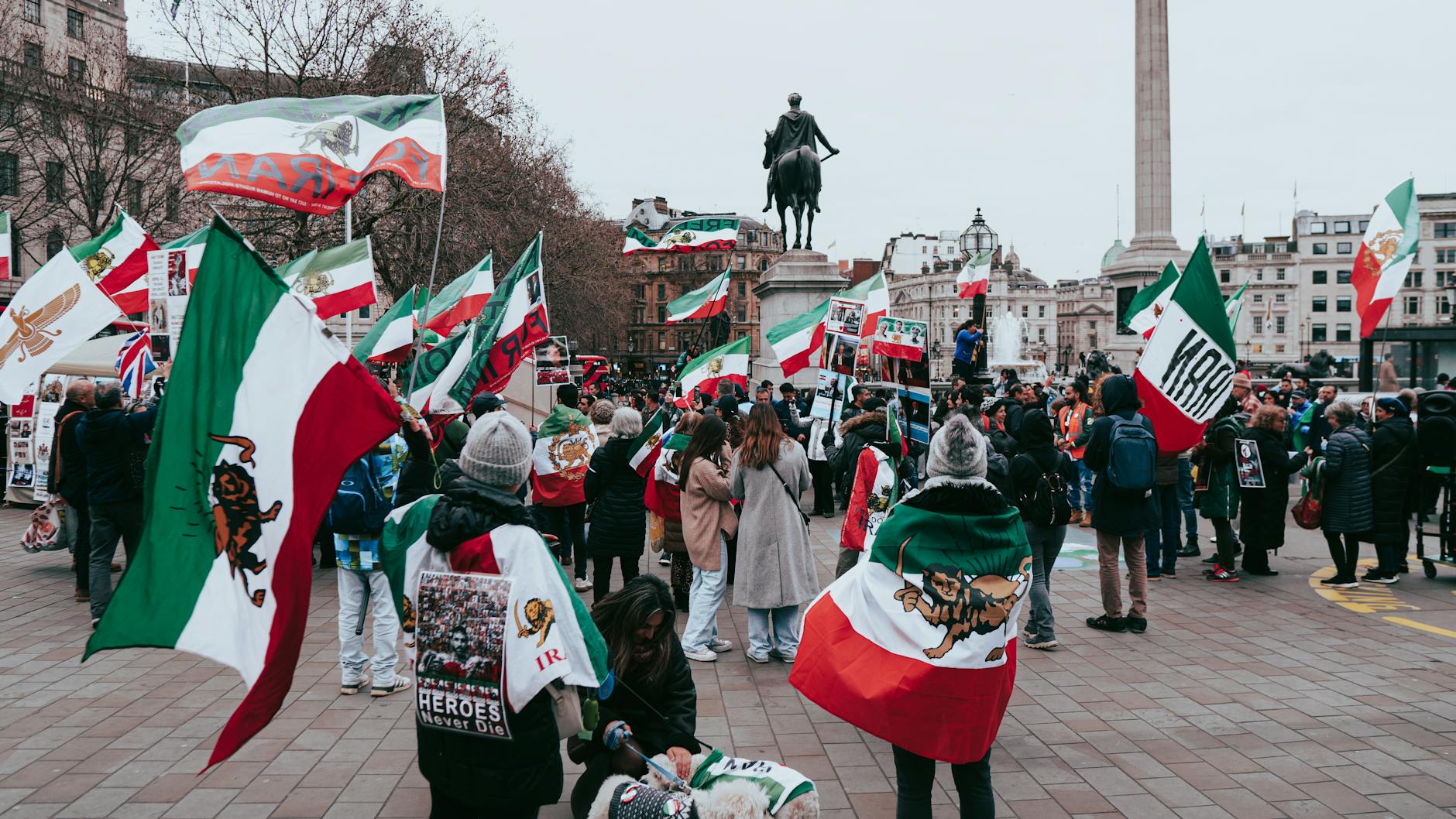
In late December 2025, a factor emerged that fundamentally changed how American policymakers assessed the situation. On December 28, protests erupted across all 31 Iranian provinces, sparked by economic deterioration and rising inflation — conditions worsened significantly by years of sanctions and military conflict. The Iranian regime responded by shutting down the internet nationwide for more than two weeks and carrying out violent crackdowns described as massacres of civilians. The protests introduced a political objective that went beyond the military goals. The White House added regime change from within as a stated aim — a phrase carefully chosen to distinguish it from the 2003 Iraq model of invasion and occupation, but one that carries enormous risk. The assumption underlying this objective is that sufficient military pressure, combined with internal dissent, will cause the Iranian government to collapse or transform.
That assumption has been wrong before. The U.S. expected regime collapse in Iraq after 2003, in Libya after 2011, and in Syria during the civil war. In each case, the result was not democratic transformation but prolonged instability. Whether Iran follows a different path depends on variables — the cohesion of the IRGC, the depth of public support for the protests, the willingness of regional powers to fill a vacuum — that no one can predict with confidence. The limitation here is significant: military force can destroy a government’s capacity to wage war, but it cannot create a functioning replacement government. That lesson has been learned repeatedly in the Middle East, and there is no indication that the current planning accounts for it in any concrete way beyond aspirational language.
Operation Epic Fury — What Happened in the First 48 Hours
At approximately 7:00 AM local time on February 28, 2026, the U.S. and Israel launched Operation Epic Fury (the American designation) and Operation Roaring Lion (the Israeli designation) with coordinated strikes across at least nine Iranian cities. Over 1,250 targets were struck in the first 48 hours, including leadership compounds, military installations, missile production sites, and nuclear program remnants. Supreme Leader Ali Khamenei was confirmed killed in an Israeli strike, prompting Iranian state media to declare 40 days of mourning. Forty senior Iranian commanders were also killed, including Chief of Staff of the Iranian Armed Forces Abdolrahim Mousavi.
📨 Get Free Accountability Coverage Alerts
Free · No spam · Unsubscribe anytime
The human cost has been immediate. On the U.S. side, six service members have been killed since the start of the war, with additional serious and minor injuries reported. The Iranian Red Crescent reported 201 civilians killed and 747 injured as of approximately 17:30 CET on the first day alone, and those numbers will almost certainly climb. Iran has vowed swift retaliation, launching missile attacks targeting U.S. interests in Israel, Jordan, Saudi Arabia, Qatar, Kuwait, the UAE, and Bahrain — a geographic scope that underscores how a bilateral conflict can rapidly become a regional war.
What Comes Next — Duration, Casualties, and the Ground Troops Question
President Trump has stated that Operation Epic Fury would last four to five weeks but that the U.S. has the capability to go “far longer.” He warned that there will likely be more American casualties and has not ruled out troops on the ground. That last point is the one that should command the most attention. Air campaigns can degrade military infrastructure, but the history of American military operations since 2001 shows that ground commitments, once begun, are extraordinarily difficult to end. The initial 2001 operation in Afghanistan was supposed to be limited.
American troops were still there 20 years later. The regional dimension adds another layer of uncertainty. Iran’s retaliatory strikes have already targeted seven countries. If those attacks cause significant casualties among U.S. allies or draw additional nations into the conflict, the scope of the war could expand well beyond what current planning envisions. The coming weeks will determine whether this remains a limited air campaign or becomes something far larger and more costly — in lives, in treasure, and in long-term strategic consequences for the United States.
Conclusion
The line from the 1979 hostage crisis to Operation Epic Fury is not straight, but it is unbroken. Each major event — the tanker wars of the 1980s, the failure to restore diplomatic relations, the JCPOA and its collapse, the Soleimani assassination, Iran’s direct attacks on Israel, the 2025 strikes, and the December protests — created conditions that made the next escalation more likely. The decision to launch the largest U.S. military operation in the Middle East since 2003 was not inevitable, but it was the product of choices made by multiple administrations over nearly half a century. What matters now is what comes after the strikes.
The four stated military objectives — eliminating Iran’s nuclear capability, destroying its missile arsenal, degrading proxy networks, and annihilating its navy — are achievable to varying degrees through air power. The political objective of regime change from within is a different matter entirely, one that depends on factors far beyond American military control. Six U.S. service members are already dead. Hundreds of Iranian civilians have been killed. The decisions made in the coming weeks about duration, scope, and ground forces will determine whether this operation remains contained or becomes the defining — and potentially most costly — American military commitment of the 21st century.
Frequently Asked Questions
What is Operation Epic Fury?
Operation Epic Fury is the U.S. military designation for the coordinated American and Israeli strikes against Iran that began on February 28, 2026. Israel’s parallel operation is called Operation Roaring Lion. Over 1,250 targets were struck in the first 48 hours across at least nine Iranian cities, targeting leadership, military installations, missile production facilities, and nuclear sites.
Why did the U.S. attack Iran in 2026?
The stated objectives are to prevent Iran from acquiring a nuclear weapon, destroy its missile arsenal and production sites, degrade its proxy networks, and annihilate its navy. The immediate trigger was a series of escalations through 2024 and 2025, including direct Iranian attacks on Israel, a 12-day Israeli-Iranian war in June 2025, and Iran’s enrichment of uranium to 60 percent with enough material assessed for nine nuclear weapons.
How long is Operation Epic Fury expected to last?
President Trump stated the operation would last four to five weeks but said the U.S. has the capability to continue “far longer.” He has not ruled out deploying ground troops, which could extend the timeline significantly.
What happened to Iran’s Supreme Leader?
Supreme Leader Ali Khamenei was confirmed killed in an Israeli strike during the opening phase of the operation. Iranian state media declared 40 days of mourning. Forty senior Iranian military commanders were also killed, including the Chief of Staff of the Iranian Armed Forces, Abdolrahim Mousavi.
How many casualties have there been?
As of March 2, 2026, six U.S. service members have been killed with additional injuries reported. The Iranian Red Crescent reported 201 civilians killed and 747 injured on the first day alone. These numbers are expected to rise as the operation continues.
Has Iran retaliated?
Yes. Iran launched missile attacks targeting U.S. interests across seven countries: Israel, Jordan, Saudi Arabia, Qatar, Kuwait, the UAE, and Bahrain. Iran has vowed continued retaliation, and the regional scope of the counterattacks demonstrates the risk of wider conflict.
You Might Also Like
- Putin’s Strategic Calculation Just Changed Because of Operation Epic Fury
- The Geopolitical Fallout From Epic Fury Will Last Far Longer Than the Bombing
- The Refugee Crisis From Iran Could Dwarf Anything the Region Has Ever Seen