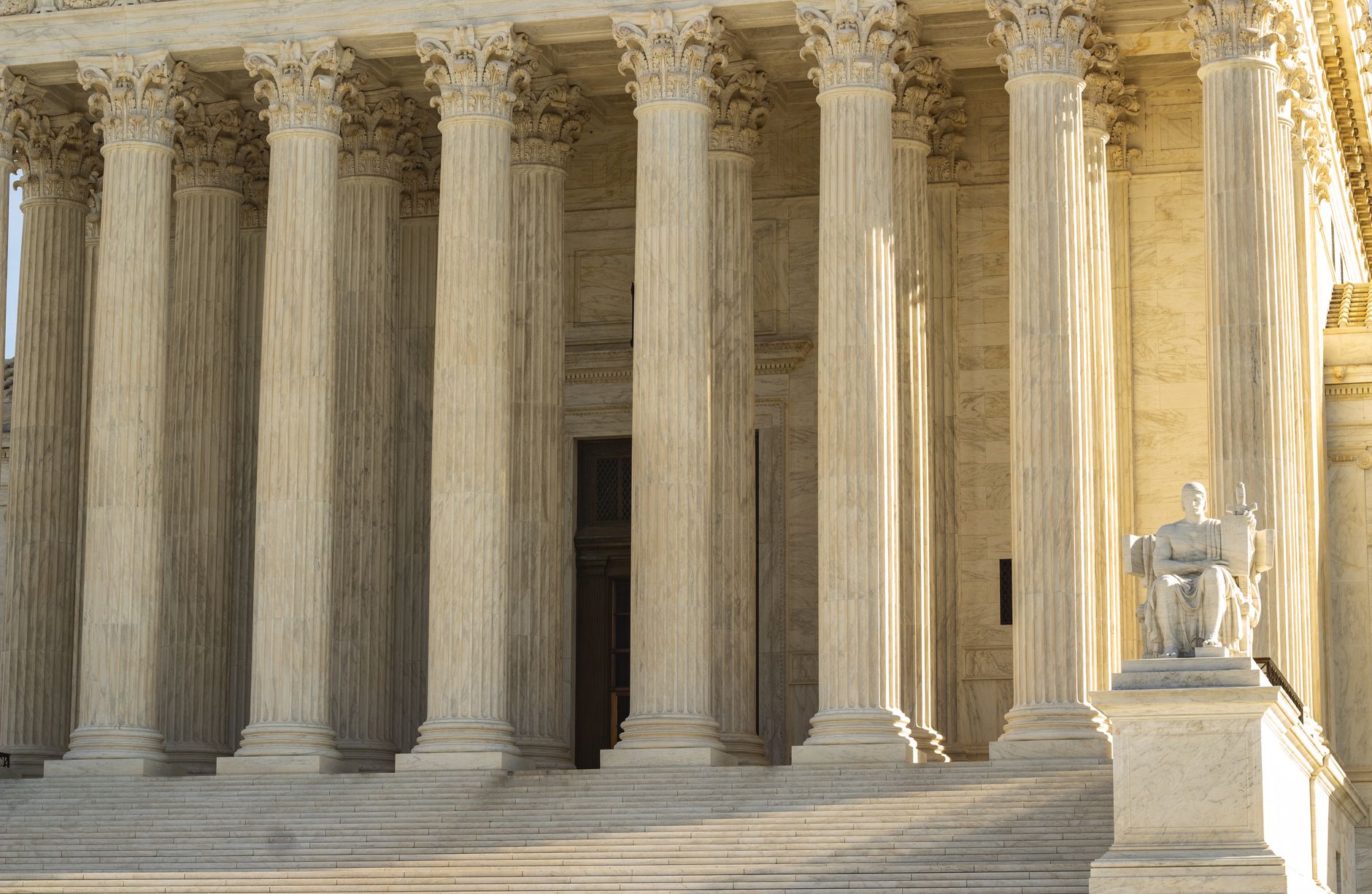
The Supreme Court could interpret the edges of the pardon power, but it cannot overrule the power itself the way Dobbs overruled Roe. Roe protected a right the Court found in the Constitution’s broad language; the supreme court pardon power cases all start from a grant spelled out in Article II, so only a constitutional amendment could remove it. No case or credible report we found suggests the justices are considering narrowing it.
Where it stands: NBC News reported in early October 2026 that “President Donald Trump said in an interview that he’s considering pre-emptively pardoning members of his administration before the end of his second term.” Rep. Ted Lieu (D-Calif.) has said a court fight over that kind of grant is coming. No such case was pending as of late October 2026, according to our sources.
What did Dobbs actually do to Roe?
Dobbs reversed a precedent about a right the Court itself had recognized. The 2022 syllabus states the holding in one line: “Held: The Constitution does not confer a right to abortion; Roe and Casey are overruled; and the authority to regulate abortion is returned to the people and their elected representatives.”
The majority framed the abortion right as an “asserted right that is nowhere mentioned in the Constitution.” It also explained why it felt free to overrule: “But stare decisis is not an inexorable command.” Stare decisis is the doctrine that courts generally follow their own earlier decisions. Quoting an earlier case, the Dobbs opinion said that doctrine “is at its weakest when [the Court] interpret[s] the Constitution.”
That is the part of Dobbs people point to when they ask about pardons. If precedent can fall, why not the precedents that read the pardon power broadly?
Why is the supreme court pardon power question different from Roe?
Because the pardon power is not a judge-made doctrine. It is a sentence in the Constitution. Article II gives the president “Power to grant Reprieves and Pardons for Offences against the United States, except in Cases of Impeachment.”
Overruling Roe removed a judicial reading of the Fourteenth Amendment. Overruling the pardon cases would not remove the text in Article II. The Court could only adopt narrower readings of particular words, such as what counts as a “pardon” or an offense “against the United States.”
The Court’s own pardon cases also point toward breadth. In 1974, Schick v. Reed held: “We therefore hold that the pardoning power is an enumerated power of the Constitution and that its limitations, if any, must be found in the Constitution itself.” A century earlier, Ex parte Garland said: “Congress can neither limit the effect of his pardon, nor exclude from its exercise any class of offenders.”
Where has the Court already drawn limits?
It has drawn several, and every one rests on reading the clause’s own words or on what a pardon is, not on a new outside restriction. The table summarizes the main cases.
| Case | Year | What it settled | Direction |
|---|---|---|---|
| Ex parte Wells | 1855 | Presidents may attach conditions to clemency | Broad |
| Ex parte Garland | 1866 | Congress cannot limit a pardon’s effect; may issue before charges | Broad |
| Knote v. United States | 1877 | A pardon does not return money already paid into the Treasury | Limit |
| Burdick v. United States | 1915 | A recipient may refuse a pardon | Limit |
| Ex parte Grossman | 1925 | Criminal contempt of court is pardonable; civil contempt is not | Mixed |
| Schick v. Reed | 1974 | Limits must come from the Constitution itself | Broad |
| Trump v. United States | 2024 | Pardons are a core power courts cannot second-guess | Broad |
The Constitution Annotated, the Congressional Research Service’s guide to the document, reads Garland as “reflecting that the President may not preemptively immunize future criminal conduct.” That limit comes from the requirement that there be an offense to pardon.
Did the 2024 immunity ruling make court review harder?
Yes, at least for review of a president’s reasons. In Trump v. United States, decided July 1, 2024, the majority listed the pardon power among the president’s core powers and wrote: “But once it is determined that the President acted within the scope of his exclusive authority, his discretion in exercising such authority cannot be subject to further judicial examination.”
Read together with Schick, that line leaves little room for a court to strike down a pardon because of why it was granted. It does not settle whether a given document is a valid pardon at all, or what conduct it covers. Those are the edges where litigation is likely to happen. We cover the immunity ruling’s effect on aides in a separate explainer.
📨 Get Free Accountability Coverage Alerts
Free · No spam · Unsubscribe anytime
Which open questions could reach the Court?
The Constitution Annotated names two directly: “Other possible limitations—for instance, whether the President may issue a self-pardon or pardon contempt of Congress—have been the subject of debate but have not been addressed by the Supreme Court.”
- Self-pardons. No president has tried one. In 1974 the Justice Department’s Office of Legal Counsel wrote that “no one may be a judge in his own case,” so a president could not pardon himself. CRS concluded: “Ultimately, given the limited authority available, the constitutionality of a self-pardon is unclear.”
- Broad preemptive grants. Garland allows pardons before charges. How far a sweeping grant covering years of uncharged conduct reaches has not been tested. Lieu told The Hill: “There will be a test to see if pre-emptive pardons are actually constitutional.”
- Revocation and autopen claims. Trump has declared some Biden pardons void; no court has ruled. See can a pardon be revoked.
- Bribery for a pardon. The justices split on it in the 2024 immunity case; no court has decided whether a bought pardon is void or prosecutable. See bribery for a pardon.
A ruling on any of these would refine the power at its margins. None would resemble Dobbs, which removed a whole right.
Can a constitutional amendment change the pardon power?
Yes, and it is the only route to a wholesale change. Article V says Congress may propose amendments “whenever two thirds of both Houses shall deem it necessary,” and they take effect “when ratified by the Legislatures of three fourths of the several States.” CRS also concluded that ordinary legislation cannot do much: “It thus appears that Congress lacks the authority to substantively constrain the President’s power to grant clemency.”
Several amendments are pending in the House, none with a vote scheduled:
- Rep. Steve Cohen (D-Tenn.) reintroduced his amendment in January 2025. His office says it “would explicitly prohibit a self-pardon, pardons of family members, administration officials, and campaign employees,” and that “no pardon issued for a corrupt purpose – past, present, or future – is valid.”
- H.J.Res. 108, from Rep. Joe Morelle (D-N.Y.) and dozens of Democrats, would end criminal immunity for official acts and provide that “the President may not grant a pardon to himself or herself.”
- H.J.Res. 135 was filed by Rep. Johnny Olszewski (D-Md.) with Republican Rep. Don Bacon. It would let Congress override individual pardons by a two-thirds vote; its text says “Congress may, within 30 days, introduce a Bill to nullify the Reprieve or Pardon.”
The full list of reform bills, including statutory ones, is in our guide to pardon reform bills. Individual grants are tracked on the Trump pardon tracker. As of late October 2026, no pardon amendment had passed either chamber.
Frequently Asked Questions
Can the Supreme Court overturn the pardon power?
Not in the way it overturned Roe. The pardon power is written into Article II, so the Court can only interpret its limits. Removing or rewriting it would take a constitutional amendment.
Has the Supreme Court ever limited the pardon power?
Yes, at the edges. It has held that a pardon does not return money already paid into the Treasury (Knote, 1877), that a recipient may refuse a pardon (Burdick, 1915), and that civil contempt cannot be pardoned (Grossman, 1925).
Could the Supreme Court rule on a self-pardon?
Only if a president issues one and a prosecutor challenges it. No president has done so, no court has ruled, and the Congressional Research Service calls the question unclear.
What did Trump v. United States say about pardons?
The 2024 decision listed the pardon power among the president’s core powers and said a president’s discretion in using such powers cannot be subject to further judicial examination.
How would a constitutional amendment on pardons pass?
Two-thirds of both the House and Senate must propose it, and three-fourths of the states must ratify it. Several pardon amendments are pending in the House, but none has received a floor vote.
Sources
- The Constitution of the United States: A Transcription — National Archives, text of 1787
- Dobbs v. Jackson Women’s Health Organization, No. 19-1392 — Supreme Court of the United States, June 24, 2022
- Schick v. Reed, 419 U.S. 256 (1974) — Legal Information Institute (Cornell), 1974
- Ex parte Garland, 71 U.S. 333 (1866) — Legal Information Institute (Cornell), December Term 1866
- Ex parte Wells, 59 U.S. 307 (1855) — Legal Information Institute (Cornell), 1855
- Knote v. United States, 95 U.S. 149 (1877) — Legal Information Institute (Cornell), 1877
- Burdick v. United States, 236 U.S. 79 (1915) — Legal Information Institute (Cornell), January 25, 1915
- Ex parte Grossman, 267 U.S. 87 (1925) — Legal Information Institute (Cornell), 1925
- Trump v. United States, No. 23-939 — Supreme Court of the United States, July 1, 2024
- ArtII.S2.C1.3.1 Overview of Pardon Power — Constitution Annotated (CRS), via LII, accessed October 2026
- Presidential Pardons: Overview and Selected Legal Issues (R46179) — Congressional Research Service (EveryCRSReport mirror), January 14, 2020
- H.J.Res. 108 (Introduced in House) — U.S. Government Publishing Office, July 22, 2025
- H.J.Res. 135 (Introduced in House) — Congress.gov / U.S. Government Publishing Office, 119th Congress
- Congressman Cohen Reintroduces an Amendment to the Constitution to Clarify and Limit the Presidential Pardon Power — Office of Rep. Steve Cohen, January 2025
- Presidential or Legislative Pardon of the President — U.S. Department of Justice, Office of Legal Counsel, August 5, 1974
- Trump says he’d consider pardoning administration officials before he leaves office — NBC News, October 1, 2026
- Democrats eyeing investigations, and perhaps prosecutions, of Trump officials — The Hill (reposted by Rep. Ted Lieu), June 7, 2026
This article is news reporting and analysis based on the public sources listed above, as they stood on the dates shown. Where officials, lawmakers or analysts disagree, including on whether an action is lawful, their positions are attributed to them; Donald Trump Class Action is not a court and nothing here is legal advice. Facts in a developing story can change.