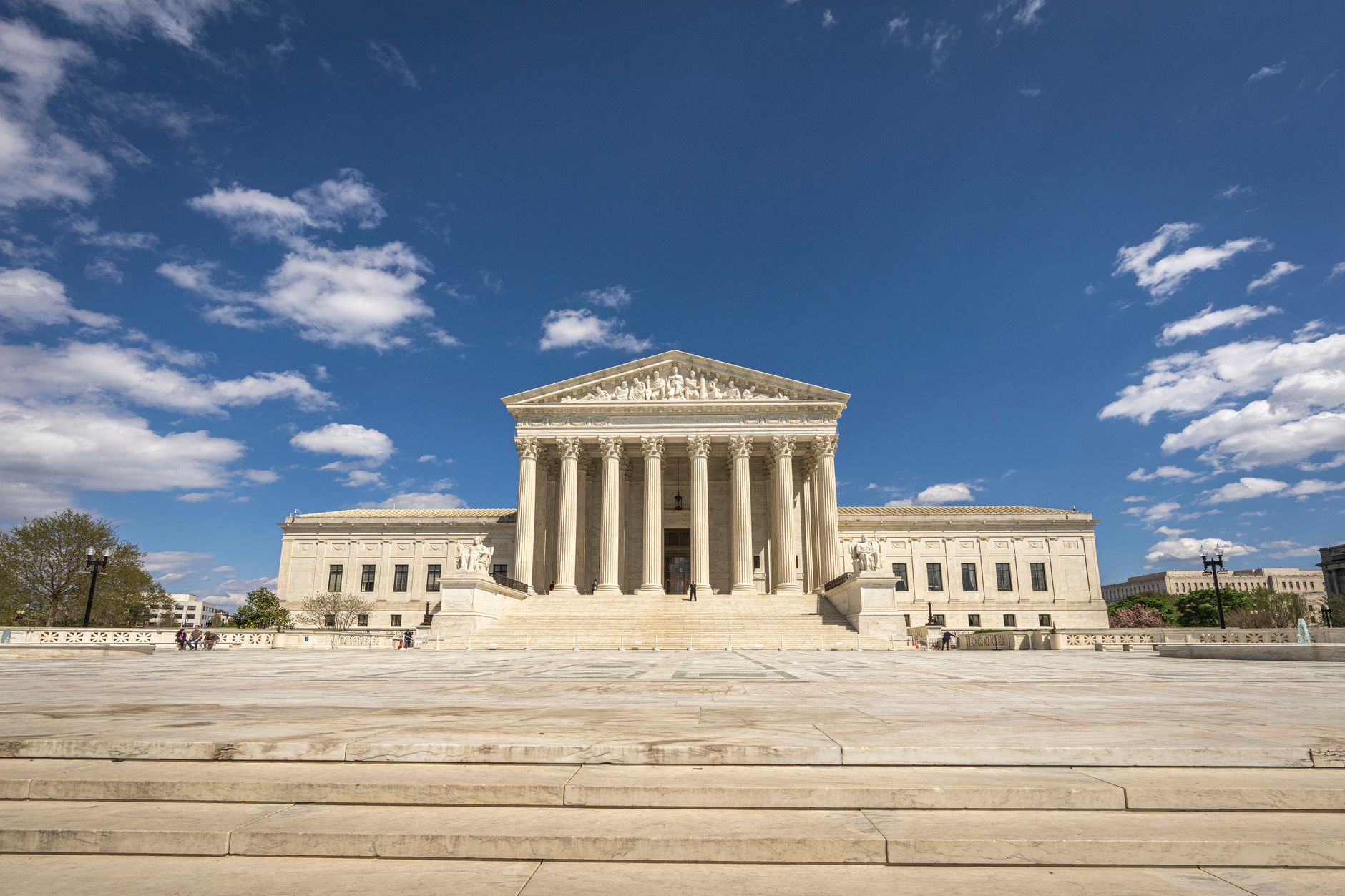
The Supreme Court’s 2024 decision in Trump v. United States gives a former president immunity from prosecution for official acts, but the opinion speaks about the President, not his Cabinet. There is no express immunity for Trump officials in the ruling, and leading scholars read it that way, though one counter-argument has never been tested in court.
The practical shield for aides is a different power: the presidential pardon, which covers federal offenses only. This article sets out what the ruling says, what it leaves open, and what the Justice Department’s own opinions say about indicting officials.
Where it stands: President Trump told Time magazine that he is considering pre-emptive pardons for members of his administration, NBC News reported on October 1, 2026. No court has ruled on whether the immunity decision extends to subordinates.
What did Trump v. United States actually hold?
The Court created three tiers of protection. Its syllabus says “the nature of that power requires that a former President have some immunity from criminal prosecution for official acts during his tenure in office.” For acts within the president’s conclusive and preclusive authority, such as his core constitutional powers, the immunity is absolute. For his other official acts it is at least presumptive. And “There is no immunity for unofficial acts.”
Every one of those tiers is framed around one office. The opinion repeatedly uses “the President” and “a former President.” It does not announce a rule for Cabinet secretaries, agency heads, White House staff or political appointees.
Two parts of the decision still matter for officials. First, the Court counted the pardon among the president’s core powers, the ones courts cannot second-guess. It listed powers that include “commanding the Armed Forces of the United States; granting reprieves and pardons for offenses against the United States.” Second, it set an evidence rule for a trial of the president: “Testimony or private records of the President or his advisers probing such conduct may not be admitted as evidence at trial.”
Is there immunity for Trump officials under the ruling?
On the text, no. Scholars on different sides of the debate read the opinion as protecting the president alone.
Jack Goldsmith, who headed the Justice Department’s Office of Legal Counsel two decades ago, wrote in Lawfare that “for almost every act of presidential lawbreaking, the president must rely on executive branch subordinates who are not immune from criminal liability even if the president is immune.” He added that “the Court nowhere hints that it is extending immunity to subordinates.”
Zachary Price, a law professor, made the same point in the Yale Journal on Regulation: “Because those subordinates lack the same criminal immunity as the President, this constraint may now be all the more important.” He also warned that the issue “could bring other untested questions to the fore.”
Democrats have adopted that reading. The Hill reported in June 2026 that the immunity granted to presidents “does not extend to other administration officials.” Deseret News reported that Sen. Elissa Slotkin (D-Mich.) made the same argument in October 2026, noting that the justices did not give similar protection to the people who work for the president.
What is the argument that aides could be covered?
The question is not fully closed. Goldsmith acknowledged that some readers think the ruling weakens aides’ exposure in the top tier, where the president acts under a conclusive and preclusive power. He wrote that former Justice Department official Jeffrey Clark has made that argument.
Goldsmith said he believes Clark is wrong and that the Court will reject it, citing a 1982 civil case, Harlow v. Fitzgerald, that refused to extend a president’s absolute immunity to his aides. He then conceded the point is open: “But if (as is possible) Clark is right and I am wrong, then Trump v. United States would weaken the principle of subordinate official liability to an uncertain degree.”
The evidence rule adds a second uncertainty. The opinion restricts White House testimony and records at a president’s trial. It does not say whether the same limits would apply if a prosecutor charged an aide over the same events. No court has answered that.
| Question | What the sources say | Settled? |
|---|---|---|
| Is a former president immune for core official acts? | Yes, absolutely (Trump v. United States, 2024) | Yes, Supreme Court holding |
| Is a former president immune for other official acts? | At least presumptively (same case) | Yes, but the line between tiers is still being drawn |
| Are Cabinet officials covered by that immunity? | Not by the opinion’s terms; Goldsmith and Price say no | Untested in court |
| Can a sitting Cabinet officer be indicted? | Yes, under the Justice Department’s 1973 and 2000 opinions | Department policy, not a court ruling |
| Can a president pardon aides? | Yes, for federal offenses only | Yes as to federal crimes; pre-emptive scope is debated |
Can officials be indicted while they are still in office?
Yes, according to the Justice Department’s own lawyers. The no-indictment rule that protects a sitting president is narrow.
In 2000 the Office of Legal Counsel reaffirmed a 1973 memo and described its conclusion: “all federal civil officers except the President are subject to indictment and criminal prosecution while still in office; the President is uniquely immune from such process.” The 2000 opinion said the 1973 view “still represents the best interpretation of the Constitution.”
📨 Get Free Accountability Coverage Alerts
Free · No spam · Unsubscribe anytime
That policy binds the Justice Department, not courts or states. It also explains why the decision to charge any official sits with the attorney general’s department. Congress can investigate and refer, but it cannot indict. The rule for the president himself is covered in our OLC no-indictment explainer.
Why do pardons matter more than immunity for aides?
Because the pardon reaches people the immunity ruling does not. Goldsmith called it “a second very robust presidential power that a bad-man president could use to skirt the principle of subordinate liability.” His phrase “bad-man president” is a hypothetical from legal theory, not a description of any president.
The Court’s opinion makes the pardon hard to challenge: once a president acts within his exclusive authority, his discretion “cannot be subject to further judicial examination.” But a federal pardon covers only federal crimes. Price noted that state offenses are ones the president cannot pardon.
That is why Trump’s comments on pre-emptive pardons drew attention. He told Time he would consider them, according to NBC News, and described what he expects if Republicans lose the House: “They’ll probably go after me and I’ll go after them.” Our pardon tracker follows each grant, and our analysis of what a 2029 Justice Department could still prosecute despite pardons covers the limits.
How long would a future Justice Department have?
For most federal crimes, five years. Under 18 U.S.C. 3282, no person can be prosecuted for a non-capital offense “unless the indictment is found or the information is instituted within five years next after such offense shall have been committed.” Exceptions and starting-point rules are covered in our piece on the statute of limitations for Trump officials.
House Minority Leader Hakeem Jeffries has pointed to that clock. Speaking in December 2025 about officials in the administration, he said, as quoted by The Hill: “It will extend well beyond the end of the Trump administration.”
Republicans reject the premise. Sen. Mike Lee (R-Utah) answered Slotkin’s call for cases against people who worked for Trump by calling it “a fascist move,” Deseret News reported. Slotkin said she stood by her remarks. No official has been charged in connection with any matter discussed here.
Frequently Asked Questions
Does presidential immunity protect Trump Cabinet members?
Not by its terms. Trump v. United States (2024) describes immunity for a former President. Legal scholars Jack Goldsmith and Zachary Price have written that subordinates do not share it, though Goldsmith notes an argument to the contrary that no court has resolved.
Can Trump pardon his officials to protect them from prosecution?
A president can pardon federal offenses, and the Supreme Court listed the pardon power among the core powers courts cannot examine. A pardon does not reach state crimes. Trump told Time in late September 2026 that he would consider pre-emptive pardons for members of his administration.
Can a sitting Cabinet secretary be indicted?
The Justice Department Office of Legal Counsel has said that all federal civil officers except the President can be indicted and prosecuted while in office. Its no-indictment policy applies only to the President.
Does the immunity ruling stop prosecutors from using White House evidence against aides?
At a trial of a former president, the ruling keeps out testimony and private papers from the president or his advisers that probe immune conduct. How that evidence rule would apply in a case against an aide has not been decided.
How long does a future Justice Department have to bring federal charges?
The general federal limit for non-capital crimes is five years under 18 U.S.C. 3282, with exceptions. Whether any charge is ever brought is a decision for prosecutors, not Congress.
Sources
- Trump v. United States, 603 U.S. 593 (2024), No. 23-939 — Supreme Court of the United States, July 1, 2024
- A Sitting President’s Amenability to Indictment and Criminal Prosecution, 24 Op. O.L.C. 222 — U.S. Department of Justice, Office of Legal Counsel, October 16, 2000
- The Relative Insignificance of the Immunity Holding in Trump v. United States (and What Is Really Important in the Decision) — Lawfare (Jack Goldsmith), July 2024
- Even if the President is Immune, His Subordinates are Not — Yale Journal on Regulation, Notice & Comment (Zachary S. Price), July 2024
- Democrats eyeing investigations, and perhaps prosecutions, of Trump officials — The Hill, June 7, 2026
- Sen. Lee attacks Democrat pushing prosecution to deter young GOP — Deseret News, October 19, 2026
- Trump considering pre-emptive pardons for administration officials — NBC News, October 1, 2026
- United States Code, Title 18, Chapter 213: Limitations — U.S. Government Publishing Office, 2023 edition
This article is news reporting and analysis based on the public sources listed above, as they stood on the dates shown. Where officials, lawmakers or analysts disagree, including on whether an action is lawful, their positions are attributed to them; Donald Trump Class Action is not a court and nothing here is legal advice. Facts in a developing story can change.