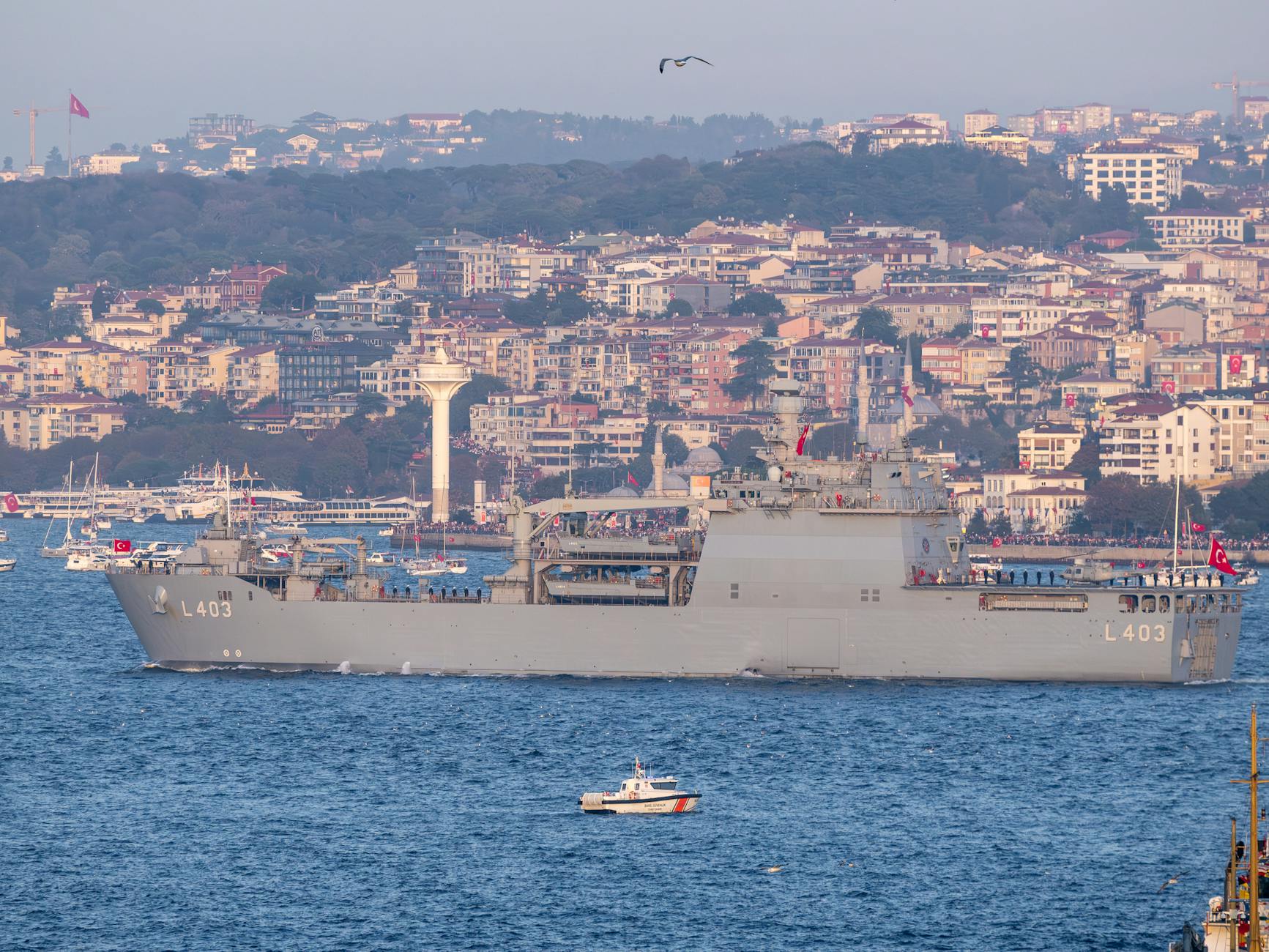
The U.S. Navy’s Sixth Fleet has substantially reinforced its Mediterranean presence in early 2026, sending multiple additional assets into the region as part of a broader military buildup tied to escalating tensions with Iran. The centerpiece of this surge is the USS Gerald R. Ford (CVN-78) Carrier Strike Group, which transited the Strait of Gibraltar on February 20, 2026, and arrived off the coast of Israel approximately one week later — just in time to support Operation Epic Fury, the U.S. strikes against Iran that began around February 28. The Ford CSG joins at least five independently deployed guided-missile destroyers already operating in the Sixth Fleet’s area of responsibility, representing one of the most significant naval concentrations in the Mediterranean in recent years.
Beyond the Ford strike group, the Navy has quietly expanded its destroyer presence in European waters. The USS Delbert D. Black began patrolling in January 2026 as an additional asset amid the Middle East buildup, joining four other independently deployed destroyers already in theater. More than 11,000 U.S. personnel participated in dual-carrier exercises in the eastern Mediterranean, with Italian Navy ships joining for NATO alliance integration. This article examines the composition of these forces, the operational context driving the buildup, the Ford’s transit through the Suez Canal into the Red Sea, and what this posture means for U.S. strategic commitments in the region.
Table of Contents
- What Additional Assets Has the Sixth Fleet Sent to the Mediterranean?
- Why Did the Ford Strike Group Move From the Caribbean to the Mediterranean So Quickly?
- The Ford’s Suez Canal Transit and Red Sea Operations
- Dual-Carrier Operations and NATO Integration
- Sustainment Challenges and Operational Limitations
- The Destroyer Force as the Mediterranean’s Backbone
- What Comes Next for the Sixth Fleet
- Conclusion
- Frequently Asked Questions
What Additional Assets Has the Sixth Fleet Sent to the Mediterranean?
The most significant addition to the Sixth Fleet’s Mediterranean force structure is the USS Gerald R. Ford Carrier Strike Group. The Ford, the Navy’s newest and most advanced nuclear-powered aircraft carrier, was rapidly redeployed from the Caribbean under U.S. Southern Command to the Mediterranean. Its escorts include the guided-missile destroyers USS Winston S. Churchill, USS Bainbridge, and USS Mahan, each capable of anti-air warfare, ballistic missile defense, and surface strike missions. Carrier Air Wing 8 is embarked aboard the Ford, bringing strike fighters, electronic attack aircraft, airborne early warning platforms, and helicopters configured for counter-air, deep strike, maritime strike, and defensive counter-drone operations. Prior to the Ford’s arrival, the Sixth Fleet already had a meaningful destroyer presence.
Four guided-missile destroyers were independently deployed in the Mediterranean: the USS Roosevelt (DDG-80), USS Bulkeley (DDG-84), USS Oscar Austin (DDG-79), and USS Thomas Hudner (DDG-116). Two of these were on station in the eastern Mediterranean. The addition of the USS Delbert D. Black in January 2026 brought the independently deployed destroyer count to five. When combined with the Ford CSG’s three escorts, the total surface combatant presence in the region reached at least eight destroyers — a force capable of providing layered air and missile defense across a wide operational area. For comparison, the typical Sixth Fleet peacetime presence consists of a command ship and a rotating complement of two to three destroyers. The current force posture represents roughly a threefold increase in surface combatants, not counting the carrier and its air wing. That kind of surge does not happen without deliberate planning at the highest levels of the Pentagon.

Why Did the Ford Strike Group Move From the Caribbean to the Mediterranean So Quickly?
The Ford’s rapid redeployment from the Caribbean to the Mediterranean was driven by the escalating confrontation with Iran. The carrier strike group’s arrival off the coast of Israel around February 27, 2026 — approximately one day before Operation Epic Fury commenced — was not coincidental. The timing suggests that military planners had been positioning the Ford for potential strikes well before the operation was publicly acknowledged. CENTCOM stated that the Ford CSG is “squeezing Iran from the sea,” language that signals an intent to maintain sustained pressure rather than conduct a single round of strikes. However, rapid redeployments of this nature carry operational costs.
Crews that had been training for one theater of operations had to recalibrate for a different threat environment. Caribbean operations under Southern Command involve counter-narcotics and partner-nation engagement — a fundamentally different mission set than high-end combat operations against a near-peer adversary’s proxy networks and air defense systems. The Navy has historically managed these transitions well, but each one stresses maintenance schedules, crew rest cycles, and logistics chains. If the Ford remains in the region for an extended period, the Navy will need to manage the downstream effects on its global deployment rotation. The speed of the transit also underscores a strategic reality: the United States has a limited number of carrier strike groups available at any given time, and surging one to the Mediterranean means that presence is reduced elsewhere. The Caribbean, the Western Pacific, and other areas of concern do not stop demanding attention simply because the Middle East heats up.
The Ford’s Suez Canal Transit and Red Sea Operations
On March 5, 2026, the uss Gerald R. Ford crossed the Suez Canal, moving from the Eastern Mediterranean into the Red Sea to continue Operation Epic Fury operations. This transit is operationally significant for several reasons. The Suez Canal is a chokepoint — one of the narrowest and most strategically sensitive waterways in the world. Moving a 100,000-ton nuclear-powered aircraft carrier through it requires extensive coordination with Egyptian authorities and represents a visible statement of American intent. Once in the Red Sea, the Ford joined what CENTCOM described as a multi-carrier posture, with another carrier strike group already operating in the broader Middle East region.
The dual-carrier presence gives U.S. commanders a significant increase in sortie generation capacity and geographic coverage. Strike aircraft from the Red Sea can reach targets across the Arabian Peninsula, the Horn of Africa, and Iran’s southern coastline, while Mediterranean-based assets can cover the Levant and eastern Mediterranean approaches. The Ford’s movement into the Red Sea also has implications for the Sixth Fleet’s Mediterranean posture. With the carrier no longer in the Mediterranean, the independently deployed destroyers become the primary U.S. naval presence in that body of water. Those five destroyers — Roosevelt, Bulkeley, Oscar Austin, Thomas Hudner, and Delbert D. Black — are now carrying a heavier burden for NATO alliance assurance, freedom of navigation, and intelligence collection in the Mediterranean without carrier-based air cover immediately available.

Dual-Carrier Operations and NATO Integration
The scale of recent naval exercises in the eastern Mediterranean illustrates both the capability and the complexity of the current buildup. More than 11,000 U.S. personnel participated in three-day dual-carrier exercises, with Italian Navy ships joining to demonstrate NATO alliance integration. These exercises are not routine training events — they are designed to test interoperability, communications, and command-and-control procedures under conditions that approximate actual combat operations. The inclusion of Italian Navy ships is particularly noteworthy. Italy hosts the Sixth Fleet’s headquarters in Naples and has been a consistent partner in Mediterranean security operations.
Joint exercises with NATO allies serve a dual purpose: they improve tactical coordination and they send a political signal that the U.S. military posture in the region has allied support. However, NATO integration in a U.S.-led operation against Iran raises questions about alliance politics. Not all NATO members are equally comfortable with the scope of Operation Epic Fury, and the degree to which allied participation extends beyond exercises into actual combat operations remains a sensitive diplomatic question. The tradeoff here is between operational effectiveness and political cohesion. Dual-carrier operations with allied participation maximize combat power and demonstrate resolve, but they also risk drawing European allies into a conflict that some of their domestic constituencies may oppose. The Navy and EUCOM leadership have to balance these considerations in real time.
Sustainment Challenges and Operational Limitations
Maintaining this level of naval presence in the Mediterranean and Red Sea is not sustainable indefinitely. The Ford CSG was already deployed when it was redirected from the Caribbean, meaning its crew has been at sea for an extended period. Navy deployment guidelines typically target seven-month cruises, though these have been routinely exceeded in recent years — a practice that contributes to retention problems and maintenance backlogs. The five independently deployed destroyers face their own sustainment challenges. These ships rely on forward-deployed logistics and periodic port calls for crew rest, resupply, and minor repairs. In a heightened operational tempo, port calls get shortened or canceled, and crews spend more time at sea than planned. The USS Delbert D.
Black, which began its European patrol in January 2026, may already be approaching the midpoint of a standard deployment. If tensions with Iran persist or escalate, the Navy will need to rotate fresh ships into the region, pulling them from other commitments or extending deployments beyond planned timelines. There is also the question of munitions expenditure. Operation Epic Fury presumably involves the use of precision-guided munitions — Tomahawk cruise missiles, Joint Direct Attack Munitions, and other standoff weapons. The U.S. military’s stockpiles of these weapons are not unlimited, and production rates have been a concern in defense policy circles for years. A sustained campaign requires a sustained logistics pipeline, and the further the Ford operates from its home port, the longer and more complex that pipeline becomes.
📨 Get Free Accountability Coverage Alerts
Free · No spam · Unsubscribe anytime

The Destroyer Force as the Mediterranean’s Backbone
With the Ford now in the Red Sea, the five independently deployed destroyers are doing the heavy lifting in the Mediterranean. These Arleigh Burke-class ships are arguably the most versatile surface combatants in any navy. Each carries the Aegis Combat System, capable of tracking hundreds of air and surface contacts simultaneously, and can be configured for anti-air warfare, ballistic missile defense, anti-submarine warfare, or land-attack missions depending on the loadout.
The USS Roosevelt and USS Oscar Austin, both based on the East Coast, have extensive Mediterranean deployment experience. The USS Thomas Hudner, a newer Flight IIA destroyer, brings enhanced helicopter capabilities with its two MH-60R Seahawk hangars. Together, these ships provide a distributed network of sensors and shooters that can cover a wide swath of the Mediterranean even without a carrier present — though they lack the organic air power that a carrier strike group provides, which limits their ability to project power deep inland or sustain a defensive combat air patrol over friendly forces.
What Comes Next for the Sixth Fleet
The trajectory of Sixth Fleet operations in the coming weeks and months depends heavily on how Operation Epic Fury evolves. If the campaign against Iran concludes relatively quickly, the Ford may return to the Mediterranean or head home, and the destroyer presence could be drawn down to more typical levels. If the operation expands or if Iran retaliates in ways that threaten U.S. forces or allied shipping, the Navy may need to sustain or even increase its current posture.
The broader 2026 U.S. military buildup in the Middle East is not limited to naval forces, but the Sixth Fleet’s role is central because of the Mediterranean’s geography. It is the corridor through which forces flow to the Suez Canal, the Red Sea, and ultimately the Persian Gulf. Every additional asset the Navy sends to the Mediterranean is a statement about priorities — and a reminder that the United States still views this body of water as a critical theater, not just a transit route.
Conclusion
The Sixth Fleet’s Mediterranean buildup in early 2026 represents a significant concentration of naval power driven by the confrontation with Iran. The USS Gerald R. Ford Carrier Strike Group, five independently deployed destroyers, Carrier Air Wing 8, and more than 11,000 participating personnel constitute a force posture well above peacetime norms. The Ford’s transit through the Suez Canal into the Red Sea on March 5 shifted the carrier’s striking power closer to Iran but left the Mediterranean destroyers as the primary U.S.
naval presence in that theater. The key questions going forward are sustainment and scope. The Navy cannot maintain this deployment tempo indefinitely without consequences for crew welfare, ship maintenance, and global force distribution. Whether the Sixth Fleet sends still more additional assets to the region — or begins drawing down — will depend on the course of Operation Epic Fury and the broader diplomatic and military dynamics between the United States and Iran. For now, the Mediterranean remains one of the most heavily militarized bodies of water on the planet, and the Sixth Fleet is at the center of it.
Frequently Asked Questions
What is the U.S. Sixth Fleet?
The U.S. Sixth Fleet is the Navy’s operational force in the European and African theaters, headquartered in Naples, Italy. It is responsible for naval operations across the Mediterranean Sea, the waters around Africa, and parts of the Atlantic, operating under U.S. Naval Forces Europe-Africa and U.S. European Command.
What is Operation Epic Fury?
Operation Epic Fury is the U.S. military operation involving strikes against Iran that began around February 28, 2026. The USS Gerald R. Ford Carrier Strike Group was repositioned from the Caribbean to the Mediterranean and ultimately the Red Sea to support this operation.
How many U.S. Navy destroyers are currently in the Mediterranean?
As of early March 2026, five guided-missile destroyers were independently deployed in the Sixth Fleet’s area of responsibility: USS Roosevelt (DDG-80), USS Bulkeley (DDG-84), USS Oscar Austin (DDG-79), USS Thomas Hudner (DDG-116), and USS Delbert D. Black. The Ford CSG also brought three additional destroyers — USS Winston S. Churchill, USS Bainbridge, and USS Mahan — though these moved with the Ford into the Red Sea.
Why did the Ford transit the Suez Canal?
The Ford crossed the Suez Canal on March 5, 2026, to move from the Eastern Mediterranean into the Red Sea, positioning it closer to Iran for continued Operation Epic Fury strikes. The Red Sea provides access to the Arabian Peninsula and Iran’s southern coastline.
Are NATO allies involved in the Mediterranean buildup?
Yes. Italian Navy ships participated in dual-carrier exercises with U.S. forces in the eastern Mediterranean, involving more than 11,000 U.S. personnel. The exercises focused on NATO alliance integration and interoperability.
You Might Also Like
- Thousands of Additional U.S. Troops May Be Deployed to the Region in Coming Days
- UAE Provided Logistical Support Despite Later Being Hit by Iranian Retaliation
- The Kurdish Region of Iraq Provided Intelligence Support for the Strikes — Then Got Hit by Iran