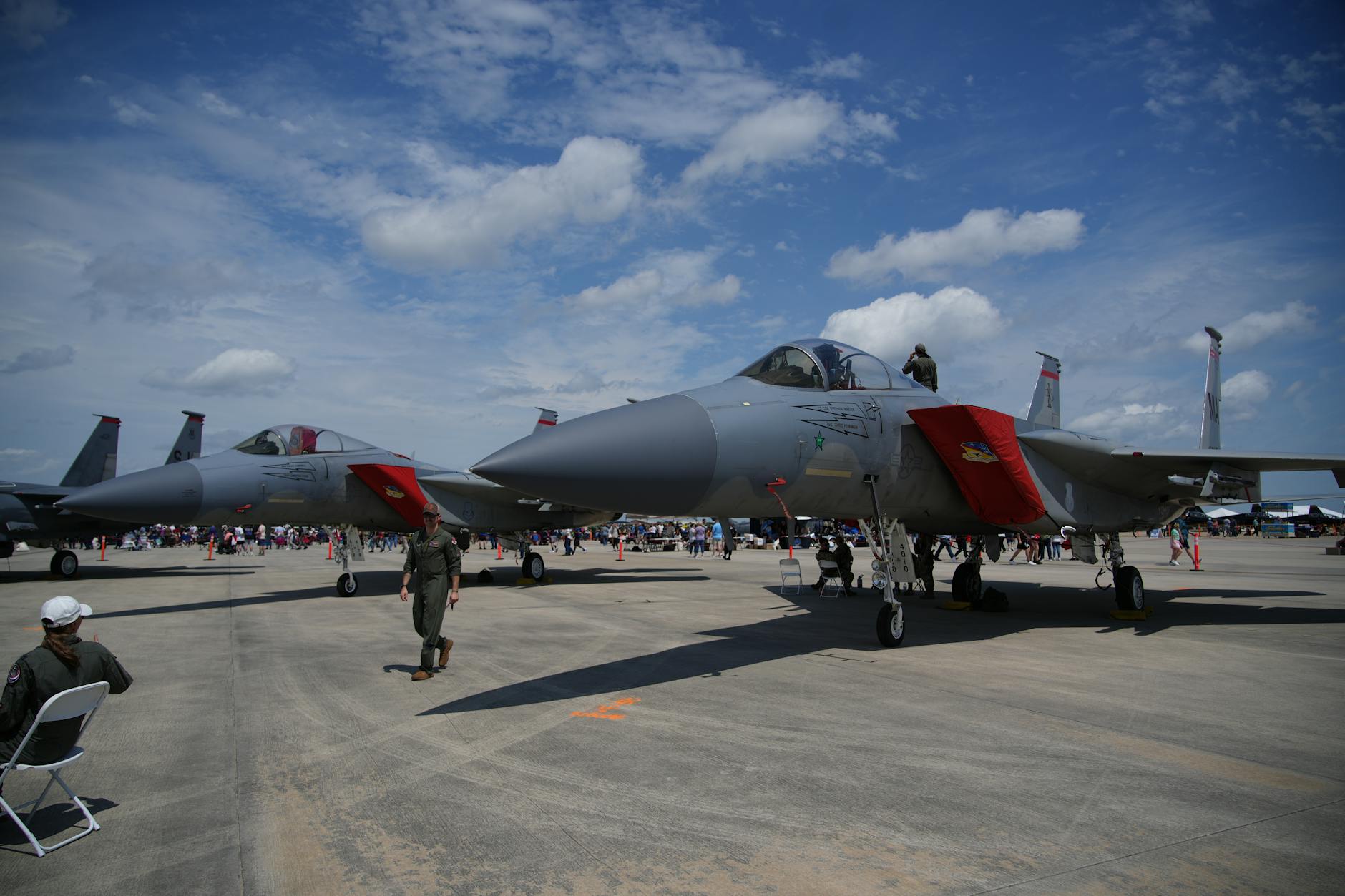
The F-22 Raptor’s air superiority capability was not just important for Operation Epic Fury — it was the linchpin that made the entire air campaign against Iran possible. When 11-12 F-22 Raptors from the 1st Fighter Wing at Joint Base Langley-Eustis deployed to Ovda Air Base in southern Israel in late February 2026, they marked the first-ever deployment of F-22s to Israel for real-world combat operations. Their mission was straightforward and unforgiving: neutralize Iranian air defenses and ensure no Iranian aircraft could contest coalition strike packages streaming into Iranian airspace. The results speak plainly.
Within the first 72 hours of Operation Epic Fury, which launched at 1:15 AM EST on February 28, 2026, coalition forces struck over 1,700 targets across Iran. No F-22s were shot down or sustained damage during the entire operation. Iran’s aging air fleet was effectively neutralized. The Raptor’s combination of stealth, supercruise, and sensor fusion allowed it to operate inside Iranian airspace with near-impunity, directing fourth-generation fighters and suppressing Russian-supplied S-300 surface-to-air missile batteries that were supposed to be Iran’s shield against exactly this kind of attack. This article examines how the F-22 established and maintained air superiority over Iran, the stealth-first doctrine that shaped the campaign, the Raptor’s prior combat role during Operation Midnight Hammer in June 2025, the technical capabilities that made it effective against Iranian defenses, and what the operation reveals about the future of air combat.
Table of Contents
- How Did the F-22 Raptor Establish Air Superiority Over Iranian Airspace During Operation Epic Fury?
- The Stealth-First Doctrine and Why It Changed the Campaign’s Risk Calculus
- Operation Midnight Hammer — The F-22’s First Combat Test Against Iran
- F-22 Technical Capabilities Versus Iranian Air Defenses — A Mismatch by Design
- What Iran’s Air Defense Failures Reveal About the Limits of Russian-Supplied Systems
- The Significance of the First F-22 Deployment to Israel
- What the F-22’s Performance Over Iran Means for Future Air Campaigns
- Conclusion
- Frequently Asked Questions
How Did the F-22 Raptor Establish Air Superiority Over Iranian Airspace During Operation Epic Fury?
The F-22 functioned as what military planners called the “quarterback” of the air campaign. Rather than simply flying combat air patrols and waiting for Iranian jets to scramble, the Raptor actively shaped the battlespace. Its integrated avionics allowed pilots to track, identify, and engage air-to-air threats before being detected themselves — a decisive advantage when operating against Iran’s layered defense network. The F-22 directed fourth-generation fighters like the F-15E Strike Eagle into their attack corridors while simultaneously helping suppress Iranian S-300 surface-to-air missile batteries that posed the greatest threat to non-stealth aircraft. Operation Epic Fury employed a “stealth-first” doctrine that put the F-22 at the tip of the spear alongside B-2 Spirit bombers and F-35 Lightning IIs. These platforms led the initial waves specifically to neutralize Iranian air defenses before non-stealth aircraft entered the battlespace.
This sequencing mattered enormously. Iran’s S-300 SAM systems, received from Russia in 2016, were designed to engage aircraft at long range. Sending conventional fighters into that threat environment without first degrading those systems would have risked significant losses. The F-22’s stealth profile — its radar cross-section minimized through aligned planform edges and continuous-curvature surfaces — made it effectively invisible to the very radar systems the S-300 depends on. The comparison to previous middle east air campaigns is instructive. In the 1991 Gulf War, the opening night required extensive standoff jamming, decoy drones, and anti-radiation missiles to carve corridors through Iraqi air defenses. In 2026, the F-22 simply flew through those defenses. The combination of the Raptor’s low-observable airframe and EA-18G Growler electronic jamming suppressed Iran’s air defense network during the opening hours, collapsing the entire defensive architecture before Iranian operators could adapt.
The Stealth-First Doctrine and Why It Changed the Campaign’s Risk Calculus
The stealth-first doctrine was not a theoretical exercise — it was a direct response to the specific threat Iran’s air defenses posed. Iran had spent years building a layered defense network anchored by Russian-supplied S-300 SAM systems, supplemented by domestically produced radars and shorter-range missile systems. On paper, this network was designed to deny airspace to exactly the kind of large-scale strike campaign the United States and Israel launched on February 28. The doctrine’s answer was to send platforms that the S-300 could not reliably track: F-22s, B-2s, and F-35s, in that order. However, stealth is not invisibility, and the doctrine had limitations that planners had to account for. The F-22’s stealth advantage degrades at shorter ranges, at certain aspect angles, and against lower-frequency radar bands that some Iranian systems employ. This is why the Raptors operated in concert with EA-18G Growlers providing electronic jamming — the combination of low observability and active electronic warfare created overlapping layers of protection.
If any single layer failed, the others compensated. Relying on stealth alone, without the Growlers and without the suppression of enemy air defenses missions that accompanied the initial waves, would have been a riskier proposition than the clean outcome suggests. The broader military buildup surrounding the F-22 deployment underscored that stealth aircraft alone do not win campaigns. The deployment also included F-35 Lightning IIs and F-15E Strike Eagles repositioned to Europe and the Middle East. The F-22 opened the door, but the mass of the strike force that poured through it consisted of fourth-generation platforms carrying heavy payloads against the 1,700-plus targets hit in the first 72 hours. Stealth-first does not mean stealth-only, and the doctrine’s success depended on rapidly transitioning from stealth penetration to conventional mass strikes once the air defense network was degraded.
Operation Midnight Hammer — The F-22’s First Combat Test Against Iran
The F-22’s performance during Operation Epic Fury did not come without precedent. In June 2025, F-22s deployed to the Middle East as part of Operation Midnight Hammer, escorting B-2 bombers dropping 30,000-pound bunker-buster bombs on Iran’s Fordow and Natanz nuclear facilities. This was the Raptor’s first direct strikes against a nation-state adversary — a milestone that fundamentally changed how military planners assessed the aircraft’s combat utility. Midnight Hammer was a more limited operation than Epic Fury, focused specifically on Iran’s nuclear infrastructure rather than the broad-spectrum campaign that followed eight months later. But it provided critical real-world data on how the F-22 performed against Iranian air defenses under actual combat conditions, not just exercises and simulations. The Raptor’s escort role during Midnight Hammer — protecting B-2 bombers as they penetrated deep into Iranian airspace to reach hardened underground facilities — validated the tactics that would be scaled up dramatically during Epic Fury.
The gap between the two operations also matters. Iran had roughly eight months between Midnight Hammer and Epic Fury to study what happened, adapt its defenses, and prepare for a potential follow-up campaign. The fact that the F-22 again operated over Iranian airspace without losses during Epic Fury suggests either that Iran’s adaptations were insufficient or that U.S. planners adjusted their tactics to account for whatever changes Iran made. Likely both. This iterative cycle of adaptation is a core feature of modern air warfare, and the F-22’s flexibility — its ability to be reprogrammed and re-tasked based on evolving threats — proved essential.

F-22 Technical Capabilities Versus Iranian Air Defenses — A Mismatch by Design
Three technical capabilities made the F-22 particularly effective against Iran’s defense network: supercruise, stealth, and sensor fusion. Supercruise allows sustained supersonic flight at Mach 1.5 or greater without afterburner. This is not just about speed — it expands the Raptor’s range at supersonic velocities and reduces the time it spends within the engagement envelopes of surface-to-air missile systems. An F-22 transiting a threat zone at Mach 1.5 gives an S-300 battery significantly less tracking and engagement time than a conventional fighter at subsonic speed. The stealth advantage is well documented but worth quantifying in context. Iran’s S-300 systems are designed to detect and engage conventional aircraft at ranges exceeding 150 kilometers. Against the F-22’s minimized radar cross-section, that detection range shrinks dramatically — potentially to the point where the missile’s flight time exceeds the Raptor’s transit time through the engagement zone.
Sensor fusion compounds this advantage by allowing F-22 pilots to build a comprehensive picture of the threat environment from multiple sensors simultaneously, identifying and prioritizing targets without emitting radar signals that would reveal their position. The tradeoff, and it is a real one, is capacity. The F-22 carries a limited internal weapons payload to maintain its stealth profile — far less than an F-15E loaded with external munitions. This is why the Raptor’s role was air superiority and escort rather than heavy strike. It excels at controlling airspace and protecting the platforms that carry the heavy ordnance. Asking the F-22 to serve as a primary strike platform would waste its greatest strengths while exposing its most significant limitation. The campaign’s planners understood this, assigning the Raptor the mission it was built for rather than trying to make it something it is not.
What Iran’s Air Defense Failures Reveal About the Limits of Russian-Supplied Systems
Iran’s S-300 systems were supposed to be the backbone of a credible anti-access defense. Russia delivered the S-300PMU-2 variant to Iran beginning in 2016, and Iranian forces had a decade to integrate, train on, and position these systems. The fact that they failed to shoot down a single F-22 during either Midnight Hammer or Epic Fury raises pointed questions about the real-world effectiveness of Russian air defense exports against peer-level stealth technology. A necessary caveat: the S-300 was not designed in a vacuum, and its failure against the F-22 does not mean it is ineffective against all threats. Against non-stealth aircraft operating without electronic warfare support, the S-300 remains a lethal system. The coalition’s use of EA-18G Growler electronic jamming in concert with stealth platforms meant that Iranian operators faced simultaneous challenges — targets they could not see on radar and jamming that degraded whatever radar picture they could assemble.
Stripping away the Growler support or sending non-stealth aircraft without prior suppression would have produced very different results. The broader warning for nations relying on imported Russian air defense systems is that these platforms have now been tested and found wanting against the specific combination of American stealth and electronic warfare. Countries that purchased S-300 or S-400 systems expecting them to deter or defeat U.S. air power will need to recalculate. However, it is also worth noting that Iran’s integration and operation of these systems may not reflect their maximum potential — Russian crews operating the same hardware with better training, maintenance, and tactical doctrine might achieve different outcomes. The system is only as good as the network it operates within.

The Significance of the First F-22 Deployment to Israel
The deployment of F-22s to Ovda Air Base in southern Israel was unprecedented. The United States had never before stationed its most advanced air superiority fighter on Israeli soil for combat operations. The decision reflected both the scale of the planned campaign and the geographic reality that striking targets deep inside Iran required forward basing closer to the theater.
📨 Get Free Accountability Coverage Alerts
Free · No spam · Unsubscribe anytime
Ovda, located in the Negev Desert, placed the F-22s within operational range of Iranian airspace without requiring the extensive aerial refueling that would have been necessary from bases in the Persian Gulf. This basing decision also carried diplomatic weight. Positioning America’s premier fighter in Israel signaled an unambiguous commitment to the operation that could not be walked back quietly. It was a statement of intent as much as a tactical necessity, and it established a precedent for future U.S.-Israeli military cooperation involving fifth-generation aircraft.
What the F-22’s Performance Over Iran Means for Future Air Campaigns
The F-22 was originally designed during the Cold War to counter Soviet fighters over Europe. The fact that it proved decisive over Iran three decades later validates the core design philosophy — that stealth and air superiority provide outsized strategic returns across a range of scenarios, not just the one the aircraft was originally built for. The Air Force had debated retiring the F-22 in favor of the newer F-35 and the planned Next Generation Air Dominance platform. Operations over Iran have likely extended the Raptor’s service life and strengthened the case for continued upgrades.
Looking forward, the campaign demonstrated that the stealth-first doctrine works against a real adversary with real air defenses, not just in exercises. But it also showed that the F-22 does not operate alone — its effectiveness depended on electronic warfare support, intelligence preparation, and integration with a broader force package. Future adversaries with more advanced air defenses, particularly China with its domestically produced systems and integrated sensor networks, will present a harder problem. The F-22 proved it can dominate the current threat environment. Whether it can do the same against the next generation of defenses is the question that will shape American air power investment for the next decade.
Conclusion
The F-22 Raptor’s air superiority capability was not merely critical for establishing control over Iranian airspace — it was the precondition for everything else the coalition accomplished during Operation Epic Fury. By leading the stealth-first doctrine, directing fourth-generation fighters, and suppressing S-300 batteries, the Raptor enabled the strike of over 1,700 targets in 72 hours without a single loss among stealth platforms. From its unprecedented deployment to Ovda Air Base in Israel to its quarterback role over Iranian territory, the F-22 performed exactly as designed against a real-world adversary with substantial air defenses.
The broader takeaway is that air superiority remains the foundation of modern military campaigns, and the platforms that deliver it — stealth fighters with advanced sensors and the ability to operate inside defended airspace — are not optional capabilities. They are the force that opens the door for everything else. Iran’s experience with its Russian-supplied S-300 systems will reverberate among other nations weighing their air defense investments, and the F-22’s combat record over Iran will factor into every future discussion about American air power priorities, fifth-generation procurement, and the timeline for next-generation platforms.
Frequently Asked Questions
How many F-22 Raptors were deployed to Israel for Operation Epic Fury?
Between 11 and 12 F-22 Raptors from the 1st Fighter Wing at Joint Base Langley-Eustis, Virginia were deployed to Ovda Air Base in southern Israel in late February 2026. This marked the first-ever deployment of F-22s to Israel for real-world combat operations.
Were any F-22s shot down during operations over Iran?
No. As of reporting from multiple defense outlets, no F-22s have been shot down or sustained damage during operations over Iranian airspace, including both Operation Midnight Hammer in June 2025 and Operation Epic Fury beginning February 28, 2026.
What was the stealth-first doctrine used in Operation Epic Fury?
The stealth-first doctrine placed F-22 Raptors, B-2 Spirit bombers, and F-35 Lightning IIs at the front of the initial attack waves to neutralize Iranian air defenses before non-stealth aircraft entered the battlespace. This approach minimized risk to conventional fighters by degrading Iran’s S-300 SAM systems and radar networks before they could engage non-stealth platforms.
What role did the F-22 play during Operation Midnight Hammer in June 2025?
During Operation Midnight Hammer, F-22s escorted B-2 bombers dropping 30,000-pound bunker-buster bombs on Iran’s Fordow and Natanz nuclear facilities. This was the Raptor’s first direct participation in strikes against a nation-state adversary.
How does the F-22’s supercruise capability provide a tactical advantage?
Supercruise allows the F-22 to sustain supersonic flight at Mach 1.5 or greater without using afterburner. This reduces the time the aircraft spends within the engagement envelopes of surface-to-air missile systems and extends its effective range at high speed, giving enemy air defense systems less time to detect, track, and engage.
Why were Iran’s S-300 air defense systems ineffective against the F-22?
Iran’s Russian-supplied S-300 SAM systems were overwhelmed by the combination of the F-22’s stealth profile, which dramatically reduced radar detection range, and EA-18G Growler electronic jamming that further degraded Iranian radar capabilities. The simultaneous challenges of invisible targets and degraded sensors proved too much for the defense network to overcome during the campaign’s opening hours.
You Might Also Like
- Iran’s Air Defense Radar Network Was the First Thing Destroyed Before the Main Strikes Began
- Every Dollar Iran Sent to Hezbollah Was a Dollar Not Spent on Iranian Infrastructure
- CENTCOM Said the Goal Was to “Dismantle the Iranian Regime’s Security Apparatus”