The Caspian Sea region is becoming measurably more dangerous because Iran’s government has effectively ceased to function as a coherent state actor. Since the February 28, 2026 joint US-Israeli strikes that killed Supreme Leader Ali Khamenei and triggered an ongoing war now entering its third week, Iran has lost the ability to participate in regional governance, enforce environmental agreements, or serve as a counterbalance to rival powers around the Caspian basin. The consequences are not hypothetical. The Strait of Hormuz is effectively closed, with tanker traffic dropping to near zero and over 150 ships anchored outside the waterway. A leadership crisis has left Mojtaba Khamenei, the hastily named successor, unable to appear in public, with unverified reports placing him in Moscow for medical treatment.
The five-nation framework that was supposed to manage the Caspian Sea’s resources and environmental decline has lost one of its most important — and most obstinate — members at precisely the worst time. This matters beyond the immediate war because the Caspian region was already under extraordinary stress before the first missiles flew. The sea itself is shrinking at roughly 7 centimeters per year, twenty times faster than global sea level rise. Russia and Iran had been increasing military use of the Caspian for purposes linked to the Ukraine conflict, making it less safe for commercial shipping. Unresolved legal disputes over billions of barrels of oil and hundreds of trillions of cubic feet of natural gas beneath the seabed remain frozen. This article examines how Iran’s collapse as a functioning government compounds each of these crises, what it means for the South Caucasus and energy markets, and why the Caspian may be entering a period of instability that outlasts whatever ceasefire eventually materializes.
Table of Contents
- Why Does the Caspian Sea Region Become More Unstable Without a Functioning Iranian Government?
- The Environmental Collapse That Makes Everything Harder
- Militarization of the Caspian and the End of Safe Commercial Shipping
- Energy Markets and the Strait of Hormuz — The Caspian’s Indirect Pressure Point
- The South Caucasus Fallout and Armenia’s Exposure
- The Trans-Caspian Corridor as a Pressure Valve
- What Comes After the War and Why It Matters for the Caspian’s Future
- Conclusion
- Frequently Asked Questions
Why Does the Caspian Sea Region Become More Unstable Without a Functioning Iranian Government?
The short answer is that iran, for all its provocations, occupied a structural role in Caspian geopolitics that no other country can fill. It is the only littoral state that has refused to ratify the 2018 Convention on the Legal Status of the Caspian Sea, insisting on a 20 percent equal division of seabed resources rather than the median-line demarcation favored by Russia, Kazakhstan, Turkmenistan, and Azerbaijan. That stubbornness created friction, but it also meant Iran was an active participant in negotiations. A government that cannot appear in public, let alone send diplomats to multilateral talks, removes that participation entirely. The convention remains unratified, and the legal vacuum over who owns what beneath the Caspian grows wider. Iran is also the only Caspian littoral state producing zero hydrocarbons from the sea, despite the basin holding an estimated 48 billion barrels of oil and approximately 292 trillion cubic feet of natural gas, according to the U.S. Energy Information Administration’s February 2025 assessment.
That zero-production status was partly a function of sanctions and partly a function of the unresolved legal disputes. But it also meant Iran had a strong incentive to eventually reach a deal — an incentive that disappears when the government’s attention is consumed by survival. Compare this with Kazakhstan or Azerbaijan, which are already extracting resources and have less urgency to finalize boundary agreements. Without Iranian pressure for resolution, the status quo — contested, ungoverned, and increasingly militarized — hardens into permanence. The practical effect is a compounding instability loop. A dysfunctional Iranian government cannot negotiate Caspian seabed rights, cannot participate in environmental preservation efforts, and cannot restrain its own military forces from acting independently in the basin. Each of these failures feeds the others. The environmental crisis makes resources scarcer, which makes territorial disputes more acute, which makes military posturing more likely, which makes diplomatic engagement less possible — and none of it can be addressed when one of the five governments around the table has effectively vacated its seat.

The Environmental Collapse That Makes Everything Harder
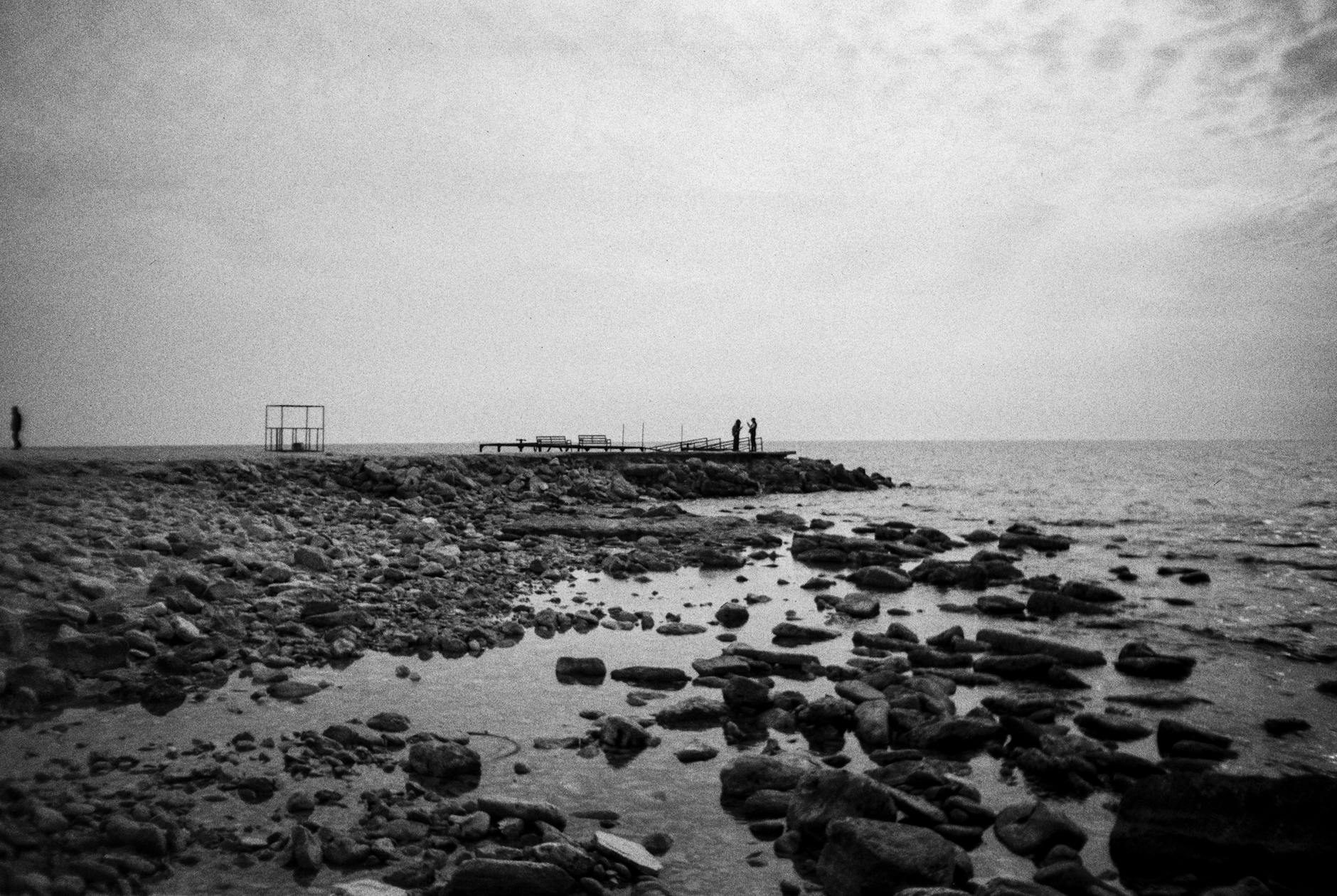
The Caspian Sea is not just shrinking — it is collapsing at a rate that threatens to render existing governance frameworks irrelevant before they can be implemented. NASA satellite data covering 2020 to 2025 show the sea’s surface declining at approximately 7 centimeters per year. In July 2025, the Caspian reached its lowest recorded level, falling below 29 meters below sea level, with Kazakhstan’s sector averaging negative 29.23 meters. Between 2006 and 2025, shorelines in parts of Kazakhstan retreated 30 to 35 kilometers. These are not projections — they are measurements. The projections, however, are worse. Water levels could fall to negative 30 meters by 2030 and negative 34 meters by 2050 under pessimistic scenarios, with declines of up to 21 meters possible by 2100 under worst-case global warming models. Iran itself has warned that a quarter of the Caspian Sea could dry up within 20 years.
A decline of 5 to 10 meters would reduce marine protected area coverage by up to 94 percent and strand billions of dollars in coastal infrastructure. Caspian seal populations have already declined 90 percent over the past century, from 1.2 million to fewer than 100,000. Winter sea ice area has decreased 40 percent in two decades. Here is the critical limitation that few analysts discuss openly: environmental cooperation in the Caspian requires all five littoral states to participate. If Iran’s government is incapacitated, it cannot enforce fishing regulations, coordinate water management on rivers feeding the Caspian from its territory, or contribute to scientific monitoring. However, if the other four states attempt to proceed without Iran, any agreements they reach will lack legitimacy on roughly one-fifth of the coastline. The environmental crisis does not wait for political stability. Forecasted economic damages exceed $10 billion annually by 2030, and for Iran specifically, this threatens the military and infrastructure funding that whoever eventually consolidates power will desperately need. The environmental collapse and the political collapse are feeding each other.
Militarization of the Caspian and the End of Safe Commercial Shipping
Before the 2026 Iran war, the Caspian was already becoming less safe for commercial vessels. Russia and Iran had increased military use of the sea, including arms transfers and operations related to the war in Ukraine, raising concerns among azerbaijan and other littoral states that the Caspian could no longer be treated as a secure commercial waterway. The Jamestown Foundation documented this shift, noting that the sea was transitioning from a space of economic cooperation to one of military competition. Joint Russia-Iran naval exercises, including CASAREX 2025, underscored the Caspian’s strategic value to both countries. But a March 2026 analysis from SpecialEurasia described the Caspian as having been transformed from what was historically “a Russian lake” into “a contested strategic zone” and “a sea of discord.” This language reflects a fundamental shift. For most of the post-Soviet period, Russia’s naval dominance in the Caspian was so overwhelming that other states largely deferred to it on security matters.
Iran’s growing naval presence in recent years, combined with Azerbaijan’s and Kazakhstan’s modernization programs, created a multipolar dynamic. With Iran’s government now in crisis and its military chain of command uncertain, the risk is not that Iranian naval forces disappear from the Caspian, but that they operate without coherent political direction — potentially more dangerous than coordinated aggression. The specific danger for commercial shipping is that no one knows who is giving orders to Iranian naval assets in the Caspian. The IRGC, which coerced the appointment of Mojtaba Khamenei as Supreme Leader, operates its own naval forces with a history of independent action. If IRGC commanders in the Caspian decide to impose checkpoints, harass foreign vessels, or simply act unpredictably, there is no functioning civilian government to restrain them. This is a fundamentally different risk profile than the one that existed even a month ago.

Energy Markets and the Strait of Hormuz — The Caspian’s Indirect Pressure Point
The Strait of Hormuz closure is the most immediate economic consequence of Iran’s governmental dysfunction, and it connects directly to Caspian energy politics through a series of pressures that policymakers are only beginning to map. When Mojtaba Khamenei called the closure “a tool to pressure the enemy,” tanker traffic had already dropped approximately 70 percent and was falling toward zero. Over 150 ships were anchored outside the strait. This disrupted roughly 20 percent of the world’s daily oil supply and significant liquefied natural gas volumes — a shock that immediately elevated the strategic importance of alternative energy sources, including Caspian basin reserves. The tradeoff is brutal. Caspian energy could partially compensate for lost Hormuz throughput, but extracting and transporting it requires exactly the kind of regional stability and legal clarity that Iran’s collapse has destroyed. A Russia-Iran gas pipeline deal signed in Moscow before the current war proposed importing Russian gas through Azerbaijan, starting at 2 billion cubic meters per year and scaling up to 55 billion cubic meters per year.
That deal reflected the practical difficulty of building a pipeline under the Caspian itself — a project that would require agreement among littoral states that do not agree on who owns the seabed. With Iran’s government unable to execute contracts or guarantee transit rights, even the overland pipeline route is in jeopardy. The alternative, the Middle Corridor or Trans-Caspian trade route bypassing both Russia and Iran, is gaining importance precisely because the two most militarily powerful Caspian states have rendered themselves unreliable partners. Compare the positions of Kazakhstan and Azerbaijan, which are actively producing Caspian hydrocarbons and have existing pipeline infrastructure to European and Asian markets, with Iran, which produces nothing from the Caspian and has now lost access to its primary oil export route through Hormuz. The World Bank projected Iran’s economy would shrink in both 2025 and 2026, with annual inflation approaching 60 percent. A government that cannot collect oil revenue, cannot export through its most important waterway, and cannot exploit the energy reserves beneath its Caspian coastline is a government that has lost most of the economic tools available to a modern state. That is what “non-functioning” looks like in practice.
The South Caucasus Fallout and Armenia’s Exposure
Iran’s dysfunction has immediate consequences for the South Caucasus, and the most vulnerable country is Armenia. An analysis published in the Armenian Weekly in January 2026 — before the February strikes — argued that a non-functioning Iranian government would remove a key balancing force in the region, emboldening Azerbaijan and Turkey while leaving Armenia more exposed. That assessment has proven prescient. Iran, despite its adversarial relationship with the West, served as a check on Azerbaijani expansionism and Turkish influence in the Caucasus. With Iran consumed by war and leadership crisis, that check has effectively been removed. The limitation that analysts should be honest about is this: Iran was never a reliable protector of Armenian interests. It acted according to its own strategic calculations, which sometimes aligned with Yerevan’s needs and sometimes did not.
However, the mere existence of a strong Iranian state on Azerbaijan’s southern border constrained Baku’s options in ways that benefited Armenia. The absence of that constraint does not automatically mean Azerbaijan will act aggressively, but it does mean the cost-benefit calculation in Baku has shifted. If Turkey and Azerbaijan pursue further integration of their positions in the South Caucasus without Iranian pushback, the regional balance of power tilts decisively — and the Caspian becomes a zone where three of the five littoral states (Russia, Azerbaijan, and Kazakhstan) are operating without any meaningful counterweight from the south. Vali Nasr, writing in Project Syndicate in January 2026, described Iran as facing “a deadly combination of internal and external threats” unlike any prior crisis, arguing that the current moment was fundamentally different from previous periods of Iranian instability. He was writing before the February strikes. The situation has since gotten significantly worse. Iran lost its key ally when Syria’s Assad fled in 2024, and US-Israeli strikes have weakened its nuclear program and military defenses. A country that has lost its regional allies, its leader, its economic stability, and its ability to project power does not simply return to the negotiating table when the shooting stops.

The Trans-Caspian Corridor as a Pressure Valve
One development that has accelerated since Iran’s collapse is international interest in the Middle Corridor, the Trans-Caspian trade route that connects China and Central Asia to Europe while bypassing both Russia and Iran. This route, which runs through Kazakhstan, across the Caspian by ferry, through Azerbaijan and Georgia, and into Turkey, has been discussed for years but lacked the urgency to attract serious investment. The combination of Russian sanctions, Iranian war, and Hormuz closure has changed that calculation dramatically.
📨 Get Free Accountability Coverage Alerts
Free · No spam · Unsubscribe anytime
The practical challenge is that the Middle Corridor still depends on Caspian Sea transit, which means it depends on the security and navigability of a body of water that is simultaneously shrinking, becoming more militarized, and losing one of its key governance participants. If Iranian IRGC naval forces in the Caspian begin acting erratically, or if the environmental decline continues to reduce navigable depths in certain sections, the corridor’s viability narrows. It is a workaround, not a solution — and its long-term success requires exactly the kind of multilateral Caspian cooperation that Iran’s governmental collapse has made impossible.
What Comes After the War and Why It Matters for the Caspian’s Future
The war will end. Wars do. But the Caspian instability it has exposed and accelerated will not end with a ceasefire. Whatever government eventually consolidates power in Tehran will inherit an economy projected to contract for two consecutive years, inflation near 60 percent, zero Caspian hydrocarbon production, an unratified legal convention governing the sea’s resources, an environmental catastrophe that is worsening by measurable increments every year, and a military establishment that has been simultaneously degraded by strikes and empowered by chaos. The question for policymakers in Washington, Moscow, Baku, Astana, and Ashgabat is whether they are prepared for the possibility that the Caspian governance vacuum is not temporary.
If Iran’s reconstruction takes years — or if the country fragments further — the other four littoral states will face a choice between proceeding without Iran on seabed demarcation, environmental agreements, and shipping security, or waiting for a partner that may never arrive. Neither option is good. Proceeding without Iran creates agreements that lack legitimacy and could be challenged by any future Iranian government. Waiting means the environmental collapse advances, the militarization continues, and the energy reserves remain largely undeveloped. The Caspian Sea region was already unstable. Without a functioning Iranian government, it has become a compounding crisis with no obvious off-ramp.
Conclusion
The instability in the Caspian Sea region is not a single problem but a series of interlocking failures that a dysfunctional Iranian government cannot address. The 2026 Iran war and leadership vacuum, the Strait of Hormuz closure disrupting 20 percent of global oil supply, the accelerating environmental collapse shrinking the sea at 20 times the rate of global sea level rise, unresolved legal disputes over 48 billion barrels of oil and 292 trillion cubic feet of natural gas, and growing militarization that has turned the Caspian into a contested strategic zone — each of these crises feeds the others, and all of them require Iranian participation to resolve. The policy implications are straightforward even if the solutions are not. The United States, which initiated the strikes that triggered this cascade, now has a direct interest in Caspian stability that extends well beyond the Iran war itself.
Energy security, environmental governance, South Caucasus balance of power, and the viability of alternative trade corridors all depend on whether the Caspian’s five-nation framework can be restored or replaced. Ignoring the Caspian dimension of Iran’s collapse would be a serious analytical failure. The region was under stress before February 28. It is now in crisis, and the trajectory is worsening on every measurable axis.
Frequently Asked Questions
Why does Iran’s government dysfunction matter for the Caspian Sea specifically?
Iran is one of five littoral states responsible for governing the Caspian Sea’s resources, environment, and shipping security. It is the only state that has not ratified the 2018 Convention on the Legal Status of the Caspian Sea, and it produces zero hydrocarbons from the Caspian despite enormous reserves. Without a functioning Iranian government, legal disputes remain frozen, environmental agreements cannot be enforced across all coastlines, and military forces may operate without coherent political direction.
How much oil flows through the Strait of Hormuz, and what does its closure mean for energy markets?
The Strait of Hormuz handles approximately 20 percent of the world’s daily oil supply plus significant LNG volumes. Since Iran’s closure of the strait in March 2026, tanker traffic has dropped to near zero and over 150 ships are anchored outside the waterway. This has dramatically increased the strategic importance of alternative energy sources, including Caspian basin reserves, while simultaneously making those reserves harder to develop due to regional instability.
Is the Caspian Sea really shrinking?
Yes. NASA satellite data from 2020 to 2025 show the Caspian declining at roughly 7 centimeters per year, which is 20 times faster than global sea level rise. In July 2025, the sea reached its lowest recorded level. Shorelines in parts of Kazakhstan have retreated 30 to 35 kilometers since 2006. Projections suggest levels could fall to negative 30 meters by 2030 and negative 34 meters by 2050 under pessimistic scenarios.
What is the Middle Corridor, and can it replace routes through Iran and Russia?
The Middle Corridor is a Trans-Caspian trade route connecting China and Central Asia to Europe through Kazakhstan, Azerbaijan, Georgia, and Turkey, bypassing both Russia and Iran. It has gained significant interest since the Iran war and Hormuz closure, but it still depends on Caspian Sea transit, meaning its viability is affected by the same militarization and environmental challenges destabilizing the region.
How does Iran’s instability affect Armenia and the South Caucasus?
Iran served as an indirect check on Azerbaijani and Turkish influence in the South Caucasus. With Iran’s government in crisis, that counterbalancing force has been removed, leaving Armenia more exposed and shifting the regional balance of power. Analysts warned about this dynamic even before the February 2026 strikes.
What are the long-term projections for the Caspian region?
Environmental models project the Caspian could lose up to a quarter of its surface area within 20 years. Economic damages are forecast to exceed $10 billion annually by 2030. A 5 to 10 meter decline would eliminate up to 94 percent of marine protected area coverage. Politically, the unresolved seabed demarcation disputes and growing militarization are likely to persist or worsen for as long as Iran remains unable to participate in multilateral governance.
You Might Also Like
- The Military Veteran Community Is Split — Combat Veterans Are More Skeptical Than Non-Veterans
- The Iranian Military Before the Strikes Had Over 600,000 Active Personnel
- Iran Has 88 Million People — More Than Germany or the UK