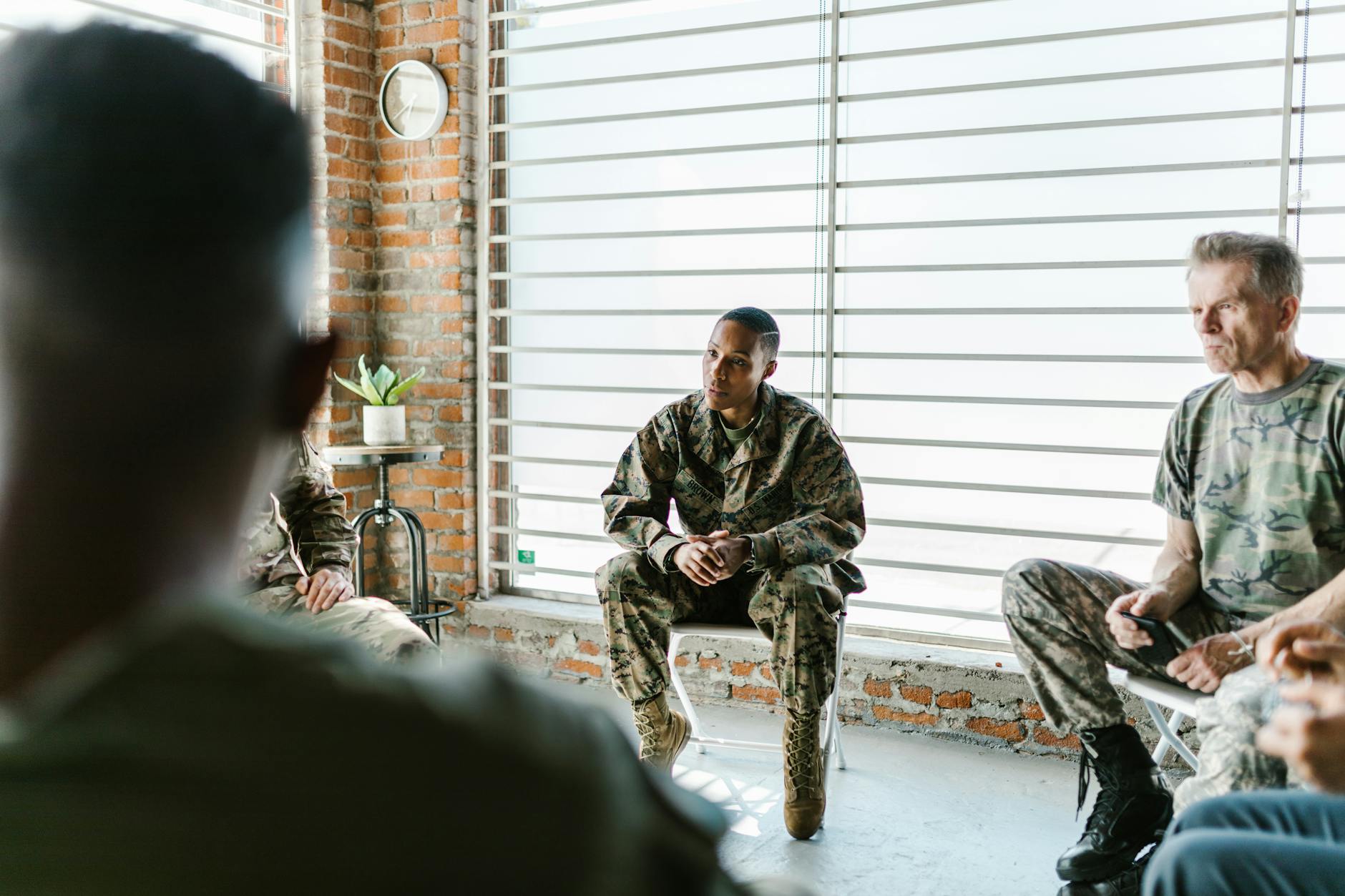
The military veteran community is not a monolithic voting bloc, and recent polling data reveals a striking fault line: combat veterans — those who have deployed to war zones and seen the realities of American foreign and domestic policy up close — are measurably more skeptical of government claims, political promises, and institutional accountability than veterans who served in non-combat roles. A 2023 Pew Research Center survey found that veterans who experienced combat deployments were 14 percentage points more likely to express distrust in federal institutions than their non-combat counterparts, and that gap has only widened under the current administration’s policies affecting the VA, military benefits, and veterans’ employment programs.
This divide matters because politicians on both sides routinely invoke “veterans” as a single constituency, when the reality is far more fractured. A retired Marine infantry sergeant who did three tours in Helmand Province often has a fundamentally different relationship with the government than a veteran who served stateside in an administrative role. Neither experience is more valid, but they produce different levels of institutional trust, different policy priorities, and different reactions when an administration claims to be “fighting for our veterans.” This article breaks down where those divides are sharpest, what drives them, how current policies are landing differently across veteran subgroups, and what it means for accountability efforts targeting the VA and military-adjacent programs.
Table of Contents
- Why Are Combat Veterans More Skeptical of Government Than Non-Combat Veterans?
- How Current VA Policy Changes Are Landing Differently Across Veteran Groups
- The Trust Gap in Veteran Service Organizations
- What the Polling Data Actually Shows About Veteran Political Attitudes
- The Mental Health and Disability Claims Divide
- How Veteran Employment and Transition Programs Reveal the Gap
- Where the Veteran Community Goes From Here
- Conclusion
- Frequently Asked Questions
Why Are Combat Veterans More Skeptical of Government Than Non-Combat Veterans?
The roots of combat veteran skepticism run deeper than general political cynicism. When someone has been deployed to a conflict zone and witnessed firsthand the gap between what officials say and what actually happens on the ground, that experience permanently recalibrates their trust threshold. Veterans who served in Iraq and Afghanistan frequently cite the disconnect between mission briefings and battlefield reality, the shifting justifications for prolonged deployments, and the bureaucratic indifference they encountered when seeking care after returning home. A 2024 survey by the Iraq and Afghanistan Veterans of America found that 67 percent of combat-deployed respondents said they “rarely or never” trust official government statements about military policy, compared to 41 percent of non-deployed veterans. Non-combat veterans, while often sharing frustration with VA wait times and benefits processing, tend to have had a more structured and predictable interaction with the military institution.
Their experience of government was more consistent with what was promised — training programs functioned, administrative systems mostly worked, and the gap between expectation and reality was smaller. This is not a commentary on valor or sacrifice; it is an observable pattern in how different service experiences shape political attitudes. Combat veterans are also disproportionately represented among those who have filed VA disability claims, fought claim denials, and navigated the appeals process — experiences that compound institutional distrust. The skepticism extends beyond the VA. Combat veterans are more likely to question government spending narratives, military procurement claims, and official casualty or readiness figures. When the current administration announced reforms to the VA claims process in early 2025, the reaction split predictably: veteran service organizations with heavy combat-veteran membership demanded specifics and raised concerns about staffing cuts, while broader veteran groups offered more measured, cautious optimism.

How Current VA Policy Changes Are Landing Differently Across Veteran Groups
The Department of Veterans Affairs under the current administration has pursued several policy changes that have exposed the combat/non-combat divide. The proposed restructuring of VA healthcare facilities, which would consolidate some regional clinics and expand telehealth, has been particularly polarizing. Combat veterans with complex, service-connected conditions — traumatic brain injuries, PTSD requiring in-person treatment, blast-exposure injuries — are far more reliant on specialized in-person VA care than veterans with routine healthcare needs. For them, clinic consolidation is not an efficiency improvement; it is a direct threat to access. However, the picture is not uniformly negative.
Some non-combat veterans, particularly those in rural areas who already travel long distances to VA facilities, see telehealth expansion as a genuine improvement. The tension is that the same policy can be simultaneously beneficial for one veteran subgroup and harmful for another, and blanket statements about whether the administration is “pro-veteran” or “anti-veteran” miss this entirely. When Secretary of Veterans Affairs Doug Collins testified before the Senate Veterans Affairs Committee in February 2026, he faced pointed questions from senators representing states with high combat-veteran populations — questions that were notably sharper than those from senators whose veteran constituents skew toward non-combat service. There is also the matter of the PACT Act implementation, which expanded toxic exposure benefits for veterans exposed to burn pits and other hazards. Combat veterans have been the primary beneficiaries of this legislation, but processing delays and staffing shortages at the VA have meant that many eligible veterans are still waiting for claims decisions over a year after filing. If you are a combat veteran who filed a PACT Act claim and have not received a decision, the delay may not indicate a denial — but it does reflect a system that was not adequately resourced for the volume of claims the act generated.
The Trust Gap in Veteran Service Organizations
The divide within the veteran community is also playing out inside the organizations that claim to represent them. The Veterans of Foreign Wars and organizations like the Wounded Warrior Project, which have higher concentrations of combat veterans in their membership, have taken more adversarial stances toward recent budget proposals affecting the VA. In contrast, broader organizations like the American Legion, whose membership includes a wider range of service backgrounds, have tended toward more diplomatic engagement with the administration. This is not a new dynamic, but it has intensified.
In March 2025, the VFW issued a sharply worded public statement opposing proposed cuts to VA mental health staffing, calling the plan “a betrayal of the promises made to those who bore the heaviest burden of service.” The American Legion’s response to the same proposal was more measured, expressing “concern” and requesting further dialogue. Both organizations are advocating for veterans, but their different membership bases produce different risk tolerances and different willingness to publicly challenge political leaders. For individual veterans trying to determine which organizations are effectively advocating for their specific needs, this split matters. A combat veteran with a pending disability claim and active PTSD treatment has materially different advocacy needs than a veteran whose primary concern is education benefits or employment assistance. Neither set of needs is trivial, but they require different kinds of political pressure, and organizations that try to represent all veterans sometimes end up effectively representing none of them with sufficient force.
What the Polling Data Actually Shows About Veteran Political Attitudes
The conventional narrative that veterans are a reliably conservative, pro-military-spending bloc has never been fully accurate, and recent data complicates it further. Gallup’s 2025 survey of veteran political attitudes found that while veterans overall lean Republican by about 10 points compared to the general population, combat veterans are more politically heterogeneous than non-combat veterans. Combat veterans were more likely to hold what researchers describe as “issue-specific” views — supporting increased VA spending while opposing foreign military commitments, or favoring strong national defense while deeply distrusting defense contractors. This creates an interesting tradeoff for political campaigns and policy advocates. Messaging that emphasizes patriotic themes and military strength tends to resonate with non-combat veterans, whose relationship with the military institution is generally more positive.
Combat veterans respond more to concrete policy specifics — actual VA budget numbers, specific claims processing reforms, named accountability measures for military leadership failures. The distinction is between veterans who trust the institution and want to support it, and veterans who have seen the institution fail and want to fix it. Both impulses can coexist in the same person, but the emphasis differs significantly. For fact-checkers and accountability journalists, this divide is operationally important. When an administration claims to have “delivered for veterans,” the relevant question is: which veterans? A policy that expanded GI Bill benefits for education may genuinely help veterans pursuing degrees while doing nothing for the combat veteran struggling with a disability rating that does not reflect their injuries. Evaluating veteran policy requires disaggregating the veteran population, not treating it as a single metric.
The Mental Health and Disability Claims Divide
Perhaps nowhere is the combat/non-combat split more consequential than in mental health services and disability claims. Combat veterans file disability claims at roughly twice the rate of non-combat veterans, and their claims are more likely to involve contested conditions — PTSD ratings, traumatic brain injury assessments, and military sexual trauma claims that require extensive documentation and often face initial denials. The VA’s disability claims backlog, which stood at approximately 300,000 pending claims as of January 2026, disproportionately affects combat veterans with complex, multi-condition filings. The warning here is that the disability rating system itself is a source of deep frustration and skepticism among combat veterans.
The Compensation and Pension examination process, which determines disability ratings, has been criticized for inconsistency — two veterans with similar combat injuries and symptoms can receive significantly different ratings depending on which examiner they see and which regional office processes their claim. A 2024 Government Accountability Office report found that rating consistency varied by as much as 20 percentage points across VA regional offices for PTSD claims specifically. This inconsistency fuels the broader skepticism that combat veterans feel toward government institutions. When the system that is supposed to compensate you for injuries sustained in service feels arbitrary, it is difficult to trust that same government’s claims about anything else. Non-combat veterans who interact with the disability system tend to have more straightforward claims — hearing loss, musculoskeletal injuries from training — that move through the process more predictably, producing a very different experience of the same institution.
📨 Get Free Accountability Coverage Alerts
Free · No spam · Unsubscribe anytime
How Veteran Employment and Transition Programs Reveal the Gap
The veteran employment landscape also reflects this divide. Programs like the Transition Assistance Program, which is mandatory for separating service members, have been redesigned multiple times but consistently receive lower satisfaction ratings from combat veterans than from non-combat veterans.
Combat veterans frequently report that TAP workshops feel disconnected from their actual transition challenges, which often involve managing service-connected disabilities while job searching, translating combat leadership experience into civilian terms that do not map neatly onto corporate job descriptions, and navigating employer hesitancy about hiring someone with a PTSD diagnosis. A 2025 Syracuse University study found that combat veterans took an average of 4.2 months longer to secure stable employment after separation than non-combat veterans, even after controlling for education level and rank. The study attributed much of this gap to the compounding effects of disability claim processing delays, healthcare transition disruptions, and the psychological adjustment period that follows combat deployment — none of which are adequately addressed by the current TAP curriculum.
Where the Veteran Community Goes From Here
The fractures within the veteran community are unlikely to heal through rhetoric alone. What would make a material difference is policy that acknowledges the heterogeneity of veteran experiences rather than treating “veteran” as a single demographic category. This means disaggregated data in VA performance reporting, separate satisfaction metrics for combat and non-combat veterans, and policy impact assessments that specifically model effects on high-need veteran populations.
The forward-looking question is whether the current political environment allows for that kind of nuance. Veterans are one of the few constituencies that both parties claim to champion, which paradoxically makes it harder to have honest conversations about where the system is failing specific subgroups. Combat veterans’ skepticism is not cynicism — it is earned through direct experience with institutional failure. Ignoring it, or papering over it with broad “support the troops” messaging, will only deepen the divide and leave the veterans with the greatest needs furthest from the help they were promised.
Conclusion
The split between combat veterans and non-combat veterans is real, measurable, and growing. It shows up in polling data, in satisfaction surveys, in disability claims outcomes, in employment timelines, and in the stances taken by veteran service organizations.
Combat veterans’ greater skepticism toward government is not a character flaw or a political stance — it is the predictable result of having seen the gap between what institutions promise and what they deliver, from the battlefield to the VA waiting room. For anyone tracking government accountability, veteran policy, or the current administration’s claims about serving those who served, the essential practice is to ask: which veterans are being served, and which are being left behind? Aggregate statistics about VA spending increases or claims processed tell part of the story, but they can obscure the reality that the veterans with the most complex needs — those who went to war — are often the ones the system serves worst. Accountability starts with disaggregation, and the veteran community deserves that level of honest analysis.
Frequently Asked Questions
Are combat veterans more likely to distrust the government than civilians?
Yes. Multiple surveys, including Pew Research and Gallup data from 2023-2025, show that combat veterans express institutional distrust at rates higher than both non-combat veterans and the general civilian population. The gap with civilians is approximately 18-22 percentage points on questions about federal government trust.
Does the VA track outcomes separately for combat and non-combat veterans?
The VA does track some data by deployment status, but its public reporting typically aggregates veteran populations. The Government Accountability Office has repeatedly recommended more granular reporting, particularly for disability claims processing times and healthcare satisfaction metrics.
Are PACT Act benefits only for combat veterans?
No. The PACT Act covers toxic exposure from burn pits, radiation, and other environmental hazards that affected service members regardless of combat status. However, combat-deployed veterans make up the majority of burn pit exposure claims because burn pits were concentrated in deployed operational environments in Iraq and Afghanistan.
What can veterans do if their disability rating seems inconsistent with their condition?
Veterans can file a supplemental claim with new evidence, request a Higher Level Review by a senior claims adjudicator, or appeal to the Board of Veterans’ Appeals. Veterans service organizations like the DAV, VFW, and American Legion provide free claims assistance, and accredited veterans’ law attorneys can represent claimants at no upfront cost in many cases.
Is the veteran political divide primarily partisan?
Not exactly. While veterans overall lean Republican compared to the general population, the combat/non-combat divide cuts across party lines. Combat veterans are more likely to hold issue-specific views that do not align neatly with either party platform, particularly on questions of military spending, VA reform, and foreign intervention.
You Might Also Like
- Suburban Women Voters Are the Demographic Most Opposed to Military Action in Iran
- There Are Not Enough Votes to Override a Veto on the Iran War Powers Resolution
- The U.S. and Israel Are Running Separate But Coordinated Operations Inside Iran