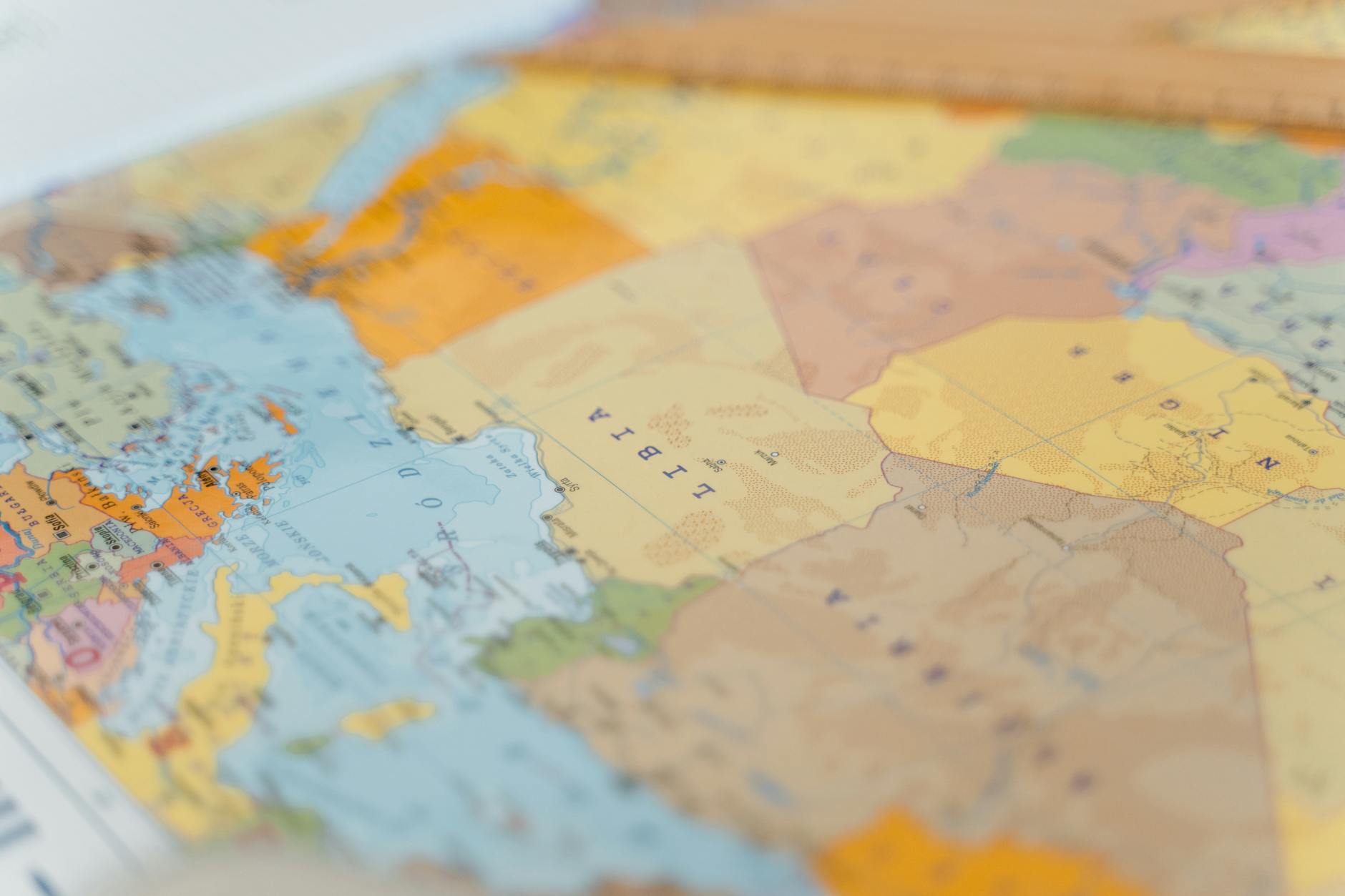
Libya’s collapse after the 2011 NATO intervention is not ancient history — it is a live, ongoing catastrophe that should terrify anyone advocating for regime change in Iran. Fifteen years after Muammar Gaddafi’s overthrow, Libya remains split between two rival governments, its economy stuck at just 65% of pre-war output, and an estimated 20 million weapons circulating among a population of only 6 million people. The country that once had Africa’s fifth-largest economy is now a failed state that has destabilized an entire region. And as of February 28, 2026, the United States and Israel launched Operation Epic Fury — a massive joint strike campaign against Iran — without congressional authorization, reportedly killing Supreme Leader Khamenei and setting the stage for exactly the kind of power vacuum that destroyed Libya.
The parallel is not hypothetical. In January 2026, Aisha Gaddafi — Muammar’s daughter — publicly warned Iran: “Don’t become Libya,” arguing that her father’s decision to abandon strategic deterrence and negotiate with Western powers led directly to his country’s destruction. Iran’s own leadership has cited Libya’s fate for over a decade as proof that disarmament deals with the West are a trap. Now, with strikes already underway and no clear plan for what comes after, the Libya model is no longer a cautionary tale — it is a playbook being repeated in real time. This article examines the full scope of Libya’s post-Gaddafi collapse, what it means for Iran’s trajectory, and why the constitutional and strategic failures of the current approach demand serious public scrutiny.
Table of Contents
- What Happened to Libya After Gaddafi, and Why Should Iran War Planners Care?
- The Weapons Catastrophe Libya Created Across Africa
- The “Libya Model” of Disarmament and Why Iran Will Never Repeat It
- Operation Epic Fury and the Constitutional Crisis at Home
- Why Airstrikes Alone Cannot Produce Regime Change — and Why That Makes Things Worse
- Libya’s Ongoing Humanitarian Crisis as a Preview of What’s Coming
- What Comes Next and Why the Libya Precedent Demands Accountability
- Conclusion
- Frequently Asked Questions
What Happened to Libya After Gaddafi, and Why Should Iran War Planners Care?
Before the 2011 intervention, Libya had a GDP of approximately $88.6 billion and per capita income of around $12,000. Oil production ran at roughly 6.2 million barrels of oil equivalent, and the country exported $58.7 billion worth of goods annually. Whatever one thinks of Gaddafi’s authoritarian rule, Libya functioned as a state. Within a single year of his overthrow, the economy contracted by 62.1% — one of the steepest drops recorded anywhere in the world. Oil production crashed to 1.8 million barrels. Exports fell to $16.8 billion. Unemployment surged past 40%. The total estimated economic loss from 2011 through 2021 reached 783.2 billion Libyan dinars, and on April 7, 2025, the Central Bank of Libya devalued its currency by another 13.3%, underscoring that the crisis is still getting worse, not better.
Iran’s economy is substantially larger and more complex than pre-war Libya’s, which means the potential for catastrophic economic fallout is exponentially greater. Iran is home to roughly 88 million people — compared to Libya’s 6 million — with a diversified industrial base, a massive domestic consumer market, and deep trade ties across Asia. If even a fraction of the economic collapse Libya experienced were replicated in Iran, the humanitarian consequences would dwarf anything seen in the Middle East since the iraq War. War planners who focus exclusively on military targets while ignoring the day-after economic reality are repeating exactly the mistake made in Libya. The comparison is especially relevant because Libya was supposed to be the easy case. A small population, massive oil wealth, no serious ethnic or sectarian divisions comparable to Iraq — and it still fell apart completely. Iran has all of the complicating factors Libya lacked: ethnic Kurds, Azerbaijanis, Baluchis, Khuzestani Arabs, and Lors, each with distinct regional identities and, in some cases, cross-border connections to neighboring states. If Libya’s homogeneous population couldn’t hold itself together without a central authority, the idea that Iran would somehow manage it defies everything we’ve observed in the past two decades of regime-change operations.
The Weapons Catastrophe Libya Created Across Africa
One of the most underreported consequences of Gaddafi’s fall was the flood of weapons that poured out of Libya into the rest of Africa and the Middle East. Gaddafi had stockpiled arms over 40 years of rule, and after the state collapsed, those arsenals were looted. The UN Security Council estimates that more than 20 million weapons now circulate inside Libya alone — a country of only about 6 million people, meaning there are roughly three guns for every man, woman, and child. But the damage did not stay within Libya’s borders. Weapons flowed into Niger, Chad, Mali, Sudan, and Algeria. Armed Tuareg fighters who had served in Gaddafi’s military returned home with heavy weapons and triggered the 2012 rebellion and military coup in Mali, which in turn created a security vacuum that jihadist groups exploited for years.
Boko Haram and Al-Qaeda in the Islamic Maghreb (AQIM) gained access to heavy weaponry from Libyan stockpiles, according to analysis by Action on Armed Violence (AOAV). The destabilization cascaded across the Sahel in ways that NATO planners never anticipated — or at least never planned for. However, if the Libyan weapons catastrophe seems bad, consider Iran’s situation. Iran does not merely stockpile conventional arms — it manufactures ballistic missiles, drones, and advanced military technology, and it supplies proxy forces across Iraq, Syria, Lebanon, and Yemen. A collapse of central authority in Iran would not just release stockpiles; it would potentially release production capabilities, technical expertise, and nuclear materials to non-state actors and rival factions. The proliferation risk from an Iranian state collapse would make Libya’s weapons crisis look contained by comparison. Anyone arguing that airstrikes alone solve the Iran problem needs to explain what happens to Iran’s military-industrial complex when there is no functioning government left to secure it.
The “Libya Model” of Disarmament and Why Iran Will Never Repeat It
In December 2003, just six days after Saddam Hussein was pulled from a spider hole in Tikrit, Muammar Gaddafi announced that Libya would voluntarily renounce its nuclear and missile programs. At the time, Western leaders celebrated this as a triumph of diplomacy and deterrence. Less than eight years later, NATO bombed Libya, Gaddafi was killed in a drainage ditch, and the country disintegrated. The lesson was not lost on anyone paying attention, least of all iran. Iran’s Supreme Leader Khamenei frequently cited Gaddafi’s fate as definitive proof that disarmament leads to regime change, not security. The IRGC-affiliated Tasnim News Agency called Libya’s disarmament deal “an obvious deception.” This was not paranoid rhetoric — it was a factual reading of recent history.
Gaddafi did exactly what the West asked, gave up his weapons programs, normalized relations, and was rewarded with a NATO air campaign that ended his life and his country. Whether or not the two events were causally linked in the minds of Western policymakers is irrelevant; what matters is that every adversary of the United States watched and drew the obvious conclusion. This is precisely why Aisha Gaddafi’s January 2026 warning to Iran — “Don’t become Libya” — resonated so widely. It was not just a daughter mourning her father. It was a succinct articulation of why no rational state actor would voluntarily disarm after watching what happened to Libya (and, for that matter, to Ukraine after giving up its Soviet-era nuclear weapons). The strategic implication is stark: the Libya precedent has made every future nonproliferation negotiation harder, and the current strikes on Iran have almost certainly made diplomatic solutions to nuclear proliferation impossible for a generation.
Operation Epic Fury and the Constitutional Crisis at Home
On February 28, 2026, the United States and Israel launched Operation Epic Fury, striking hundreds of targets across Iran. Supreme Leader Khamenei was reportedly killed in the strikes, according to Al Jazeera’s analysis. The operation was launched without congressional authorization — a fact that immediately triggered bipartisan War Powers resolutions from Representatives Thomas Massie (R-KY) and Ro Khanna (D-CA) in the House, and Senators Tim Kaine (D-VA) and Rand Paul (R-KY) in the Senate. The constitutional question is not academic. Article I of the Constitution grants Congress the sole power to declare war. The War Powers Resolution of 1973 requires the president to notify Congress within 48 hours of committing armed forces and limits unauthorized military action to 60 days. The scale of Operation Epic Fury — hundreds of targets, a reported head-of-state killing — is not a limited defensive action by any reasonable interpretation.
It is an act of war against a sovereign nation conducted without the consent of the American people’s elected representatives. The bipartisan nature of the congressional pushback suggests this is not a partisan complaint but a genuine institutional crisis. The tradeoff being made here is deeply consequential. Supporters of the strikes argue that speed and surprise were necessary to neutralize Iran’s nuclear and military capabilities. Critics counter that bypassing Congress removes the democratic check that is supposed to prevent exactly the kind of open-ended military commitments that defined Iraq, Afghanistan, and — critically — Libya. The Libya intervention also began with the promise of limited action, and it ended with regime change and a failed state. Without congressional debate and authorization, there is no mechanism to define objectives, set limits, or hold decision-makers accountable when things go wrong.
Why Airstrikes Alone Cannot Produce Regime Change — and Why That Makes Things Worse
Military analysts at the Atlantic Council have noted that air strikes alone cannot achieve regime change without ground forces or an organic popular uprising. This is an important observation because it means Operation Epic Fury exists in a strategic no-man’s-land: powerful enough to decapitate the regime’s leadership and destroy infrastructure, but not sufficient to install or support an alternative government. The result, as Libya demonstrated, is not a liberated country — it is a power vacuum. Iran’s internal dynamics make this vacuum particularly dangerous. The Washington Post reported in January 2026 on Iran’s significant ethnic minorities — Kurds, Azerbaijanis, Baluchis, Khuzestani Arabs, and Lors — and the fear that regime collapse could trigger partition along ethnic lines. The IRGC and Basij forces have already expanded operations in minority regions with warrantless raids and mass detentions, suggesting the regime itself recognized the centrifugal pressures building within the country.
Analysts at the Eurasia Review warned explicitly that regime collapse would likely trigger civil war, with outside actors backing competing factions along ethnic and sectarian lines. The limitation that should concern every American taxpayer is this: the United States has demonstrated repeatedly — in Iraq, in Afghanistan, in Libya — that it can destroy a government but cannot build a stable replacement. Each time, the costs of the aftermath have vastly exceeded the costs of the initial military operation. Libya’s total economic losses from 2011 to 2021 reached 783.2 billion Libyan dinars, and that is in a country of 6 million people. Scale that to Iran’s 88 million, factor in the regional proxy networks and ethnic complexities, and the potential costs become almost incomprehensible. The warning from Libya is not that military force never works — it is that military force without a viable political strategy produces outcomes worse than the status quo.

Libya’s Ongoing Humanitarian Crisis as a Preview of What’s Coming
Fifteen years after Gaddafi’s fall, approximately 300,000 Libyans remain displaced. The Uppsala Conflict Data Program recorded roughly 4,000 deaths from internal conflict in 2011 alone, followed by an average of over 1,100 conflict fatalities per year through the end of the decade. Amnesty International reported in February 2026 that systemic impunity for crimes under international law continues to this day — meaning not only has Libya failed to rebuild, it has failed to establish even basic accountability for ongoing abuses. In February 2026, Saif al-Islam Gaddafi — Muammar’s son and onetime heir apparent — was killed, according to Chatham House, marking what analysts called the end of a political era but not the end of Libya’s dysfunction.
📨 Get Free Accountability Coverage Alerts
Free · No spam · Unsubscribe anytime
If Iran follows a similar trajectory, the humanitarian consequences would be staggering. Iran’s population is nearly 15 times Libya’s. Its geographic position — bordering Iraq, Afghanistan, Pakistan, Turkey, and several Central Asian states — means that refugee flows and armed group movements would immediately affect some of the most volatile regions on earth. The international community struggled to manage Libya’s relatively modest displacement crisis; an Iranian equivalent would be beyond anything existing institutions are equipped to handle.
What Comes Next and Why the Libya Precedent Demands Accountability
The strikes on Iran are two days old as of this writing. The full consequences will take months and years to unfold. But the Libya precedent tells us what to watch for: an initial period of apparent success followed by political fragmentation, economic collapse, weapons proliferation, and humanitarian catastrophe. The fact that no congressional authorization was sought before Operation Epic Fury means there has been no public debate about objectives, no defined exit strategy, and no legal framework for accountability.
What Americans should demand — regardless of party — is transparency about what the plan actually is. Libya taught us that “we’ll figure it out after the bombs stop” is not a strategy. It is a guarantee of failure. The bipartisan War Powers resolutions from Massie, Khanna, Kaine, and Paul represent the bare minimum of democratic accountability. Whether those resolutions gain traction or die in committee will tell us a great deal about whether the United States has learned anything at all from Libya’s destruction — or whether we are simply watching the same catastrophe unfold on a much larger scale.
Conclusion
Libya’s post-Gaddafi collapse is not a distant analogy — it is a direct, evidence-based warning about what happens when military force is used to destroy a government without any viable plan for what comes next. The numbers are damning: a 62.1% economic contraction, 20 million loose weapons, two rival governments 15 years later, 300,000 displaced people, and a currency still being devalued in 2025. Every metric of Libyan life is worse today than it was under Gaddafi, and the destabilization spread across an entire continent. Iran is larger, more complex, more ethnically diverse, and more strategically significant than Libya ever was. The immediate priorities for engaged citizens are clear.
First, support the bipartisan War Powers resolutions demanding congressional authorization for continued military action against Iran. Second, demand public hearings on what the post-strike strategy actually looks like — because Libya proved that the absence of such a strategy is itself the strategy for failure. Third, pay close attention to the proliferation question: who secures Iran’s military assets, nuclear materials, and missile technology if the central government collapses? Libya’s weapons are still killing people across Africa 15 years later. Iran’s arsenal is orders of magnitude more dangerous. The time to ask these questions is now, not after the next failed state is already a fact on the ground.
Frequently Asked Questions
Did Libya have weapons of mass destruction before the 2011 intervention?
No. Gaddafi voluntarily renounced Libya’s nuclear and missile programs in December 2003. By the time NATO intervened in 2011, Libya had no WMD programs. This is precisely what makes the Libya precedent so damaging to nonproliferation efforts — Gaddafi disarmed and was overthrown anyway.
Was congressional approval required for the strikes on Iran?
Under both the Constitution’s Article I war powers clause and the War Powers Resolution of 1973, the president must obtain congressional authorization for sustained military operations. Operation Epic Fury was launched on February 28, 2026 without such authorization, prompting bipartisan War Powers resolutions from both chambers of Congress.
Could Iran’s government collapse the same way Libya’s did?
Analysts at the Atlantic Council note that airstrikes alone cannot achieve regime change without ground forces or an organic uprising. However, the killing of Supreme Leader Khamenei creates a severe leadership vacuum. Iran’s ethnic diversity — with significant Kurdish, Azerbaijani, Baluchi, Arab, and Lor populations — introduces partition and civil war risks that Libya, with its more homogeneous population, did not face.
What happened to Libya’s economy after Gaddafi?
Libya’s economy contracted by 62.1% in 2011. Oil production fell from 6.2 million to 1.8 million barrels of oil equivalent. Unemployment surged above 40%. As of 2024, Libya’s per capita PPP GDP remains at only 65% of its 2010 level, and the Central Bank devalued the currency by 13.3% in April 2025.
How did Libya’s collapse affect other countries?
Weapons from Gaddafi’s 40-year stockpile — an estimated 20+ million weapons — flowed into Niger, Chad, Mali, Sudan, and Algeria. Armed Tuareg fighters triggered the 2012 Mali rebellion and coup. Boko Haram and AQIM gained access to heavy weaponry from Libyan arsenals, destabilizing much of the Sahel region.
Who is Aisha Gaddafi and why did she warn Iran?
Aisha Gaddafi is Muammar Gaddafi’s daughter. On January 20, 2026, she publicly warned Iran not to “become Libya,” arguing that her father’s decision to negotiate with Western powers and abandon strategic deterrence led directly to Libya’s destruction. Her warning was widely covered by African and Middle Eastern media.
You Might Also Like
- Weapons Scattered Across Iran After Regime Collapse Could Arm Extremists for Decades
- North Korea Watches the Iran War Closely as a Warning About Its Own Nuclear Future
- Who Actually Profits From the Iran War — A Look at the Money