
North Korea is watching the U.S.-Israel strikes on Iran with a mixture of vindication and alarm, and the lesson Pyongyang is drawing is straightforward: get nuclear weapons, keep nuclear weapons, and never trust that diplomacy will save you. The killing of Iran’s Supreme Leader Ayatollah Ali Khamenei in the February 28, 2026 joint strikes — codenamed “Roaring Lion” by Israel and “Operation Epic Fury” by the United States — has confirmed what Kim Jong Un has long argued to his own generals and party officials. Iran negotiated. Iran degraded its stockpiles.
Iran, days before the strikes, had even agreed through Oman to reduce its nuclear material to “the lowest level possible.” And Iran got bombed anyway. For a regime in Pyongyang that already possesses an estimated 50 assembled nuclear warheads, the message could not be clearer. On March 1, 2026, North Korea’s Foreign Ministry issued a blistering statement condemning the strikes as “illegal and outrageous acts of aggression” and “the most despicable form of sovereignty violation.” The language was predictable. What matters more is what comes next — an accelerated nuclear buildup, deeper bunker construction, and an even more paranoid leadership that now has fresh evidence that sitting down at a negotiating table can end with cruise missiles coming through the window. This article examines how the Iran war reshapes North Korea’s nuclear calculus, why a similar strike on Pyongyang is far less feasible, what the broader proliferation fallout looks like, and why Kim Jong Un’s military parade just days before the Iran strikes now reads like a statement of intent.
Table of Contents
- Why Is North Korea Watching the Iran War So Closely as a Warning About Its Own Nuclear Future?
- How North Korea’s Nuclear Arsenal Makes a U.S. Strike Far More Dangerous Than Iran
- Kim Jong Un’s Military Parade and the Signal No One Can Ignore
- The Proliferation Domino Effect — Who Learns What From the Iran Strikes
- Why U.S.-North Korea Diplomacy Just Got Harder
- The Doomsday Clock and the New Nuclear Landscape of 2026
- What Comes Next for Kim Jong Un’s Nuclear Program
- Conclusion
- Frequently Asked Questions
Why Is North Korea Watching the Iran War So Closely as a Warning About Its Own Nuclear Future?
Because Iran’s experience validates the single most important assumption in North Korean strategic thinking: that the United States will use military force against countries that don’t have a credible nuclear deterrent, regardless of whether those countries are engaged in diplomacy. North Korea’s leadership has studied every case — Libya’s Muammar Gaddafi gave up his weapons program in 2003 and was killed in 2011. Iraq’s Saddam Hussein had no weapons of mass destruction and was overthrown in 2003. Now Iran, which had enriched uranium but never assembled a deliverable weapon, has seen its supreme leader killed and its nuclear infrastructure devastated in Operation Midnight Hammer (June 2025) and the subsequent February 2026 strikes. The contrast with North Korea is instructive. Kim Jong Un has taken the opposite approach to every one of these cautionary tales. Where Gaddafi negotiated away his program, Kim accelerated his. Where Iran enriched uranium but stopped short of weaponization, North Korea tested its first nuclear device in 2006 and has conducted six tests since.
Where Iran relied on diplomatic channels through Oman and Geneva, Kim has alternated between provocative missile launches and selective engagement with U.S. presidents, always from a position of growing capability rather than concession. Analysts at Foreign Affairs have described this as “the North Korean way of proliferation” — steady progress toward a bomb, using diplomacy to test U.S. resolve, and rapidly advancing the program when talks break down. The timing of North Korea’s response is also significant. Just three days before the Iran strikes, on February 25-26, Kim presided over a nighttime military parade of roughly 14,000 troops in Pyongyang, capping the 9th Congress of the Workers’ Party of Korea. He vowed to expand North Korea’s nuclear arsenal, calling it the party’s “firm will” to increase both the number of weapons and delivery systems. That parade and those words now look less like routine propaganda and more like a deliberate signal that Pyongyang will not follow Tehran’s path.

How North Korea’s Nuclear Arsenal Makes a U.S. Strike Far More Dangerous Than Iran
The uncomfortable reality for U.S. military planners is that North Korea is not Iran, and the playbook that worked against Tehran’s nuclear infrastructure would almost certainly fail against Pyongyang’s. Iran’s key nuclear facilities at Natanz, Fordow, and Isfahan — while hardened — were ultimately vulnerable to sustained precision strikes. The CIA reported severe damage from Operation Midnight Hammer that would take Iran years to rebuild. North Korea’s nuclear infrastructure, by contrast, sits hundreds of meters underground beneath solid bedrock, in facilities specifically designed to survive exactly this kind of attack. The Federation of American Scientists estimates that North Korea possesses fissile material sufficient for 70 to 90 weapons, with approximately 50 already assembled. These are not theoretical weapons or enrichment facilities that could be destroyed before they produce a bomb. They are finished warheads, dispersed across multiple locations, mounted on mobile launchers and potentially submarine-launched ballistic missiles.
A preemptive strike would need to destroy all of them simultaneously — a feat that is, by any realistic military assessment, impossible. If even a handful survived, North Korea has the delivery systems to strike Seoul, Tokyo, U.S. military bases across the Pacific, and potentially the American mainland. However, this deterrent only works as long as North Korea maintains the credibility of its retaliatory capability. If Kim Jong Un perceives that the U.S. has developed intelligence or weapons systems capable of neutralizing his arsenal in a first strike — a perception that the iran war may well intensify — the incentive shifts toward building more weapons, dispersing them more widely, and adopting a launch-on-warning posture that increases the risk of accidental or unauthorized use. The Iran strikes, paradoxically, may make North Korea’s nuclear posture more dangerous precisely because they demonstrate that the U.S. is willing to act decisively against nuclear aspirants.
Kim Jong Un’s Military Parade and the Signal No One Can Ignore
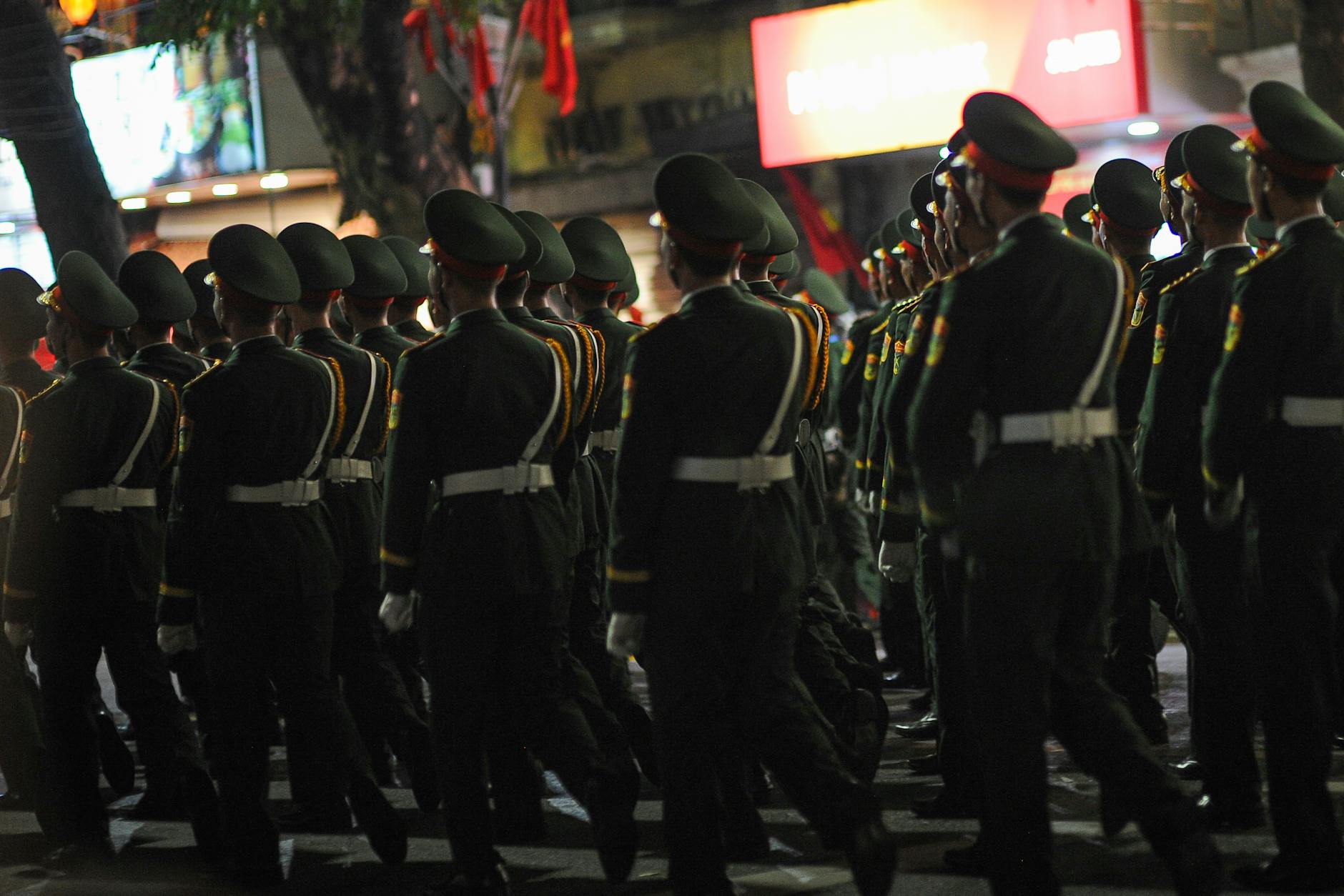
The February 25-26 military parade in Pyongyang was notable not only for what it displayed but for what it did not. Roughly 14,000 troops marched through the capital in a nighttime spectacle designed for maximum visual impact. Kim Jong Un stood at the center, flanked by senior military officials and, prominently, his daughter Kim Ju Ae. South Korean intelligence believes she is being positioned as heir apparent, possibly already overseeing the Missile Administration — a role that would place her at the center of North Korea’s most strategically important institution. What the parade conspicuously lacked was heavy hardware. No ICBMs rolled through the streets. No tanks. No large mobile launchers of the kind North Korea has displayed in previous parades.
Analysts initially read this as a possible signal of openness to dialogue with the Trump administration — a way of saying that Pyongyang is willing to talk without brandishing its most provocative systems. In the wake of the iran strikes, that interpretation has become more complicated. It is equally possible that the absence of ICBMs reflected operational security concerns — a desire not to reveal the current state or location of North Korea’s most advanced systems at a moment when the U.S. had just demonstrated its willingness to strike nuclear infrastructure without warning. Kim’s vow at the parade to expand the nuclear arsenal now carries a different weight. Before the Iran strikes, it was a familiar piece of domestic rhetoric. After the killing of Khamenei and the destruction of Iranian nuclear facilities, it reads as a concrete policy commitment backed by a fresh strategic rationale. The Workers’ Party Congress that preceded the parade provided the institutional framework for accelerated weapons development, and Kim’s language — describing nuclear expansion as the party’s “firm will” — suggests that this is not a bargaining position but a settled decision.
The Proliferation Domino Effect — Who Learns What From the Iran Strikes
The consequences of the Iran war extend far beyond the Korean Peninsula. Foreign Affairs published analysis arguing that the strikes teach aspiring nuclear powers three lessons: “Do not wait to get the bomb, assume major powers will attack, and do not trust that diplomacy is within reach.” This is not an abstract concern. Analysts at Just Security and The Diplomat have identified a specific list of countries that may now pursue nuclear programs more aggressively — including Poland, Saudi Arabia, South Korea, Ukraine, and the UAE. The tradeoff at the heart of this proliferation risk is between transparency and survival. Under the existing nonproliferation framework, countries that pursued nuclear technology were expected to do so openly, under international inspection, with the understanding that compliance would protect them from attack. Iran largely followed this model, even as it pushed the boundaries of what was permitted. The result — an internationally monitored program that was then destroyed by military force — undermines the fundamental bargain.
Countries drawing lessons from Iran’s experience will be incentivized to pursue nuclear capabilities covertly, prioritizing speed and operational security over transparency and diplomatic engagement. North Korea, in this framework, becomes the model proliferator rather than the cautionary tale. It made steady, largely clandestine progress toward a deliverable weapon. It used diplomacy selectively, to buy time and test U.S. resolve. And it emerged with a nuclear arsenal that makes a military strike against it effectively unthinkable. For countries weighing their own nuclear options, the comparison between Iran’s path and North Korea’s path now has a clear winner — and that winner is the one that refused to trust the international system.
Why U.S.-North Korea Diplomacy Just Got Harder
The killing of Khamenei has introduced a new variable into the already frozen U.S.-North Korea relationship: the personal security of supreme leaders. Kim Jong Un has always been obsessed with his own safety, but the Iran strikes — combined with the arrest of Venezuela’s Nicolás Maduro — create a pattern that Pyongyang’s leadership will interpret as a deliberate U.S. strategy of decapitation. Analysts expect this concern to make any future diplomatic engagement between Washington and Pyongyang significantly more difficult. The problem is structural, not just psychological. Previous U.S.-North Korea summits required Kim to travel internationally, expose himself to foreign intelligence services, and place some degree of trust in security arrangements he did not control.
The Singapore summit in 2018 and the Hanoi summit in 2019 both involved significant personal risk for Kim, risk that he accepted because the potential diplomatic payoff seemed worth it. After Iran, the calculus changes. Any future summit would require Kim to trust that the same government that killed Khamenei during what were nominally active negotiations — the February 6, 2026 talks in Oman had produced a second round scheduled for Geneva — would negotiate with him in good faith. There is a deeper warning here for U.S. policymakers. The Iran strikes may have eliminated a specific nuclear threat, but they have also demonstrated to every authoritarian leader in the world that engaging with the United States carries existential risk. The short-term gain of destroying Iranian nuclear infrastructure must be weighed against the long-term cost of making diplomatic solutions to nuclear proliferation nearly impossible to achieve.

The Doomsday Clock and the New Nuclear Landscape of 2026
The Bulletin of the Atomic Scientists flagged elevated nuclear risk in its 2026 Doomsday Clock statement, and the events of late February have only validated that assessment. Both Global Security Review and Chatham House identified nuclear proliferation as a top challenge for 2026, with Iran’s example potentially triggering a cascade of new nuclear programs across the Middle East and beyond. Saudi Arabia, which has long maintained a latent interest in nuclear capability, now faces a regional landscape in which its primary rival’s nuclear program has been destroyed — but the method of destruction has also demonstrated that conventional nonproliferation guarantees are worthless.
📨 Get Free Accountability Coverage Alerts
Free · No spam · Unsubscribe anytime
The risk is not that a dozen countries will test nuclear weapons next year. The risk is that the slow, quiet groundwork for future weapons programs is being laid right now, in countries that previously accepted the nonproliferation framework as sufficient protection. North Korea’s example — patient, covert, ultimately successful — is the template, and the Iran strikes have made that template more attractive than at any point since the end of the Cold War.
What Comes Next for Kim Jong Un’s Nuclear Program
The most likely outcome of the Iran war, as far as North Korea is concerned, is acceleration. Kim Jong Un has the institutional mandate from the Workers’ Party Congress, the strategic rationale from Iran’s destruction, and the technical capability to expand his arsenal significantly. The Federation of American Scientists’ estimate of fissile material for 70 to 90 weapons suggests considerable room for growth, and North Korea’s underground facilities provide the operational security to pursue that growth without meaningful interference. The question is not whether North Korea will expand its nuclear program but whether the expansion will be accompanied by any diplomatic engagement at all.
The absence of ICBMs from the February parade may have been a signal, but signals require a willing recipient. With the Iran war consuming U.S. attention and the precedent of Khamenei’s killing poisoning any prospect of trust, the window for negotiation — already narrow — may have closed entirely. Kim Jong Un appears to have concluded that his father and grandfather were right all along: the bomb is the only guarantee, and everything else is theater.
Conclusion
The Iran war has crystallized a dynamic that was already well underway. North Korea’s nuclear arsenal, once seen as a dangerous aberration, now looks like the most successful national security strategy of the 21st century — at least from the perspective of regime survival. Kim Jong Un watched Iran negotiate, watched Iran agree to degrade its stockpiles, and watched Iran’s supreme leader die in an airstrike launched during what were ostensibly active peace talks. The lesson is not subtle, and Pyongyang is not a regime that misses strategic lessons.
For the United States, the challenge is now twofold. The Iran strikes removed a specific nuclear threat but supercharged the broader proliferation problem, with North Korea as both the most dangerous existing case and the model for future proliferators. Any path toward denuclearization of the Korean Peninsula — already the longest of long shots — now requires overcoming not just decades of mutual distrust but the fresh, vivid example of what happens to countries that trust the United States enough to negotiate away their nuclear capabilities. That is a diplomatic obstacle that no amount of military capability can overcome.
Frequently Asked Questions
Did North Korea officially respond to the U.S.-Israel strikes on Iran?
Yes. On March 1, 2026, North Korea’s Foreign Ministry condemned the strikes as “illegal and outrageous acts of aggression,” “the most despicable form of sovereignty violation,” and “gangster-like conduct.”
How many nuclear weapons does North Korea currently have?
The Federation of American Scientists and ICAN estimate North Korea possesses approximately 50 assembled nuclear warheads, with fissile material sufficient for 70 to 90 weapons total.
Could the U.S. carry out a similar strike on North Korea’s nuclear facilities?
Analysts consider this extremely unlikely. North Korea’s key nuclear facilities are located hundreds of meters underground beneath solid bedrock, and its existing arsenal of deliverable warheads means any strike risks nuclear retaliation against South Korea, Japan, and potentially the U.S. mainland.
What was Operation Midnight Hammer?
Operation Midnight Hammer was the June 2025 U.S. strike on Iranian nuclear facilities at Natanz, Fordow, and Isfahan. The CIA reported severe damage that would take Iran years to rebuild.
Who is Kim Ju Ae and why does she matter?
Kim Ju Ae is Kim Jong Un’s daughter, who appeared prominently beside him at the February 2026 military parade. South Korean intelligence believes she is being positioned as heir apparent and may already oversee the Missile Administration.
What countries might pursue nuclear weapons after the Iran strikes?
Analysts at Foreign Affairs and Just Security have identified Poland, Saudi Arabia, South Korea, Ukraine, and the UAE as countries that may now pursue nuclear programs more covertly, prioritizing speed and operational security over diplomatic transparency.
You Might Also Like
- TikTok Videos About the Iran War Get Millions of Views Overnight
- Japan Fears Oil Supply Disruption From Iran War Could Hit Its Economy
- Iran Releases Its Own Footage Claiming Successful Retaliation Against U.S. and Israel