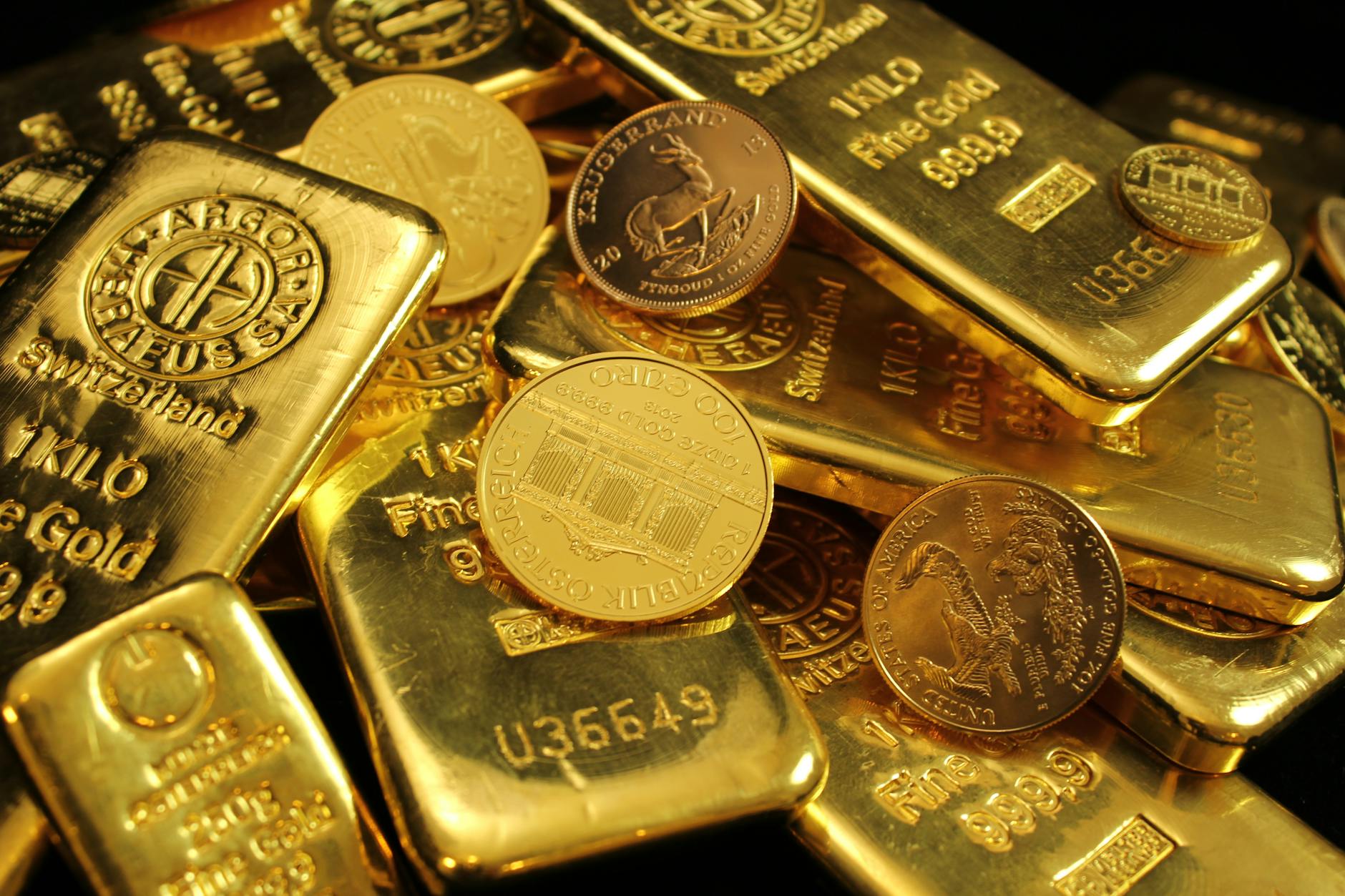
Gold prices have blown past $5,300 per ounce, and the reasons are not mysterious. A collision of tariff chaos, a landmark Supreme Court ruling that invalidated the legal basis for most of President Trump’s trade levies, and escalating geopolitical tensions — including U.S. and Israeli strikes on Iranian targets — have sent investors scrambling for the one asset that thrives on uncertainty. As of March 1, 2026, gold sits at $5,296.40 per ounce, up $102.20 on the day alone, capping a February that saw the metal climb more than 10% in a single month and 74% year-over-year. The Supreme Court’s 6-3 decision in *Learning Resources Inc. v.
Trump* on February 20 is the single event tying all of this together. By ruling that the International Emergency Economic Powers Act does not authorize presidential tariffs, the Court struck down both the “Liberation Day” reciprocal tariffs and the fentanyl-related levies — wiping out the legal foundation for much of the administration’s trade agenda. Trump responded within hours by imposing a new 10% global tariff under Section 122 of the Trade Act of 1974, then raised it to 15% the next day. Over 1,000 companies have now filed lawsuits seeking refunds for tariffs they paid under the invalidated IEEPA authority. Trade deals with Indonesia, Taiwan, India, the EU, and Japan are all in varying stages of uncertainty. This article breaks down the gold surge, the tariff fallout, and the trade landscape as it stands right now.
Table of Contents
- Why Are Gold Prices Surging After Trump’s Tariff Defeat at the Supreme Court?
- What the Supreme Court Actually Ruled — and What It Did Not
- The Refund Lawsuits — Over 1,000 Companies Want Their Money Back
- Trade Deals Are Falling Apart — Who Benefits and Who Gets Hurt
- Trump’s State of the Union Tariff Claims vs. the Numbers
- China’s Growing Leverage Ahead of the Beijing Summit
- Where Gold Goes From Here
- Conclusion
- Frequently Asked Questions
Why Are Gold Prices Surging After Trump’s Tariff Defeat at the Supreme Court?
Gold’s run to $5,300 is not just about one headline. It is the accumulation of structural forces that have been building for over a year. China’s central bank has been buying gold for 15 consecutive months, providing steady demand that underpins prices regardless of what happens in Washington. J.P. Morgan now forecasts gold will reach $6,300 per ounce by year-end 2026 — a 22% increase above current levels. UBS sees gold hitting $6,200 as soon as this month, before settling around $5,900 by December.
But the Supreme Court ruling added rocket fuel. When the Court invalidated the IEEPA tariffs, it did not simply resolve a legal question — it created a new one. Trump’s pivot to Section 122 authority has never been tested at this scale, and legal scholars are already questioning whether the statute was designed to support tariffs of 10% or 15% across the board. That legal ambiguity, combined with the prospect of years of litigation from the 1,000-plus companies suing for refunds, means businesses cannot plan and investors cannot model outcomes. Gold thrives in exactly that environment. The February 28 spike past $5,300 came on the same day U.S. and Israeli strikes on Iranian targets triggered a fresh wave of safe-haven buying, compounding the tariff-driven uncertainty.
What the Supreme Court Actually Ruled — and What It Did Not
Chief Justice Roberts, writing for a majority that included Sotomayor, Kagan, Gorsuch, Barrett, and Jackson, held that IEEPA’s text does not grant the president authority to impose tariffs. The statute allows the president to regulate economic transactions during a declared emergency, but the majority concluded that tariffs — which are taxes on imports collected at the border — fall outside that scope. The ruling struck down both the April 2025 “Liberation Day” reciprocal tariffs and the fentanyl-related tariffs that had been applied primarily to goods from China, Canada, and Mexico. What the Court did not do is ban presidential tariffs entirely.
trump retains authority under other statutes, including Section 122 of the Trade Act of 1974, Section 301 (unfair trade practices), and Section 232 (national security). Section 122, however, was designed as a temporary measure to address balance-of-payments emergencies, and it caps tariffs at 15% for a maximum of 150 days without Congressional approval. That creates a ticking clock. If Congress does not act to authorize the tariffs within that window, the legal basis evaporates again. For consumers and businesses, the practical effect is ongoing uncertainty — the tariff rate today is 13.7% on average according to the Tax Foundation, but nobody can say with confidence what it will be in six months.
The Refund Lawsuits — Over 1,000 Companies Want Their Money Back
The Supreme Court ruling did more than block future tariffs under IEEPA. It retroactively invalidated tariffs that companies had already paid, and the corporate response has been swift and enormous. Over 1,000 companies, including Costco and FedEx, have filed lawsuits in the Court of International Trade seeking refunds for tariffs collected under the now-illegal IEEPA authority. The total amount at stake runs into the tens of billions of dollars. These are not speculative claims.
The Supreme Court has already said the tariffs were unlawful, which means the legal question in most refund cases is not whether the money is owed but how quickly the government must pay it back and whether interest accrues. The U.S. Treasury has not indicated how it plans to handle the flood of refund claims, and the administration has not acknowledged the liability in any public budget document. For smaller importers who paid IEEPA tariffs but lack the resources to hire trade lawyers, the path to recovery is far less clear. Some trade attorneys expect a class action or consolidated proceeding to emerge that would allow smaller businesses to participate without filing individual suits, but nothing has been formally organized yet.

Trade Deals Are Falling Apart — Who Benefits and Who Gets Hurt
The Supreme Court ruling has reshaped the leverage in every trade negotiation the administration is pursuing. The Indonesia deal, finalized in late February, maintains a 19% reciprocal tariff rate with some products at 0%. Taiwan’s deal, signed January 15, lowered its reciprocal rate from 20% to 15%. India’s deal, announced February 2, dropped the tariff on Russian oil purchases and reduced the reciprocal rate from 25% to 18% — but India has since paused plans to finalize the interim agreement. The EU has postponed its parliamentary vote on a deal for a second time, with lawmakers expected to reconvene March 4.
The comparison that matters here is between countries that locked in deals before the ruling and those that did not. Indonesia and Taiwan have signed agreements that give them at least some certainty, even if the legal basis for enforcement is now murkier. India and the EU, by contrast, have strong incentives to wait and see whether Section 122 tariffs survive legal challenge before committing to anything. Japan’s trade minister has publicly urged Washington not to treat Japan less favorably than its existing deal terms, noting that the new 10% universal tariff could impose additional burdens on top of negotiated rates. The risk for the administration is that the ruling erodes its bargaining position with every country that has not yet signed — and China, with the most leverage of all, is in no rush to finalize anything before Trump’s scheduled visit to Beijing at the end of March.
Trump’s State of the Union Tariff Claims vs. the Numbers
At his February 25 State of the Union address, Trump claimed that tariffs could “substantially replace the modern-day system of income tax” and said they have brought in “hundreds of billions of dollars.” These claims deserve scrutiny. The federal government collected approximately $2.2 trillion in individual income taxes in fiscal year 2025. Tariff revenue, even at elevated rates, has historically generated between $80 billion and $120 billion annually. To replace income taxes, tariffs would need to increase by roughly 15 to 20 times their current levels — which would require rates so high that imports would collapse, defeating the purpose.
The “hundreds of billions” framing is also misleading in context. A significant portion of the tariff revenue collected under IEEPA authority may now need to be refunded following the Supreme Court ruling. The administration has not clarified whether it is counting gross collections (before refunds) or net revenue (after accounting for the legal liability). For taxpayers watching the State of the Union, the practical takeaway is this: tariffs at their current effective rate of 13.7% are a meaningful source of revenue, but they are not remotely close to replacing income taxes, and any revenue collected under the struck-down IEEPA authority is subject to court-ordered return.

China’s Growing Leverage Ahead of the Beijing Summit
Trump is scheduled to travel to Beijing at the end of March to meet with Xi Jinping, and the dynamics of that meeting have shifted dramatically. Before the Supreme Court ruling, Trump held the unilateral ability to impose or remove tariffs at will under IEEPA — a powerful tool for extracting concessions. That tool is gone. Section 122 tariffs are capped at 15% and expire without Congressional renewal. China knows this.
📨 Get Free Accountability Coverage Alerts
Free · No spam · Unsubscribe anytime
China’s central bank, meanwhile, has been steadily buying gold for 15 consecutive months, diversifying reserves away from dollar-denominated assets. That is not a coincidence. Beijing is positioning itself for a prolonged period of trade friction, and gold is its hedge. The March 4 escalation — with Canada’s retaliatory tariffs taking effect and Trump announcing an additional 10% increase on Chinese goods — will set the tone for the summit. If the administration enters Beijing having already exhausted its Section 122 authority, Xi has little reason to offer significant concessions.
Where Gold Goes From Here
The forecasts from major banks suggest gold has room to run. J.P. Morgan’s $6,300 target and UBS’s $6,200 near-term forecast both reflect the view that the forces driving gold higher — central bank buying, tariff uncertainty, geopolitical risk, and dollar weakness — are not going away soon. A resolution of the Iran situation or a breakthrough at the Beijing summit could pull prices back temporarily, but the structural demand from central banks provides a floor that did not exist five years ago.
The risk for gold investors is that Congress acts quickly to authorize tariffs under a new legal framework, removing the uncertainty premium. That seems unlikely given the current political dynamics, but it is not impossible. If tariffs are placed on firm legal footing and trade deals stabilize, gold could plateau or pull back from these levels. For now, though, the metal is trading as if the world is getting less predictable, not more — and the evidence supports that view.
Conclusion
Gold at $5,300 is not a bubble or a speculative frenzy. It is a rational response to a legal and economic environment that has become genuinely unpredictable. The Supreme Court’s 6-3 ruling invalidated the primary legal tool the administration was using to reshape global trade, and the pivot to Section 122 authority has introduced a new set of time limits, legal questions, and political uncertainties. Over 1,000 companies are suing for refunds. Trade deals are stalling. And the president is heading to Beijing with less leverage than he had a month ago.
For consumers, investors, and businesses, the practical implications are straightforward. Tariff rates remain elevated at 13.7% on average but could change at any time. Gold is expensive but supported by structural demand that is unlikely to reverse. And the trade deals that have been signed may not hold if the legal framework beneath them shifts again. The next major inflection points are March 4, when new tariffs and retaliatory measures take effect, and the end of March, when Trump meets Xi in Beijing. Until those events resolve, expect continued volatility in markets and continued demand for safe-haven assets.
Frequently Asked Questions
Why did the Supreme Court strike down Trump’s tariffs?
In *Learning Resources Inc. v. Trump*, the Court ruled 6-3 that the International Emergency Economic Powers Act does not authorize the president to impose tariffs. The majority held that tariffs are taxes on imports and fall outside the scope of IEEPA’s emergency powers. Chief Justice Roberts authored the opinion, joined by Sotomayor, Kagan, Gorsuch, Barrett, and Jackson.
Can Trump still impose tariffs after the ruling?
Yes, but under different legal authority. Trump immediately imposed a 10% global tariff under Section 122 of the Trade Act of 1974, then raised it to 15%. However, Section 122 tariffs are capped at 15% and require Congressional approval to extend beyond 150 days.
Can companies get refunds for tariffs paid under IEEPA?
Over 1,000 companies including Costco and FedEx have filed lawsuits seeking refunds for tariffs paid under the now-invalidated IEEPA authority. Since the Supreme Court ruled those tariffs were unlawful, the legal basis for refunds is strong, though the timeline and process remain uncertain.
How high could gold prices go in 2026?
J.P. Morgan forecasts gold reaching $6,300 per ounce by year-end 2026, a 22% increase above current levels. UBS projects gold could hit $6,200 as soon as March before settling at $5,900 by December. These forecasts are driven by central bank buying, tariff uncertainty, and geopolitical risk.
Will tariffs replace the income tax as Trump claimed?
This is extremely unlikely. Federal income tax revenue was approximately $2.2 trillion in fiscal year 2025. Tariff revenue, even at elevated rates, generates roughly $80 billion to $120 billion annually. Replacing income taxes would require tariff rates so high that imports would collapse.
What happens at the Trump-Xi Beijing summit?
Trump is scheduled to meet Xi Jinping at the end of March to discuss trade. China’s leverage has increased following the Supreme Court ruling, since Trump can no longer unilaterally impose high tariffs under IEEPA. The March 4 tariff escalation on Chinese goods — an additional 10% — will set the tone for negotiations.
You Might Also Like
- Supreme Court Struck Down Tariffs…$175 Billion May Be Refunded to Corporations, Not Consumers
- Trump Said He “Ended Eight Wars”…Here Are the 8 “Wars” and What Really Happened
- Social Security Class Action: Children of Early Retirees — March 2026 Court Hearing