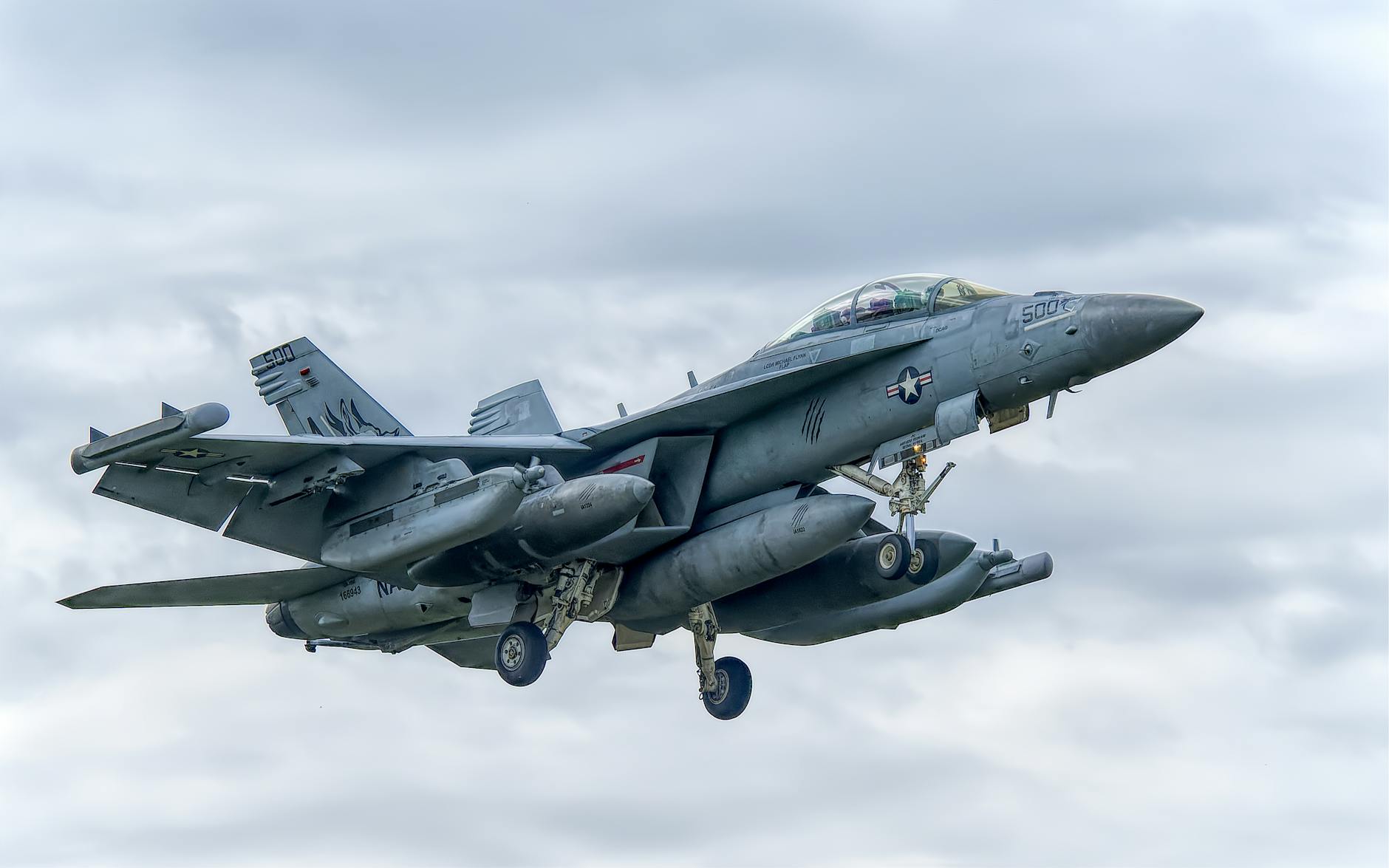
The United States has assembled its largest military force in the Middle East since the 2003 Iraq invasion, deploying two aircraft carrier strike groups, more than 150 aircraft, and an estimated 40,000 to 50,000 troops across the region. The buildup, which accelerated sharply after U.S.-Iran nuclear talks collapsed without a deal on February 17, 2026, represents a massive projection of naval and air power aimed squarely at Tehran. The USS Abraham Lincoln arrived in the Middle East on January 26, followed by the USS Gerald R. Ford — the world’s largest aircraft carrier — which deployed on February 13 and passed through the Strait of Gibraltar less than a week later.
This is not a ground invasion force. Analysts at the Center for Strategic and International Studies have been clear on that point. The current deployment is built around carrier-launched airstrikes, stealth fighter operations, and cruise missile capabilities rather than the kind of boots-on-the-ground occupation force that characterized Iraq in 2003. But the scale is unmistakable, and the message to Iran is difficult to misread. This article breaks down the naval assets now in theater, the air power surge underway, the strategic calculations driving the buildup, how it compares to past Middle East deployments, and what it could mean for American taxpayers and the broader geopolitical landscape.
Table of Contents
- Why Has the U.S. Deployed Two Aircraft Carriers and 40,000 Troops to the Middle East?
- What Naval Firepower Is Actually in the Region Right Now?
- The Air Power Surge and What It Signals About Strike Planning
- How Does This Buildup Compare to the 2003 Iraq Invasion and Desert Storm?
- The Financial and Strategic Risks of Extended Forward Deployment
- What Iran’s Response Options Look Like
- Where This Goes From Here
- Conclusion
- Frequently Asked Questions
Why Has the U.S. Deployed Two Aircraft Carriers and 40,000 Troops to the Middle East?
The immediate trigger was the failure of the second round of U.S.-Iran nuclear negotiations on February 17, 2026. President trump had repeatedly warned that military action remained on the table if diplomacy failed to curb Iran’s nuclear ambitions, and the collapse of talks set the current escalation in motion. Within days, the Washington Post reported that more than 150 aircraft had been moved to bases across Europe and the Middle East, with 50 additional fighter jets arriving in the region in rapid succession.
Twelve F-22 Raptor stealth fighters were deployed to Ovda Airbase in southern Israel, a placement that puts America’s most advanced air superiority platform within striking distance of Iranian territory. The broader context stretches back further. The 2025-2026 Iranian protests have destabilized the regime internally, and Trump’s June 2025 Operation Midnight Hammer — a series of strikes on Iranian nuclear sites using B-2 stealth bombers escorted by F-22s and F-35s — established that the administration is willing to use force. The current buildup appears designed to ensure the military has overwhelming capability in place should the president order another round of strikes. Diego Garcia, the U.S. base in the Indian Ocean, remains capable of hosting B-2 bombers for long-range missions, adding yet another layer to the strike architecture now surrounding Iran.

What Naval Firepower Is Actually in the Region Right Now?
The carrier strike groups represent the backbone of the deployment. The USS Abraham Lincoln (CVN-72) was ordered to the Middle East around January 15, 2026, and arrived on January 26 with guided-missile destroyers, cruisers, and approximately 5,700 service members. The USS Gerald R. Ford (CVN-78) followed, deploying on February 13 with three destroyers and more than 5,000 additional personnel. The Ford docked at Souda Bay, Crete on February 23 for resupply before continuing eastward.
Together, the two carrier groups bring 14 surface warships to the theater — the largest naval concentration in the Middle East since five carrier battle groups assembled for the Iraq invasion in 2003. However, surface ships are only part of the picture. The Navy operates four Ohio-class guided-missile submarines — the USS Ohio, Florida, Michigan, and Georgia — each capable of carrying up to 154 Tomahawk cruise missiles. The Pentagon does not typically confirm submarine positions, but these vessels represent an enormous standoff strike capability that could be brought to bear without any additional visible buildup. If even two of the four SSGNs are in or near the theater, that adds more than 300 Tomahawk missiles to the available arsenal, a detail that rarely makes headlines but fundamentally shapes the military calculus.
The Air Power Surge and What It Signals About Strike Planning
The air component of this buildup tells a specific story about what kind of military operation the Pentagon is preparing for. The deployment of 12 F-22 Raptors to Ovda Airbase in southern Israel is particularly notable. The F-22 is not a ground-attack workhorse — it is America’s premier air superiority fighter, designed to establish control of contested airspace. Sending F-22s to Israel suggests the Pentagon is planning for scenarios in which Iranian air defenses, including Russian-supplied S-300 systems, need to be suppressed or destroyed before strike aircraft can operate freely.
The broader movement of more than 150 aircraft to the region since February 17 constitutes the largest U.S. air force presence in the Middle East since 2003. The speed of the deployment is striking: 50 fighter jets arrived in just the final days before reporting, suggesting pre-positioned logistics and basing agreements were already in place. This is consistent with lessons learned from Operation Midnight Hammer, where the strike package had to be assembled and executed on a compressed timeline. The current posture appears designed to ensure that if a strike order comes, the assets are already forward-deployed rather than days or weeks away.

How Does This Buildup Compare to the 2003 Iraq Invasion and Desert Storm?
The “biggest since 2003” framing, while accurate, requires some important context. The 2003 Iraq invasion involved approximately 250,000 troops, and Desert Storm in 1991 deployed more than 500,000. The current Middle East presence of 40,000 to 50,000 troops is a fraction of either operation, and the composition is fundamentally different. Iraq required massive ground forces for invasion and occupation. The current buildup, as CSIS senior vice president Seth Jones has noted, is primarily naval and air power — a force designed for strikes and defense against retaliation, not territorial control.
That distinction matters enormously for understanding what this buildup can and cannot accomplish. An air and naval campaign can destroy fixed targets like nuclear facilities, degrade military infrastructure, and impose costs on an adversary. What it cannot do is occupy territory, secure borders, or force regime change through military presence alone. The comparison to 2003 is useful for conveying scale, but the strategic purpose is closer to the 1998 Operation Desert Fox strikes against Iraq — a punitive campaign designed to set back a weapons program rather than topple a government. Anyone expecting a replay of the Iraq War ground campaign is misreading both the force structure and the political dynamics.
The Financial and Strategic Risks of Extended Forward Deployment
Maintaining two carrier strike groups on station in the Middle East is extraordinarily expensive. A single carrier strike group costs roughly $6 to $7 million per day to operate when fully deployed, meaning the current two-carrier presence burns through more than $12 million daily before accounting for the air force deployments, submarine operations, and logistics chains supporting the broader buildup. These costs come on top of the existing defense budget and are not subject to the kind of congressional authorization that a declared military operation would require — at least not until shots are fired. The strategic risks extend beyond the financial.
Extended forward deployments strain equipment and personnel. The Gerald R. Ford, despite being the Navy’s newest and most capable carrier, has experienced well-documented reliability issues with its electromagnetic aircraft launch system. Operating two carriers in a high-threat environment simultaneously also creates force management challenges elsewhere. The Pacific Fleet’s ability to respond to contingencies in the Taiwan Strait or South China Sea is reduced when capital ships are committed to the Middle East. This is the perpetual tradeoff of American global military commitments — projecting power in one theater necessarily means accepting risk in another.

What Iran’s Response Options Look Like
Iran’s military options in the event of a U.S. strike are asymmetric but real. Tehran’s ballistic missile arsenal, estimated at more than 3,000 missiles of various ranges, could target U.S.
📨 Get Free Accountability Coverage Alerts
Free · No spam · Unsubscribe anytime
bases across the Gulf states, and Iran demonstrated a willingness to use them during the January 2020 strikes on Al Asad Air Base in Iraq. Iran’s network of proxy forces — including Hezbollah, various Iraqi militias, and the Houthis in Yemen — could open multiple fronts simultaneously, threatening commercial shipping in the Strait of Hormuz and Red Sea. The 14 surface warships now in theater are partly there to defend against exactly this kind of distributed retaliation, but protecting every potential target across a region that spans thousands of miles is a challenge even for the U.S. Navy.
Where This Goes From Here
The trajectory of this buildup depends almost entirely on whether a third round of nuclear talks materializes and whether those talks produce anything Iran and the United States can both accept. The military assets now in position give Trump maximum leverage — or maximum temptation, depending on your perspective. The infrastructure for a large-scale air campaign is essentially in place, from the carrier-based strike aircraft to the F-22s in Israel to the Tomahawk-carrying submarines that may already be on station. The gap between “maximum pressure” and “active hostilities” has rarely been this narrow in the post-9/11 era.
For Americans watching this unfold, the critical question is one of authorization. The current buildup has occurred under existing executive authority without a specific congressional vote. If strikes are ordered, the legal basis will almost certainly be contested, as it was after Operation Midnight Hammer. The War Powers Resolution gives the president 60 days of military action before congressional approval is required, but the political and human costs of a wider Middle East conflict would be felt long before that clock runs out.
Conclusion
The 2026 U.S. military buildup in the Middle East is real, substantial, and historically significant. Two carrier strike groups with 14 warships, more than 150 aircraft including F-22 stealth fighters, and an estimated 40,000 to 50,000 troops now constitute the largest American military presence in the region since the Iraq War. The force is configured for air and naval strikes against Iran’s nuclear infrastructure and for defense against the retaliation that would inevitably follow, not for a ground invasion.
Whether this buildup leads to conflict or serves as the pressure that finally produces a diplomatic breakthrough remains an open question. What is not in question is the scale of the commitment and the stakes involved. A military confrontation with Iran would be fundamentally different from Iraq — Iran is larger, more populous, better armed, and backed by a network of regional proxies capable of inflicting serious costs on American forces and allies. The decisions made in the coming weeks will shape the Middle East for years, and they deserve the kind of public scrutiny and congressional oversight that a deployment of this magnitude demands.
Frequently Asked Questions
Is this the biggest U.S. military deployment ever in the Middle East?
No. While it is the largest since the 2003 Iraq invasion, that conflict involved approximately 250,000 troops. Desert Storm in 1991 was even larger, with more than 500,000 U.S. service members deployed. The current buildup of 40,000 to 50,000 troops is significant but far smaller than those operations.
Are U.S. ground troops being sent to invade Iran?
No. The current deployment is primarily naval and air power, according to analysts at CSIS. The force structure — carrier strike groups, stealth fighters, and cruise missile platforms — is designed for strikes and defense against retaliation, not a ground invasion.
What aircraft carriers are currently deployed to the Middle East?
The USS Abraham Lincoln (CVN-72) arrived in the Middle East on January 26, 2026. The USS Gerald R. Ford (CVN-78), the world’s largest aircraft carrier, deployed on February 13 and docked at Souda Bay, Crete on February 23 for resupply before continuing eastward. Together they bring 14 surface warships and more than 10,000 personnel.
Why were F-22 Raptors sent to Israel?
Twelve F-22 stealth fighters were deployed to Ovda Airbase in southern Israel. The F-22 is designed for air superiority and suppression of advanced air defenses, suggesting the Pentagon is preparing for scenarios involving Iran’s Russian-supplied S-300 air defense systems.
Has Congress authorized this military buildup?
The buildup has occurred under existing executive authority without a specific congressional vote. If strikes are ordered, the legal basis would likely be contested. The War Powers Resolution allows the president 60 days of military action before requiring congressional approval.
What happened during Operation Midnight Hammer?
Operation Midnight Hammer was a series of U.S. strikes on Iranian nuclear sites ordered by President Trump in June 2025. B-2 stealth bombers, escorted by F-22s and F-35s, conducted the strikes. The current buildup appears designed to ensure similar or greater capability is already in position if additional strikes are ordered.
You Might Also Like
- Trump Says Manufacturing Is “Back.” Factory Employment Is Flat. Here’s the Data.
- Trump Says Drug Prices Fell 60%. Federal Data Shows a 4% Drop. Here’s the Actual Impact.
- Trump Said Energy Bills Dropped 50%. Utility Data Shows a 9% Decline. Here’s the Real Change.