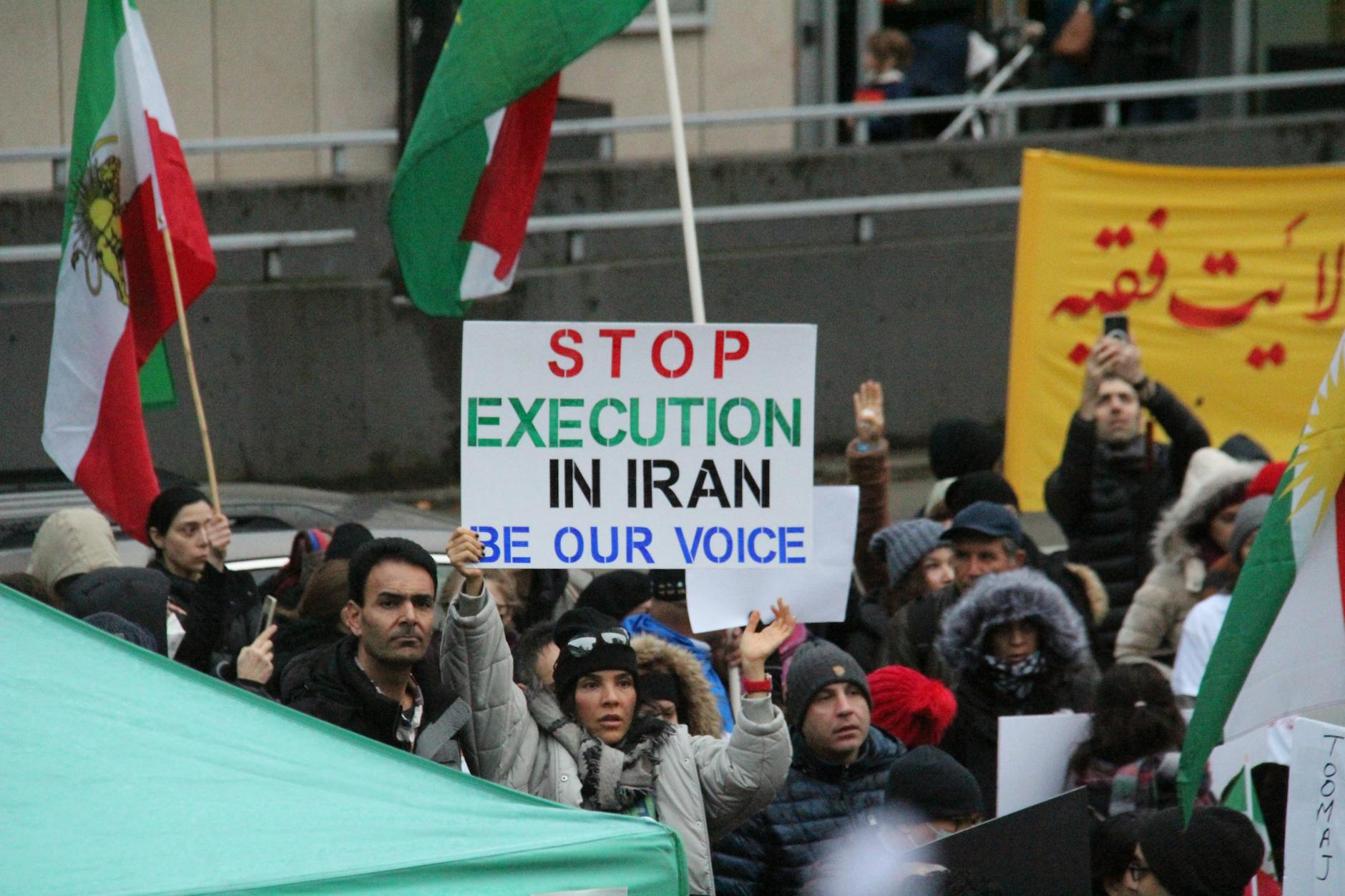
Thousands of Iranian Americans flooded the streets around the Westwood Federal Building in Los Angeles on March 1, 2026, waving American, Israeli, and pre-revolutionary Iranian flags in celebration after the confirmed death of Ayatollah Ali Khamenei. The Supreme Leader, who had ruled Iran for nearly four decades, was killed in joint U.S.-Israeli military strikes on February 28, with Iranian state television confirming his death hours after President Trump’s initial announcement and formal government confirmation following on March 1. The rally, which grew so large that LAPD shut down Wilshire Boulevard and Veteran Avenue by 1:20 p.m., marked one of the most significant public gatherings of the Iranian diaspora in recent memory. But the community response was far from monolithic.
While celebratory crowds chanted “Free Iran” and “No More Ayatollah” in Westwood, a separate group of protesters gathered outside Los Angeles City Hall to oppose the strikes, warning that military action would cost American and Iranian civilian lives. At least three U.S. service members were killed during the operation, lending weight to those concerns. This article examines the dueling rallies, the deep divisions within the Iranian American community, the succession crisis now unfolding in Tehran, and what this moment means for the largest Iranian population outside of Iran.
Table of Contents
- Why Did Iranian Americans Rally in Los Angeles After Khamenei’s Death Was Confirmed?
- What Happened at the Anti-War Counter-Protests at City Hall?
- The Strikes That Killed Khamenei — What We Know
- Iran’s Succession Crisis and What It Means for the Diaspora
- A Community Divided — The Limits of Diaspora Unity
- Why Los Angeles Is Ground Zero for the Iranian American Response
- What Comes Next for Iran and the Diaspora
- Conclusion
- Frequently Asked Questions
Why Did Iranian Americans Rally in Los Angeles After Khamenei’s Death Was Confirmed?
southern California is home to the largest Iranian population outside of Iran, concentrated heavily in the Westwood neighborhood of Los Angeles — sometimes called “Tehrangeles.” That demographic reality made L.A. the inevitable epicenter of diaspora reaction when news broke that Khamenei had been killed. Starting around 1:00 p.m. on Sunday, March 1, demonstrators converged on the Westwood Federal Building at 11000 Wilshire Boulevard. The California Society for Democracy in Iran was among the organized groups present, calling for a provisional government led by Iranian opposition figures. The atmosphere was overwhelmingly celebratory among the Westwood crowd. Speakers rotated on a stage while music played.
Many demonstrators wore shirts reading “Free Iran” and carried posters of President Trump. Chants of “Freedom for Iran,” “We want freedom,” and “King Reza Pahlavi” — a reference to the son of the deposed Shah — echoed through the blocked-off streets. The pre-revolutionary Iranian flag, bearing the golden lion symbol used before the 1979 Islamic Revolution, was a dominant visual throughout the gathering. What made this rally distinct from past Iranian diaspora protests was the sense of finality. Previous demonstrations — including massive turnouts during the 2022 Mahsa Amini protests — carried an air of aspiration. This one carried an air of arrival. For many in the crowd, the death of the man who had served as the theological and political backbone of the Islamic Republic since 1989 represented not just a news event but the potential end of an era they had spent decades opposing.
What Happened at the Anti-War Counter-Protests at City Hall?
Not all Iranian Americans saw the strikes as cause for celebration. A separate group of protesters assembled outside Los Angeles City Hall on the same day, voicing opposition to the military action that killed Khamenei. Their concerns were concrete and immediate: the operation had already cost at least three American service members their lives, and the toll on Iranian civilians remained unclear in the early hours after the strikes. Some Iranian Americans at the City Hall protest made a deliberate point of distancing themselves from the regime while still opposing the military intervention. This is an important distinction that often gets lost in media coverage. Opposition to U.S.
military strikes does not equal support for the Islamic Republic, and several demonstrators explicitly stated solidarity with Iranian civilians while criticizing the method of regime change. Protesters also seized on what they called a broken campaign promise, noting that Trump had pledged “no new wars” during his campaign. However, if the City Hall protesters hoped for equal media attention, the sheer scale differential worked against them. The Westwood rally drew thousands and shut down major roads; the City Hall gathering was smaller and more diffuse. That imbalance in turnout does not invalidate the concerns raised — particularly the question of American military casualties — but it did shape the initial narrative of how L.A.’s Iranian community responded to Khamenei’s death.
The Strikes That Killed Khamenei — What We Know
The joint U.S.-Israeli military operation that killed Khamenei targeted Iran’s nuclear and missile programs, with an explicit aim of initiating regime change. The CIA provided intelligence on the locations of Iranian leaders, which enabled the strikes to reach their highest-value target. Trump announced Khamenei’s death on Saturday, February 28. Iranian state television confirmed the killing hours later, though formal government confirmation did not come until March 1 — a delay that fueled hours of uncertainty and speculation. The operation’s scope extended well beyond a single targeted killing. By striking nuclear and missile infrastructure simultaneously, the U.S.
and Israel signaled that the goal was not merely decapitation of leadership but a fundamental disruption of Iran’s military capabilities. For context, this represents a dramatic escalation from previous U.S. policy toward Iran, which under prior administrations had ranged from economic sanctions to the 2020 killing of General Qasem Soleimani — a senior military figure, but not the head of state. The confirmation of at least three U.S. service member deaths added a somber dimension to what some were treating as an unalloyed victory. Those casualties became a focal point for critics of the operation, including the protesters at City Hall, who argued that the human cost of military intervention was being minimized in the rush to celebrate.
Iran’s Succession Crisis and What It Means for the Diaspora
With Khamenei dead, Iran faces a constitutional succession process that is anything but straightforward. Khamenei had no officially appointed successor — the position of Vice Supreme Leader was abolished in 1989. Under Iran’s constitution, an interim three-member council consisting of the president, the head of the judiciary, and a jurist from the Guardian Council is supposed to carry out leadership duties until the Assembly of Experts appoints a new Supreme Leader. The practical question is whether that constitutional process will hold under the extraordinary circumstances of a foreign military strike that killed the sitting leader. The diaspora community in L.A. is watching with a mixture of hope and wariness.
Groups like the California Society for Democracy in Iran are already calling for a provisional government led by opposition figures rather than a continuation of the existing regime under new clerical leadership. The chants of “King Reza Pahlavi” at the Westwood rally suggest at least a segment of the diaspora favors monarchist restoration, though that position is far from universal even among regime opponents. The tradeoff here is between speed and legitimacy. A rapid collapse of the regime could create a power vacuum that destabilizes not just Iran but the broader region. A managed transition through constitutional mechanisms preserves some institutional continuity but risks simply installing another Supreme Leader who perpetuates the same system. For Iranian Americans who have spent decades advocating for a free Iran, the question of what comes next may prove more difficult than the question of what came before.
A Community Divided — The Limits of Diaspora Unity
The dueling rallies in Los Angeles exposed a fault line that runs through the Iranian American community and is often invisible to outside observers. The division is not simply between regime supporters and opponents — virtually no one in the L.A. diaspora publicly defends the Islamic Republic. The split is over method, cost, and consequences. Those who rallied in Westwood generally view military intervention as a necessary and justified means of ending a regime that has brutalized its own population, sponsored terrorism, and pursued nuclear weapons.
Those who protested at City Hall generally agree with the characterization of the regime but reject external military force as the mechanism for change, pointing to the Iraq War as a cautionary tale of what happens when regime change is imposed from outside. The death of three American service members in this operation is, for the anti-war contingent, an early indicator that the costs may compound. This is worth stating plainly: both groups want a free Iran. The disagreement is not about the destination but the route. Treating the Westwood celebration as the sole authentic voice of Iranian Americans erases legitimate dissent, while treating the City Hall protest as representative of majority diaspora sentiment ignores the overwhelming turnout differential. The reality is messy, and the community will likely remain divided as the consequences of the strikes continue to unfold.
Why Los Angeles Is Ground Zero for the Iranian American Response
The concentration of Iranian Americans in Southern California is not incidental — it is the direct product of the 1979 revolution. Waves of emigration following the fall of the Shah brought hundreds of thousands of Iranians to Los Angeles, drawn by existing community networks, climate, and economic opportunity. Westwood in particular became a cultural hub, with Persian-language media, restaurants, and businesses lining its streets.
📨 Get Free Accountability Coverage Alerts
Free · No spam · Unsubscribe anytime
That density of population and institutional infrastructure is why L.A. consistently produces the largest and most visible diaspora reactions to events in Iran. The Westwood Federal Building has served as a gathering point for decades, from protests during the Iran-Iraq War through the Green Movement of 2009 and the Mahsa Amini uprisings of 2022. The March 1 rally was the latest — and arguably the most consequential — chapter in that long history.
What Comes Next for Iran and the Diaspora
The killing of Khamenei has opened a chapter with no clear ending. Whether the Islamic Republic reconstitutes itself under new clerical leadership, fractures into competing power centers, or yields to some form of transitional government will depend on factors largely beyond the control of the diaspora — military dynamics on the ground, the posture of the Revolutionary Guard, and the willingness of regional actors to intervene or stand aside.
For Iranian Americans in Los Angeles and across the country, the weeks ahead will test whether the celebratory energy of the Westwood rally can translate into organized political advocacy, or whether it dissipates as the complexities of post-Khamenei Iran become apparent. The anti-war contingent, meanwhile, will be watching casualty figures and civilian impact reports closely, prepared to say “we warned you” if the operation’s costs escalate. Both sides have skin in the game — family members still in Iran, cultural ties that transcend politics, and a shared stake in an outcome that remains genuinely uncertain.
Conclusion
The dueling rallies in Los Angeles on March 1, 2026, captured the full spectrum of Iranian American reaction to Khamenei’s death. Thousands celebrated in Westwood, carrying pre-revolutionary flags and chanting for a free Iran, while a smaller but vocal group protested at City Hall, warning of the human costs already evident in the deaths of three U.S. service members.
The division reflects not a disagreement about the nature of the Islamic Republic, but a fundamental dispute about how it should end and what should replace it. What happens next in Iran — the succession process, the stability of the regime’s remaining institutions, the trajectory of military operations — will determine whether March 1 is remembered as the beginning of Iranian liberation or the opening act of a prolonged and costly conflict. For the largest Iranian community outside of Iran, the stakes could not be higher, and the uncertainty could not be more acute.
Frequently Asked Questions
Why did Iranian Americans rally in Westwood specifically?
Westwood, sometimes called “Tehrangeles,” is home to the largest concentration of Iranian Americans in the United States. The Westwood Federal Building at 11000 Wilshire Boulevard has served as a traditional gathering point for Iranian diaspora protests and celebrations for decades.
How was Khamenei killed?
Ayatollah Ali Khamenei was killed on February 28, 2026, in joint U.S.-Israeli military strikes targeting Iran’s nuclear and missile programs. The CIA provided intelligence on the locations of Iranian leaders. Trump announced the death first, with Iranian state television confirming hours later and formal government confirmation on March 1.
Were there American casualties in the Iran strikes?
Yes. At least three U.S. service members were killed during the military operation, according to confirmed reports. This became a central point of contention for protesters who opposed the strikes.
Who is Reza Pahlavi, and why were demonstrators chanting his name?
Reza Pahlavi is the son of Mohammad Reza Shah Pahlavi, the last Shah of Iran who was deposed in the 1979 Islamic Revolution. Some segments of the Iranian diaspora support a restoration of constitutional monarchy under his leadership, though this position is not universally shared among regime opponents.
What happens to Iran’s government now that the Supreme Leader is dead?
Under Iran’s constitution, an interim three-member council — consisting of the president, head of the judiciary, and a Guardian Council jurist — assumes leadership duties until the Assembly of Experts appoints a new Supreme Leader. However, whether this process will function normally under the current circumstances remains highly uncertain.
Were the L.A. rallies peaceful?
Yes. Both the pro-freedom rally in Westwood and the anti-war protest at City Hall were peaceful gatherings. LAPD’s road closures around the Westwood Federal Building were a crowd-management response to the large turnout, not a response to any violence.
You Might Also Like
- Kurdish Peshmerga Forces on Alert After Erbil Airport Hit by Iranian Missiles
- UN Security Council Emergency Meeting Called After Iran Strikes Begin
- South Korea Activates Emergency Energy Reserves After Iran Strikes