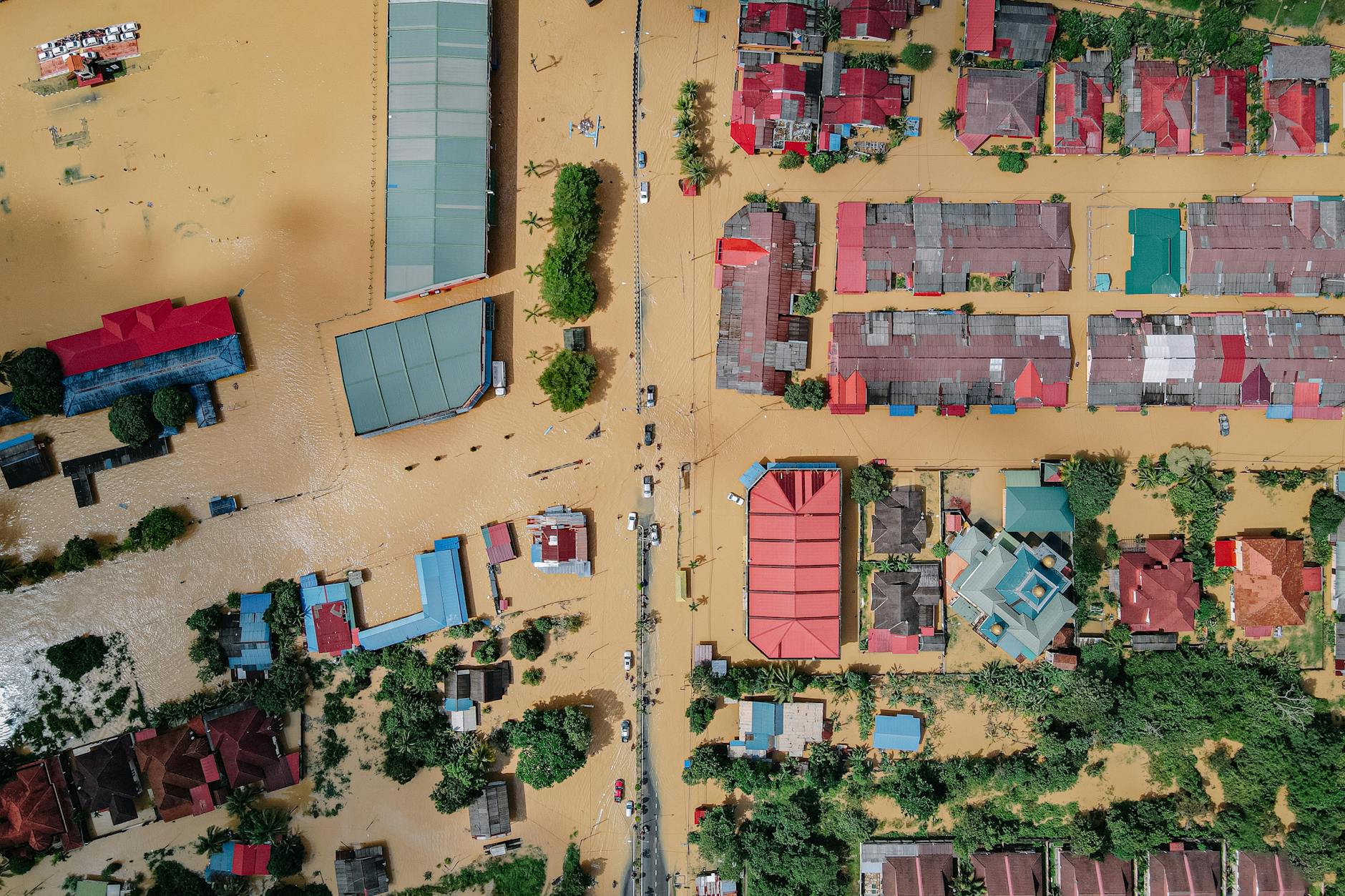
Floods and fires reshape elections by directly preventing people from voting, displacing voters, destroying polling infrastructure, and creating political conditions where incumbents face judgment for disaster response. When extreme weather strikes near election day, turnout drops, voter registration systems break down, and election workers become unavailable—physically preventing the democratic process from functioning normally. The scale is undeniable: in the past 20 years alone, 94 elections across multiple countries have been disrupted by extreme weather, and 2024 alone saw 23 elections affected by natural hazards in 18 countries, including floods, wildfires, hurricanes, and heatwaves that impacted millions of voters. These disruptions don’t just affect participation rates—they reshape electoral outcomes themselves.
Disaster relief spending can swing incumbent vote share by up to 5.4 percentage points. Anti-environment politicians face more competitive races when disasters strike. Floods that displace even one foot of water reduce voter likelihood to vote by 8.7 percentage points in affected areas. The United States experienced this directly in 2024: freezing temperatures disrupted Iowa’s caucuses in January, wildfires affected Texas primaries in March, and hurricanes Helene, Milton, and Debby disrupted voter registration and voting operations across southeastern states from August through October. Natural disasters are no longer rare exceptions in electoral politics—they are becoming predictable factors that candidates, election officials, and voters must actively plan around.
Table of Contents
- How Extreme Weather Directly Disrupts the Mechanics of Voting
- The Documented Scale of Weather-Related Election Disruptions
- Recent Real-World Examples From the 2024-2025 Election Cycle
- The Measurable Impact on Voter Turnout
- How Disasters Reshape Electoral Outcomes and Incumbent Performance
- The Politics of Disaster Response and Electoral Legitimacy
- What These Patterns Mean for Future Elections
- Conclusion
How Extreme Weather Directly Disrupts the Mechanics of Voting
Flooding and wildfires attack elections at their operational foundation. Polling places get destroyed or become inaccessible when roads flood or evacuation orders are issued. Election workers cannot reach voting locations, forcing last-minute closures and consolidations. Voter registration systems go offline when disaster damage affects power and telecommunications infrastructure. Ballot counting centers lose electrical power or physical security when fires or floods strike. These are not theoretical problems—they happened across southeastern U.S.
states in autumn 2024 when Hurricanes Helene and Milton made roads impassable, forced evacuation orders in multiple counties, and left election officials scrambling to relocate voting operations days before early voting was set to begin. The operational impact extends beyond the single election day. voters displaced by flooding or evacuation may not know whether their polling place exists or where it has been moved. Election officials working in disaster zones face simultaneous demands: coordinate emergency response, manage displaced residents, and maintain electoral infrastructure. In India’s 2024 election—the world’s largest ever held—extreme heat resulted in dozens of deaths among voters and election officials, forcing election officials to pause voting in some areas and reschedule elections. The comparison is stark: a normal election runs on established logistics, but a disaster-year election is improvised under crisis conditions.
The Documented Scale of Weather-Related Election Disruptions
The International IDEA’s analysis reveals that weather-related election disruptions follow a clear pattern. Floods cause 44 percent of all election-disrupting disasters, making them the single largest threat to electoral operations. Heatwaves account for 22 percent, tropical storms for 17 percent, and wildfires for 16 percent. Between 2024 and 2025 alone, 20 elections in 15 countries were disrupted by natural hazards—a period that included the U.S.
presidential cycle, elections in India, Indonesia, Mexico, Canada, Austria, Romania, Mozambique, and Senegal. What makes this concerning is the acceleration. A single decade saw 94 disrupted elections; the 2024 “super-cycle” year—when multiple countries held major elections simultaneously—experienced disruptions in 23 elections across 18 countries within a single year. This is not a random occurrence: the research documents specific, measurable impacts on voting behavior and electoral outcomes. The limitation worth noting is that International IDEA data focuses on documented, officially recorded disruptions; some smaller elections or election rounds affected by weather may not appear in this count, meaning the true number could be higher.
Recent Real-World Examples From the 2024-2025 Election Cycle
The United States presidential cycle in 2024 demonstrated how multiple disaster types can disrupt elections at different stages. Iowa’s caucus process in January faced disruption from freezing temperatures that affected voter turnout and candidate logistics. In March, wildfires directly affected Texas primary voting operations and voter access to polls. Most significantly, in August through October 2024, Hurricanes Debby, Milton, and Helene impacted southeastern states including Florida, Georgia, North Carolina, and surrounding regions, directly disrupting voter registration deadlines, early voting periods, and polling location operations during a critical moment in the general election. Election officials in affected counties had days to relocate polling places, notify voters, and reorganize counting operations.
India’s April 2024 election, the largest election by number of voters in history, was disrupted by extreme heat. Election officials documented dozens of heat-related deaths among voters and election workers during the multi-week voting period. This casualty count underscores a critical point: disasters don’t just create logistical inconvenience—they create public health crises that intersection with electoral participation. Mexico, Indonesia, and Canada also held major elections during this period affected by flooding or other extreme weather events, suggesting this is not an isolated U.S. phenomenon but a global pattern affecting democracies on every continent.
The Measurable Impact on Voter Turnout
Research synthesizing 27 studies on weather and voter behavior from 1993 to 2023 found a consistent relationship: for every centimeter of rain on election day, voter turnout drops by one percentage point. This meta-analysis, examined by the Journalists Resource, demonstrates that bad weather is a reliable predictor of lower participation. But the impact of flooding is even more severe. Voters in areas experiencing one foot of flooding show an 8.7 percentage point reduction in the likelihood of voting—a substantial swing that can change electoral outcomes in close races.
The counterintuitive finding is that deeper flooding actually shows a smaller turnout effect (3.7 percentage points for six feet of flooding), likely because deeper flooding triggers mandatory evacuations and wholesale displacement, making voting logistics entirely inaccessible rather than merely inconvenient. This distinction matters: shallow flooding discourages some voters but doesn’t completely prevent voting, while deep flooding removes voters from the electorate by force. Neither scenario benefits voter participation, but the mechanisms differ. The warning here is that turnout reductions are not evenly distributed—they concentrate in specific disaster-affected communities, which means some elections see dramatically depressed participation in decisive swing areas.
📨 Get Free Accountability Coverage Alerts
Free · No spam · Unsubscribe anytime
How Disasters Reshape Electoral Outcomes and Incumbent Performance
Natural disasters don’t just reduce voter turnout; they change which candidates win. Research published in Political Behavior found that effective disaster relief increases the vote share of the governing party by 2.8 to 5.4 percentage points—a substantial electoral advantage. This creates a perverse incentive: in election years following disasters, incumbent governments have strong motivation to maximize visible disaster relief spending to improve re-election chances. The research also documents a time-lag effect: the closer the election to the disaster, the worse incumbents perform. Disasters immediately before elections hurt sitting governments, but as time passes between disaster and election day, the incumbent advantage from relief spending begins to reassert itself.
Anti-environment politicians face particular electoral jeopardy when disasters strike. Research in the Journal of the Association of Environmental and Resource Economists found that when extreme weather events occur, incumbent politicians with anti-environment voting records face more competitive races. Challenger campaigns receive increased contributions, media coverage intensifies scrutiny of climate-related positions, and re-election likelihood drops. The limitation here is that this effect is stronger in areas with higher environmental awareness and more engaged climate advocacy; in other regions, anti-environment incumbents may face less electoral penalty. Still, the pattern suggests that disaster years amplify the political salience of environmental policy in ways that alter campaign dynamics.

The Politics of Disaster Response and Electoral Legitimacy
Disaster response during election years creates unusual political scenarios. When federal emergency declarations and relief funds flow into swing states or districts during election season, questions arise about whether relief is distributed based on need or electoral value. This was visible in 2024 when political figures sought federal disaster declarations and relief funding for hurricane-affected areas simultaneous with ongoing voting operations. The tension is unavoidable: election officials need disaster relief resources to function (generators for polling places, fuel for emergency services, replacement equipment), but those same resources and federal attention inevitably get interpreted through electoral lens.
Voters in disaster zones may view disaster relief as connected to incumbent performance, which can swing votes either way. A government seen as responsive to disaster victims gains political capital. A government seen as slow or inadequate loses it. This perception may or may not match reality—relief logistics are genuinely complex—but electoral outcomes depend on voter perception. The comparison worth making: a disaster in a non-election year is a pure governance test of response capacity, while a disaster in an election year becomes inseparable from incumbent electoral prospects, potentially distorting both relief priorities and voter judgment.
What These Patterns Mean for Future Elections
The trajectory is clear: as climate change increases the frequency and severity of extreme weather events, election disruptions will become more common, not rarer. The 2024 “super-cycle” year demonstrated that when multiple countries hold major elections simultaneously, the odds that at least some will be disrupted by weather approaches near-certainty. By 2025, this pattern was continuing, with multiple countries in Europe, Africa, Asia, and the Americas experiencing weather-disrupted elections. The forward-looking question is whether electoral systems are adapting.
Some jurisdictions are developing emergency protocols for rapid polling place relocation, backup power for counting equipment, and alternative voter registration systems. Others are not. The variation in disaster preparedness across election systems may become a source of unequal electoral access—wealthy, well-resourced election systems may weather disasters better than underfunded ones, creating disparities in whose votes are actually counted. This suggests that election security and climate adaptation are no longer separate policy domains but interconnected requirements for functional democracy.
Conclusion
Floods and fires reshape elections by degrading the mechanical ability to vote, depressing turnout in disaster-affected areas, and creating political opportunities and perils for sitting governments based on disaster relief effectiveness. The data from the past 20 years shows this is not a rare occurrence—94 elections have been disrupted in that period, and 2024 alone saw 23 disruptions across 18 countries. The mechanisms are clear: disaster-affected voters face barriers to voting, displaced voters become inaccessible, polling infrastructure gets destroyed, and incumbent politicians face judgment based on relief response.
As climate patterns continue to intensify extreme weather events, elections will increasingly occur in the shadow of disaster recovery. Voters, candidates, and election officials should expect that major elections will be disrupted by flooding, wildfires, heatwaves, and tropical storms. The question is not whether weather will disrupt elections, but whether electoral systems will invest in the infrastructure and planning needed to protect voter access when disasters strike. Without that adaptation, natural disasters will continue to reshape not just individual elections but the trajectory of democratic representation itself.
You Might Also Like
- Why So Many Americans Tune Out Elections
- Why 2028 May Feel Like a New Generation Election
- Why Silent Anti Trump Voters Could Surprise Everyone