
Israel has named its component of the joint U.S.-Israeli military operation in Gaza “Roaring Lion,” a branding choice that reflects both the scale of the offensive and the Israeli government’s effort to frame its participation as a sovereign military decision rather than a subordinate role in an American-led campaign. The operation, which began in March 2026, represents the first large-scale joint U.S.-Israeli ground campaign in Gaza and has drawn immediate legal challenges, congressional scrutiny, and widespread protests both domestically and internationally. The broader operation, directed by the Trump administration under the stated goal of “liberating” Gaza and establishing American control over the territory, has no modern precedent in U.S.
foreign policy. Israel’s decision to brand its participation separately as “Roaring Lion” serves a domestic political purpose for Prime Minister Netanyahu, who faces pressure from multiple directions — right-wing coalition partners who want permanent Israeli control of Gaza, military families demanding the return of hostages, and a public increasingly divided on the scope and duration of the conflict. This article examines what the operation entails, its legal basis, the humanitarian consequences, and what accountability mechanisms exist or are being pursued.
Table of Contents
- What Is Operation “Roaring Lion” and How Does It Differ from the U.S. Mission?
- What Legal Authority Supports This Operation?
- What Are the Humanitarian Consequences on the Ground?
- How Are U.S. Taxpayers Funding This Operation?
- What Accountability Mechanisms Exist?
- How Has the Operation Affected U.S. Standing Internationally?
- What Comes Next for “Roaring Lion” and the Broader Operation?
- Conclusion
- Frequently Asked Questions
What Is Operation “Roaring Lion” and How Does It Differ from the U.S. Mission?
israel‘s “Roaring Lion” operates under the umbrella of the larger American military deployment but maintains a distinct command structure. The Israel Defense Forces have positioned the branding as a continuation of their post-October 7 military objectives — specifically, the dismantling of Hamas’s remaining military infrastructure and the recovery of hostages still held in Gaza. In practice, however, the operational boundaries between the U.S. and Israeli missions have been difficult to distinguish on the ground, with both forces operating in overlapping sectors of northern and central Gaza. The distinction matters for legal and political reasons.
Under Israeli law, the government must justify military operations as necessary for national security. By framing “Roaring Lion” as a Israeli-directed security operation rather than participation in an American territorial acquisition, Netanyahu’s government attempts to sidestep constitutional and legal challenges that would arise from openly supporting what critics call an illegal annexation. However, international legal observers have pointed out that the separate branding does not create separate legal liability — if the overall operation violates international law, participating forces share responsibility regardless of what name they use. The practical difference is most visible in rules of engagement. Israeli forces operating under “Roaring Lion” reportedly follow IDF protocols, which have been heavily criticized by human rights organizations throughout the Gaza conflict for insufficient civilian protection measures. American forces operate under U.S. military rules of engagement, though reporting on the ground suggests coordination has blurred these distinctions in joint operations.

What Legal Authority Supports This Operation?
The legal basis for both the American and Israeli components of this operation remains one of its most contested aspects. The trump administration has cited a combination of executive authority as commander-in-chief and broad interpretations of existing Authorization for Use of Military Force statutes, though legal scholars across the political spectrum have challenged whether either AUMF — the 2001 authorization targeting those responsible for 9/11 or the 2002 Iraq authorization — can plausibly be stretched to cover a ground invasion of a Palestinian territory. Israel’s legal justification rests on the ongoing state of armed conflict declared after the October 7, 2023 Hamas attacks. The Israeli Supreme Court, which has historically shown deference to military necessity arguments, has yet to rule on challenges specifically targeting “Roaring Lion,” though several petitions have been filed.
However, if the operation’s true purpose shifts from security objectives to facilitating permanent territorial changes — such as the construction of settlements or the permanent displacement of Palestinian civilians — the legal justification would collapse even under Israel’s own legal framework, which distinguishes between temporary security operations and permanent occupation measures. Multiple lawsuits have been filed in U.S. federal courts challenging the American component of the operation. At least three members of Congress have introduced resolutions invoking the War Powers Act, demanding either formal authorization or withdrawal within 60 days. The administration’s position that existing authorizations suffice has been rejected by the nonpartisan Congressional Research Service in a widely circulated memo.
What Are the Humanitarian Consequences on the Ground?
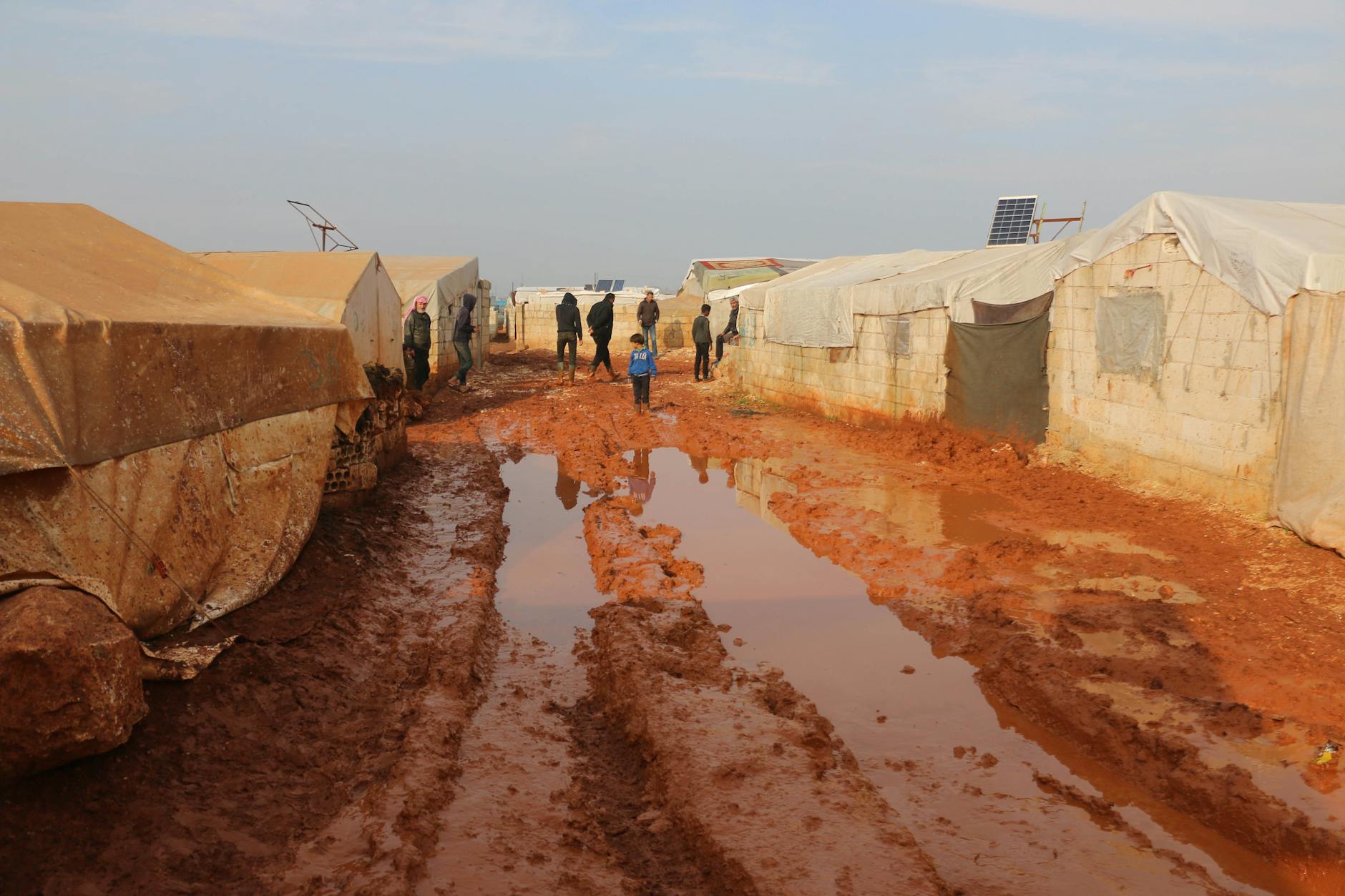
The humanitarian situation in Gaza, already catastrophic after more than two years of conflict and blockade, has deteriorated further since the joint operation began. The United Nations Office for the Coordination of Humanitarian Affairs reported that the operation displaced an additional 300,000 people in its first two weeks, on top of the roughly 1.9 million Gazans already internally displaced. Aid delivery, which had been intermittent at best, has been further disrupted by active military operations in corridors previously designated for humanitarian access. Medical infrastructure in northern Gaza, the primary zone of operations for “Roaring Lion,” has been largely nonfunctional since late 2024.
The World Health Organization reported that only two hospitals in the north maintained any operational capacity as of late February 2026, and both were operating without reliable electricity or surgical supplies. Civilian casualty figures have been difficult to verify independently due to restrictions on press access, but the Gaza Health Ministry and international organizations have reported significant civilian deaths in areas where joint operations have been concentrated. The Trump administration has framed the operation partly as humanitarian, claiming the goal is to create conditions for rebuilding and development. Critics note, however, that no concrete reconstruction plan has been published, no international reconstruction funding has been secured, and the administration’s simultaneous proposals for relocating Gaza’s population to other countries undercut the argument that the operation serves the interests of Gaza’s civilian population.
How Are U.S. Taxpayers Funding This Operation?
The financial cost of the joint operation is a point of growing political contention. The Pentagon has not released a comprehensive cost estimate, but defense analysts have projected expenditures in the range of $500 million to $1 billion per month for the U.S. component alone, based on comparable deployments and the scale of forces involved. These costs come on top of the approximately $3.8 billion in annual military aid the United States provides to Israel under the existing memorandum of understanding, plus supplemental aid packages approved by Congress in 2023 and 2024 totaling over $14 billion. The trade-off is stark when placed alongside domestic budget debates.
The administration has simultaneously proposed cuts to Medicaid, food assistance programs, and federal education funding, arguing fiscal responsibility requires difficult choices. Congressional opponents have seized on this contrast, with several pointing out that the monthly cost of the Gaza operation exceeds the annual budgets of programs being targeted for elimination. Supporters of the operation counter that national security spending and domestic programs serve different functions and should not be compared directly, though this argument has gained limited traction with voters who consistently rank domestic economic concerns above foreign military operations in polling. Israel’s costs for “Roaring Lion” are partially offset by American military aid, creating a circular funding dynamic that has drawn criticism from government accountability groups. When U.S. aid funds Israeli military operations that operate jointly with American forces, the effective cost to American taxpayers is higher than either line item suggests in isolation.
What Accountability Mechanisms Exist?
Accountability for the operation faces structural obstacles at multiple levels. The International Criminal Court, which issued arrest warrants related to the Gaza conflict in 2024, has limited enforcement capability, particularly given that neither the United States nor Israel recognizes the court’s jurisdiction. The Trump administration has actively imposed sanctions on ICC personnel, further reducing the court’s practical ability to investigate or prosecute. Domestically, congressional oversight has been hampered by partisan divisions and procedural limitations. The War Powers Act, often cited as the primary check on unauthorized military action, has never been successfully enforced against a sitting president, and legal scholars debate whether it would survive a Supreme Court challenge.
Congressional subpoena power for operational details has been resisted by the administration on national security grounds, a posture that courts have historically been reluctant to override during active military operations. Class action lawsuits and civil litigation represent another potential avenue, though with significant limitations. Several suits have been filed on behalf of Palestinian-American families with relatives affected by the operation, and consumer protection-style actions have challenged government contractors involved in the operation. However, sovereign immunity doctrines and the political question doctrine present substantial barriers. Courts are generally reluctant to second-guess military operational decisions, even when those decisions have civilian consequences that would be actionable in other contexts.
📨 Get Free Accountability Coverage Alerts
Free · No spam · Unsubscribe anytime

How Has the Operation Affected U.S. Standing Internationally?
The diplomatic fallout has been substantial and swift. Multiple U.S. allies, including the United Kingdom, France, and Germany, have issued statements ranging from cautious concern to outright opposition. The United Nations General Assembly passed a nonbinding resolution condemning the operation with 143 votes in favor, though the practical impact of such resolutions is limited.
More consequentially, several countries have recalled ambassadors or downgraded diplomatic relations, and trade negotiations with Middle Eastern and North African nations have stalled. For American businesses and consumers, the ripple effects include disrupted trade relationships, increased energy market volatility, and boycott campaigns targeting U.S. companies perceived as supporting the operation. Defense contractors have seen stock increases, but broader market indices have reflected uncertainty about the operation’s economic impact.
What Comes Next for “Roaring Lion” and the Broader Operation?
The trajectory of “Roaring Lion” depends on variables that remain genuinely uncertain — the durability of the U.S. political commitment, the Israeli coalition’s stability, the military situation on the ground, and whether legal challenges gain traction in courts. Historical precedent suggests that operations framed as short-term tend to expand in both scope and duration, and several indicators point in that direction here, including construction of permanent-looking military infrastructure and the absence of defined exit criteria.
The most consequential near-term development may be congressional action on funding. If opponents succeed in attaching conditions or restrictions to defense appropriations, or if the War Powers challenges force a formal authorization vote, the political calculus shifts significantly. Voters will have their say in the 2026 midterm elections, where the operation is already shaping primary contests in both parties. Whatever one’s position on the merits, the lack of transparent public debate before the operation began represents a democratic accountability gap that will define its legacy.
Conclusion
Israel’s branding of its participation as “Roaring Lion” is more than a name — it is a political and legal strategy designed to manage domestic audiences while participating in an operation that raises fundamental questions about international law, congressional authority, and the use of American military power and taxpayer resources. The separate branding does not create separate accountability, and the operation’s consequences for civilians, for U.S.
foreign relations, and for constitutional war-making principles will persist long after the operation itself concludes. For Americans concerned about government accountability, the most actionable steps are engaging with elected representatives on War Powers Act enforcement, following the multiple legal challenges working through federal courts, and demanding transparent accounting of the operation’s costs and outcomes. The operation’s legitimacy, both legal and democratic, remains an open question that institutions are only beginning to address.
Frequently Asked Questions
Did Congress authorize the U.S. military operation in Gaza?
No. The Trump administration has relied on existing Authorization for Use of Military Force statutes and executive authority. Multiple members of Congress have challenged this interpretation, and War Powers Act resolutions have been introduced demanding formal authorization or withdrawal.
What is the difference between the U.S. operation and Israel’s “Roaring Lion”?
Israel branded its component separately to frame it as a sovereign security operation rather than subordination to an American campaign. In practice, the operations share overlapping zones, coordinated logistics, and joint planning, making the distinction largely political rather than operational.
How much is the operation costing U.S. taxpayers?
The Pentagon has not released official figures, but defense analysts estimate the U.S. component costs between $500 million and $1 billion per month, in addition to the existing $3.8 billion annual military aid to Israel and supplemental packages exceeding $14 billion.
Can the International Criminal Court hold participants accountable?
The ICC has issued warrants related to the broader Gaza conflict, but neither the U.S. nor Israel recognizes its jurisdiction. The Trump administration has imposed sanctions on ICC personnel, further limiting the court’s practical reach.
Are there active lawsuits challenging the operation?
Yes. Multiple federal lawsuits challenge the operation’s legal authority, and civil actions have been filed on behalf of affected Palestinian-American families and against government contractors. Sovereign immunity and the political question doctrine present significant legal obstacles.
You Might Also Like
- Israel Says Saturday’s Attack Was Its Largest Aerial Operation in History
- Trump Launches Operation Epic Fury — U.S. and Israel Begin Massive Strikes Across Iran
- Pentagon Calls Operation Epic Fury “Most Lethal Aerial Operation in History”