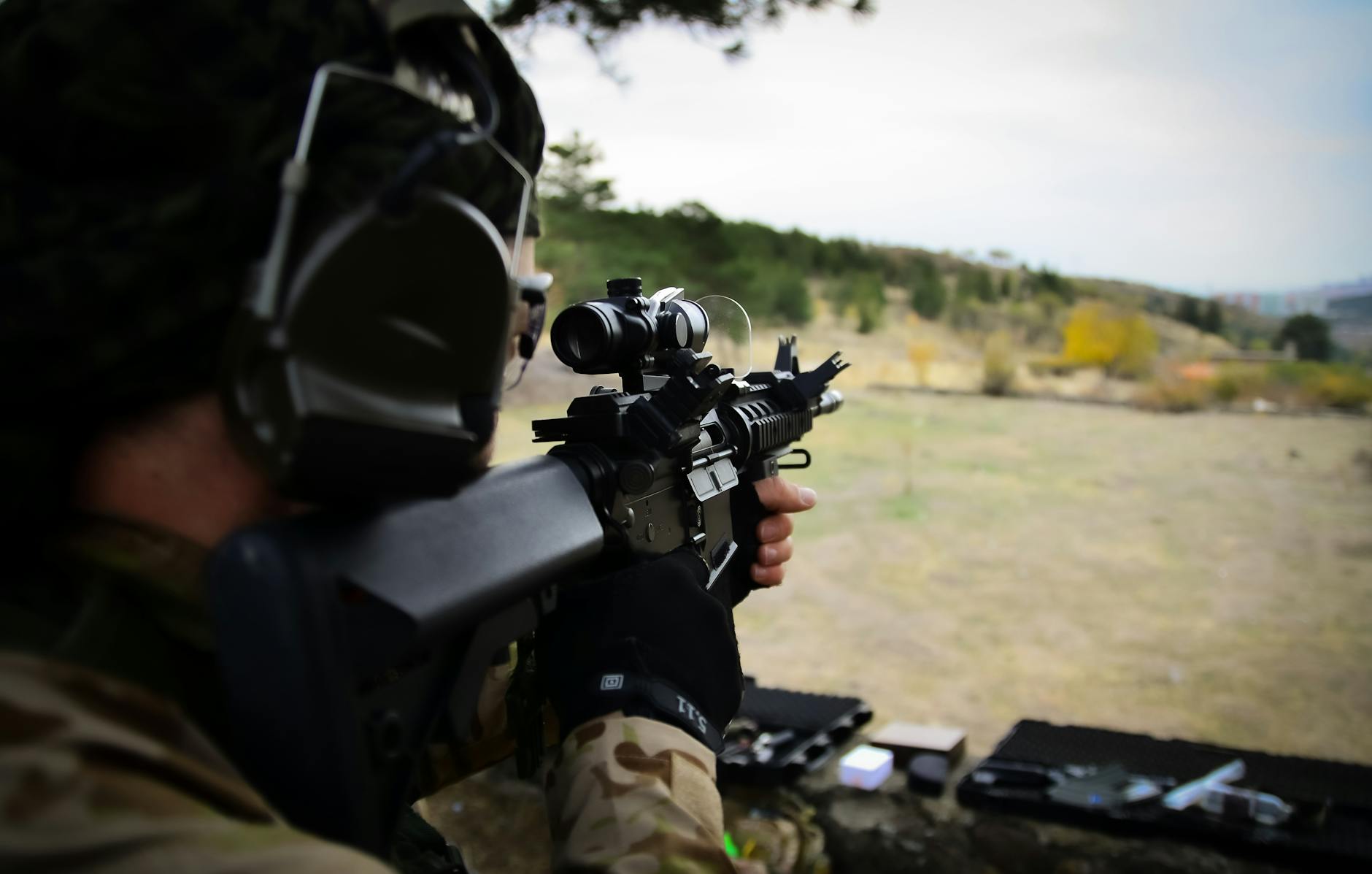
Iran’s Basij militia claims millions of members on paper, but the real question facing U.S. and Israeli military planners in March 2026 is how many of those members could actually pick up a rifle and wage an insurgency. The answer is sobering. While Iranian officials have cited figures as high as 25 million registered members, independent Western analysts estimate that between 450,000 and 600,000 are genuinely combat-capable — still a staggering number when you consider that the entire U.S. military intervention in Iraq at its peak involved roughly 170,000 troops.
The Basij, operating under the Islamic Revolutionary Guards Corps, was never designed to win a conventional war. It was designed to make occupation impossible. Since U.S.-Israeli military strikes began on February 28, 2026, the Basij’s role has shifted from morality policing and protest suppression to something far more dangerous: activating a decentralized guerrilla warfare network built over two decades. Iran has announced activation of its “mosaic defense” system, a strategy that splits command and control into 31 independent provincial units, each capable of waging its own insurgency without orders from Tehran. Even as IRGC headquarters and Basij checkpoints in Tehran have been struck and internal communications severely disrupted, the system was specifically engineered to survive exactly this kind of decapitation. This article examines the real numbers behind the Basij, how its insurgent infrastructure works, what the current conflict has revealed, and why the gap between paper membership and actual fighting capability matters enormously for what comes next.
Table of Contents
- How Many Basij Members Could Actually Fight in an Insurgency?
- How Iran’s Mosaic Defense Strategy Turns Civilians Into Combatants
- The Basij’s Three Armed Wings and What Each One Does
- Who Joins the Basij and Why It Matters for Insurgent Resilience
- What the First Two Weeks of Strikes Reveal About Basij Vulnerability
- The Basij’s Terrorist Designation and International Legal Implications
- What Comes Next — Insurgency, Collapse, or Something Else
- Conclusion
- Frequently Asked Questions
How Many Basij Members Could Actually Fight in an Insurgency?
The membership numbers surrounding the Basij are some of the most inflated and misleading figures in modern military analysis. Former Basij commander Mohammad-Reza Naqdi claimed in December 2016 that registered members numbered over 25 million. More recent Iranian sources cite 12.6 million members, including women. But those numbers include everyone who ever signed a membership card — students looking for university admission preferences, civil servants seeking job benefits, and millions of people whose involvement never went beyond filling out paperwork. The three-tier membership structure tells the real story: full-time active participants at the top, part-time volunteers who mostly report on neighbors and suspected dissent in the middle, and nominally registered members with no active involvement at the bottom. Strip away the paper members and you get to the numbers that actually matter. The IRGC’s Basij maintains approximately 90,000 regular soldiers and 300,000 reservists.
An additional layer of 300,000 to 600,000 members receive some level of military and ideological training. Compare this to Afghanistan, where roughly 60,000 Taliban fighters tied down 100,000-plus NATO troops for twenty years. Even the conservative estimate of Basij combat strength dwarfs what Western militaries faced in iraq or Afghanistan, and Iran’s population of 88 million, its mountainous terrain, and its urban density make it a fundamentally different battlefield. The distinction between claimed and actual strength matters because it shapes policy decisions. If hawks in Washington look at 25 million and conclude that regime change would face impossible resistance, they may pursue different strategies. If they look at 450,000 and assume the force is manageable, they may underestimate the resilience of a decentralized insurgent network that operates out of at least 47,000 bases throughout the country — roughly one for every 1,900 Iranians.

How Iran’s Mosaic Defense Strategy Turns Civilians Into Combatants
In 2005, General Mohammad Jafari restructured the irgc around a concept called “mosaic defense.” The idea was straightforward but radical: instead of concentrating military power in a centralized command structure that could be destroyed with precision strikes, Iran would distribute military capability across 31 separate provincial commands, each operating semi-independently. Local commanders were given broad freedom of action to execute objectives without real-time central oversight. The strategy was specifically designed to survive the kind of shock-and-awe campaign that dismantled Saddam Hussein’s military in weeks. What makes mosaic defense particularly difficult to counter is that it “socializes” warfare. The military structure is woven into civilian structures at the provincial level. Fighters defend their own neighborhoods and cities — places they know intimately, where they have family, social networks, and local intelligence that no foreign force could replicate. Each city is divided into “resistance areas,” subdivided into resistance zones, then resistance bases, then small groups.
This granular organization means that even if an entire provincial command is wiped out, the neighborhood-level cells can continue operating. It is, in essence, a pre-built insurgency waiting to be activated. However, this strategy has a critical limitation that is now being tested in real time. Decentralized command works well when morale is high and the cause feels worth fighting for. But after approximately two weeks of U.S.-Israeli strikes, reports indicate organizational disorder within the IRGC, with many forces described as exhausted and without secure bases. Mosaic defense assumes fighters will keep fighting without orders from above. Whether that assumption holds when the regime itself appears to be fracturing is the open question of this war.
The Basij’s Three Armed Wings and What Each One Does
The Basij is not a single monolithic force. It operates through three main armed wings, each with a distinct mission. The Ashoura Brigades (male) and Al-Zahra Brigades (female) handle security and military functions at the neighborhood level — they are the local defense units that would form the backbone of any urban insurgency. These brigades know their territories block by block and have spent years building intelligence networks within their communities. The third wing, the Imam Hossein Brigades, consists of war veterans who cooperate directly with IRGC ground forces and represent the most conventionally capable element of the Basij. For context, consider how these units operated during the 2022 Mahsa Amini protests.
Basij members in civilian clothes deployed through their neighborhood networks to identify, track, and suppress protesters. They used their intimate knowledge of local geography and social networks to conduct operations that conventional security forces could not. That same capability — identifying threats, moving undetected through familiar terrain, operating without uniforms or obvious military presence — is exactly what makes an effective insurgent force. The infrastructure that crushed domestic protests is the same infrastructure that could wage asymmetric warfare against an occupying army. Military analysts have assessed that in a worst-case scenario, the IRGC and Basij could transform into what has been described as a “ghost proxy,” retreating into Iran’s mountainous regions or across the Iraqi border for prolonged guerrilla warfare. The IRGC was built from the start as a parallel force designed for exactly this kind of irregular warfare. Some analysts predict any final stand could involve weeks or months of armed urban conflict — what regime loyalists might frame as their “Karbala moment,” a reference to the Shia martyrdom narrative that has defined the Islamic Republic’s ideology since 1979.

Who Joins the Basij and Why It Matters for Insurgent Resilience
Understanding who actually fills the Basij’s ranks is essential to predicting whether its members would fight in an insurgency or melt away. Members are predominantly young, working-class men drawn from traditionally Shia loyalist segments of Iranian society. Many volunteer not out of deep ideological commitment but in exchange for tangible benefits: preferential university admissions, government job preferences, and social status in conservative communities. This creates a force with a wide spectrum of motivation — from true believers who would fight to the death, to opportunists who joined for a tuition break. This mix presents a genuine tradeoff for military planners. On one hand, the opportunistic members are unlikely to wage guerrilla warfare when the personal costs outweigh the benefits, and the collapse of the state that provides those benefits could dissolve their loyalty overnight.
The 2022 protests showed that many young Iranians, including some from demographics that traditionally supplied Basij recruits, were willing to turn against the regime. On the other hand, the ideologically committed core — those who genuinely believe in velayat-e faqih (guardianship of the jurist) and view resistance as a religious duty — are exactly the kind of fighters who sustain insurgencies for years. Even if only ten percent of the 450,000 combat-capable members fall into this category, that is 45,000 dedicated insurgents in a country with terrain that favors guerrilla warfare. The comparison to Iraq’s de-Baathification is instructive. When the U.S. disbanded the Iraqi military and banned Baath Party members from government jobs in 2003, it created a pool of hundreds of thousands of angry, trained, unemployed men who had every incentive to join the insurgency. The Basij presents a similar risk: a large paramilitary force whose members face loss of status, benefits, and possibly prosecution under any post-regime government.
What the First Two Weeks of Strikes Reveal About Basij Vulnerability
The U.S.-Israeli strikes that began on February 28, 2026, have provided the first real-world test of the Basij’s resilience. Israel’s military struck Basij checkpoints in Tehran and several central IRGC/Basij headquarters as part of a broader campaign targeting nuclear facilities and ballistic missile sites. The initial results suggest that the conventional, visible elements of the Basij — headquarters buildings, established checkpoints, known command nodes — are as vulnerable to precision strikes as any other fixed military target. But here is the critical warning: destroying the Basij’s visible infrastructure may actually accelerate its transition into an insurgent force rather than defeating it. The mosaic defense strategy was designed for precisely this scenario.
When central communications are severed and headquarters are rubble, local commanders are expected to act independently. After approximately two weeks of conflict, signs of organizational disorder are visible, with many forces described as exhausted and without secure bases. Whether this represents the beginning of the Basij’s collapse or merely the messy transitional phase between conventional defense and guerrilla insurgency will not be clear for weeks or possibly months. The limitation that Western analysts consistently flag is that airpower alone cannot defeat a decentralized paramilitary embedded in a civilian population of 88 million. The Basij’s 47,000 bases are not military installations in the traditional sense — many are rooms in mosques, community centers, and private homes. Striking them means striking civilian infrastructure in densely populated areas, with all the political and humanitarian consequences that follow.

The Basij’s Terrorist Designation and International Legal Implications
The Basij is indirectly designated as a terrorist organization by the United States, the European Union, Bahrain, and Saudi Arabia, through its formal status as a component of the IRGC. This designation has practical consequences beyond symbolism. It means that any post-conflict negotiation involving Basij members — whether amnesty deals, disarmament agreements, or reintegration programs — runs into legal barriers in multiple jurisdictions. For comparison, Colombia’s peace process with the FARC required years of legal innovation to allow former fighters to participate in society without facing terrorism charges.
📨 Get Free Accountability Coverage Alerts
Free · No spam · Unsubscribe anytime
Any similar process in Iran would be exponentially more complex given the number of countries that have designated the IRGC. This legal reality creates a perverse incentive. If Basij members believe they face prosecution or permanent exclusion from any future Iranian government regardless of whether they lay down arms, they have little reason to stop fighting. Effective counterinsurgency has historically required some path back to civilian life for rank-and-file fighters, and the blanket terrorist designation complicates that path considerably.
What Comes Next — Insurgency, Collapse, or Something Else
The next several weeks will determine whether the Basij becomes the insurgent force that military analysts have long warned about or whether it fragments under pressure. The historical pattern is not encouraging for those hoping for a clean resolution. Iran is significantly larger, more populated, and more mountainous than either Iraq or Afghanistan. Its paramilitary infrastructure is more deeply embedded in civilian society than anything the U.S.
military has faced. And the Shia martyrdom narrative that undergirds Basij ideology provides a ready-made framework for framing prolonged resistance as a sacred duty rather than a losing cause. The most likely outcome, based on available evidence, is neither total Basij mobilization nor total collapse, but something in between: a fragmented force where some units dissolve as members go home, some units continue conventional resistance until they are destroyed, and some units — particularly those led by ideologically committed commanders in favorable terrain — transition into a genuine insurgency that could persist for years. Iran’s announcement that it has activated its mosaic defense system suggests the regime is already planning for this scenario. Whether the United States and Israel are equally prepared for a protracted, decentralized conflict across a country of 88 million people is the question that will define this war’s legacy.
Conclusion
Iran’s Basij militia is both less and more dangerous than its headline membership numbers suggest. The 25 million figure is propaganda; the 12.6 million figure counts mostly inactive cardholders. But the 450,000 to 600,000 combat-capable members, operating through 47,000 bases in a decentralized command structure specifically designed to survive decapitation strikes, represent a genuine insurgent threat that dwarfs what Western forces faced in Iraq or Afghanistan.
The mosaic defense strategy, the deeply localized command structure, and the ideological framework that frames resistance as religious duty all point toward a force that could sustain asymmetric warfare long after conventional military operations end. The early weeks of the 2026 strikes have damaged the Basij’s visible infrastructure and disrupted its communications, but they have not yet answered the fundamental question: how many Basij members will actually fight when the costs become real? The gap between paper strength and genuine combat capability will be closed not by analysts’ estimates but by events on the ground. What is clear is that any strategy premised on the assumption that the Basij will simply dissolve under pressure is not supported by the organization’s design, its two-decade preparation for exactly this scenario, or the historical record of what happens when large paramilitary forces are left with no path back to civilian life.
Frequently Asked Questions
How many members does the Basij actually have?
Iranian officials have claimed between 12.6 million and 25 million registered members. However, independent Western analysts estimate only 450,000 to 600,000 are combat-capable. The IRGC’s Basij maintains approximately 90,000 regular soldiers and 300,000 reservists. The vast majority of registered members are nominal participants who signed up for social benefits like university admissions preferences.
Is the Basij considered a terrorist organization?
The Basij is indirectly designated as a terrorist organization by the United States, the European Union, Bahrain, and Saudi Arabia through its status as a component of the IRGC. This designation affects legal options for post-conflict amnesty or reintegration of former fighters.
What is Iran’s mosaic defense strategy?
Adopted in 2005 under General Mohammad Jafari, mosaic defense is a decentralized command-and-control system that divides Iran’s military structure into 31 independent provincial commands. Each command can operate and launch insurgency operations without central oversight, and the military structure is woven into civilian communities at the neighborhood level. The strategy was specifically designed to survive strikes on central command.
Could the Basij sustain a long-term insurgency against U.S. and Israeli forces?
Military analysts assess that the IRGC and Basij could transform into a prolonged guerrilla warfare force, potentially retreating into Iran’s mountainous regions or across the Iraqi border. The decentralized structure, local territorial knowledge, and ideological motivation of core members all favor sustained insurgent operations. However, the actual durability of such an insurgency depends on how many members are willing to fight versus how many abandon the organization under pressure.
What happened to the Basij in the first weeks of the 2026 strikes?
U.S.-Israeli strikes beginning February 28, 2026, targeted IRGC and Basij headquarters and checkpoints in Tehran. After approximately two weeks, IRGC internal communications were severely disrupted, with visible organizational disorder and many forces described as exhausted and without secure bases. Iran responded by announcing activation of its mosaic defense system.
Who joins the Basij and why?
Members are predominantly young, working-class men from Shia loyalist communities who volunteer in exchange for benefits including preferential university admissions and government job preferences. Motivation ranges from deep ideological commitment to the Islamic Republic to purely transactional participation for personal advancement.
You Might Also Like
- Iran’s Road and Rail Network Could Be Used by Insurgent Forces for Years
- The Vote Will Be Symbolic — But Forcing Members on the Record Matters for Accountability
- The Plausible Deniability Around Who Killed Khamenei Is Deliberate Strategy