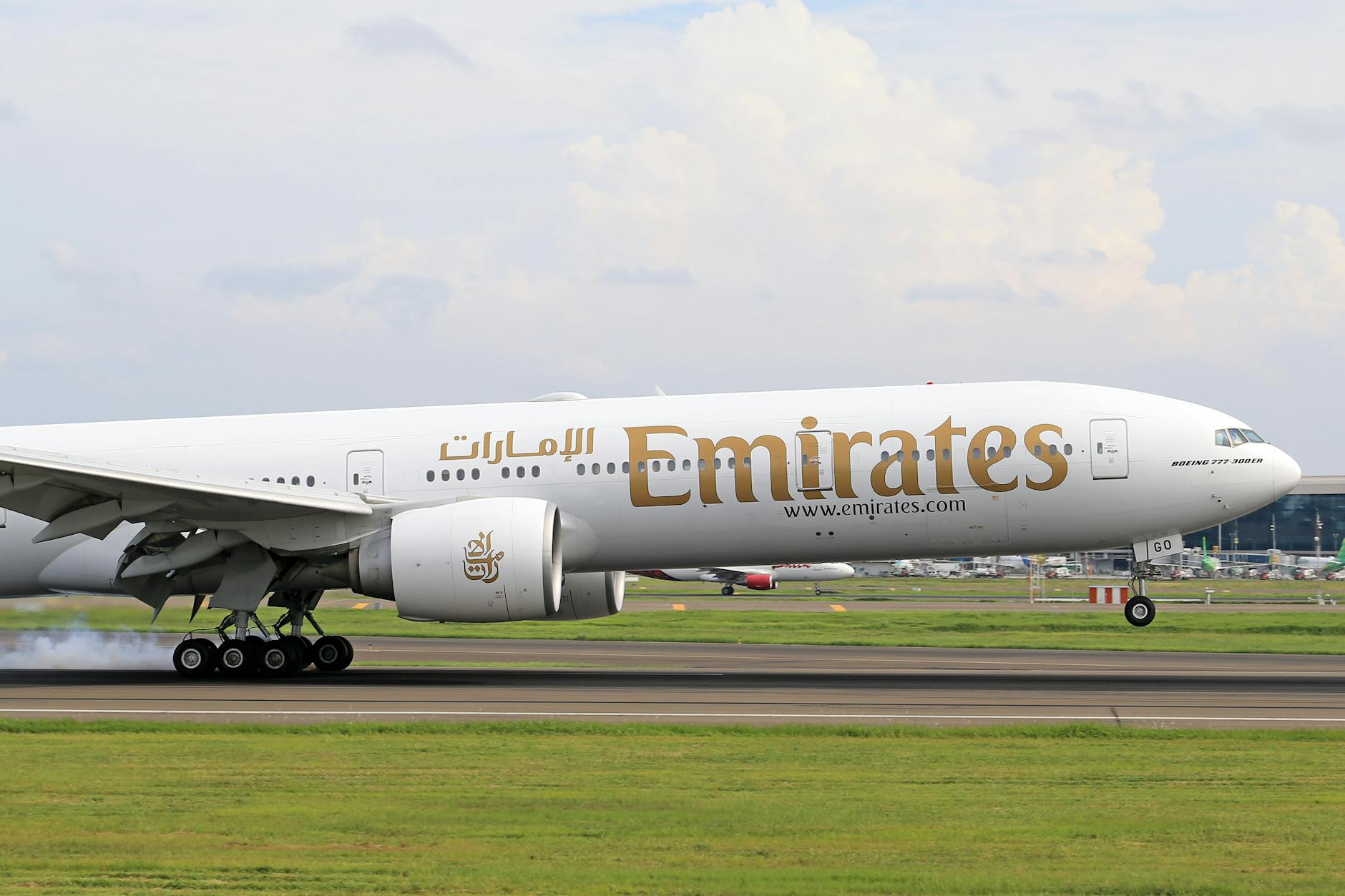
On February 28, 2026, Iran launched a massive retaliatory strike against multiple Gulf Arab states, hitting Dubai International Airport — the world’s busiest hub for international passenger traffic — with missiles and drones that sent passengers fleeing through smoke-filled corridors strewn with debris. Kuwait International Airport was also struck, and within hours, civilian aviation across the entire region ground to a halt. As of March 1, over 3,400 flights have been canceled across seven Middle Eastern airports, with global ripple effects delaying more than 19,000 additional flights worldwide.
The Iranian attacks came in direct response to joint U.S.-Israeli strikes on Iran that included the assassination of Supreme Leader Ali Khamenei. Tehran retaliated not only against Israel but against the UAE, Bahrain, Kuwait, and Qatar — all of which host American military installations. The result is the most significant disruption to Gulf aviation since the region emerged as a global transit hub, with Emirates, Etihad Airways, and Qatar Airways all suspending operations indefinitely. This article examines the scope of the airport attacks, the scale of flight disruptions, casualty figures, airspace closures across at least six nations, and what this means for tens of thousands of stranded travelers.
Table of Contents
- How Severe Were Iran’s Attacks on Dubai and Kuwait Airports?
- What Flights Are Canceled and How Long Will Disruptions Last?
- Which Countries Have Closed Their Airspace?
- What Are the Casualty Numbers and Who Is Most Affected?
- What Triggered This Escalation and Could It Have Been Avoided?
- How Are Insurance and Compensation Claims Likely to Play Out?
- What Comes Next for Gulf Aviation and Regional Stability?
- Conclusion
- Frequently Asked Questions
How Severe Were Iran’s Attacks on Dubai and Kuwait Airports?
The scale of iran‘s assault on Gulf aviation infrastructure was staggering. Iran fired 137 missiles and 209 drones at the UAE alone, according to the UAE Ministry of Defence. Dubai International Airport took direct hits, with four airport staff confirmed injured in the initial strike. Footage circulating on social media and verified by CNN showed passengers running through a passageway choked with smoke and littered with ceiling tiles and shattered glass. Fires and smoke reached iconic Dubai landmarks including Palm Jumeirah and Burj Al Arab, underscoring just how close the strikes came to densely populated civilian areas.
Abu Dhabi’s Zayed International Airport was hit by a separate drone strike that killed one person and injured seven others. Kuwait fared somewhat better in terms of direct damage, thanks to its air defense systems intercepting 97 ballistic missiles and 283 drones, but the airport was still hit. Kuwaiti authorities reported one person killed and more than 30 injured, all of them foreign nationals — a grim reminder that the Gulf’s massive expatriate workforce bears outsized risk in these conflicts. To put this in perspective, the combined volume of Iranian munitions launched at the UAE alone exceeded the scale of Iran’s April 2024 direct attack on Israel, which involved roughly 300 missiles and drones. The difference this time is that the targets were civilian commercial airports, not military installations, raising immediate questions about whether Tehran deliberately targeted aviation infrastructure or whether these were collateral hits on dual-use facilities near military bases.

What Flights Are Canceled and How Long Will Disruptions Last?
The flight cancellation numbers are severe and growing. Flightradar24 data shows over 3,400 flights canceled on Sunday, March 1, across seven Middle Eastern airports. Globally, FlightAware and Euronews reported more than 19,000 flights delayed and 2,280 canceled as the cascading effects rippled through international route networks. Emirates, the world’s largest international airline by passenger kilometers, suspended all flights indefinitely — a move without precedent in the carrier’s history. Etihad Airways extended its cancellations through at least 2 AM Monday, and Qatar Airways halted all operations with an update expected at 9 AM Monday. However, if you are a traveler currently booked on flights through the Gulf, the situation is fluid enough that “indefinitely” may not mean weeks.
Airlines in the region have historically resumed operations quickly after security events — but those prior disruptions were nothing like this. The physical damage to dubai International Airport’s infrastructure means that even if hostilities cease immediately, runway inspections, terminal repairs, and safety certifications will take time. Travelers rerouting through airports in Turkey, India, or East Africa should expect those hubs to be overwhelmed with displaced demand for days. The key hub airports in Dubai, Abu Dhabi, and Doha are all currently closed. For context, Dubai alone handled over 87 million passengers in 2024. Even a 48-hour closure would strand hundreds of thousands of people and disrupt cargo shipments worth billions of dollars, given that the Gulf airports serve as critical logistics nodes for trade between Asia, Europe, and Africa.
Which Countries Have Closed Their Airspace?
At least six nations — Iran, Iraq, Kuwait, Israel, Bahrain, and Qatar — have fully closed their airspaces as of March 1. Neighboring countries have implemented additional restrictions, effectively creating a no-fly zone stretching from the eastern Mediterranean to the Persian Gulf. This is the broadest airspace closure in the Middle East since the early days of the 2003 Iraq invasion, and it affects not just regional flights but every long-haul route that normally transits the area. For example, the heavily trafficked corridor between Europe and South/Southeast Asia funnels through Iraqi and iranian airspace.
Airlines like Lufthansa, British Airways, and Singapore Airlines that operate dozens of daily flights on these routes now face the choice of rerouting south over the Red Sea and around the Arabian Peninsula — adding hours of flight time and fuel costs — or canceling outright. During past Iranian escalations, reroutes alone added two to four hours per flight, costing carriers tens of thousands of dollars in additional fuel per trip. Multiply that across thousands of daily flights and the economic toll mounts fast. The airspace closures also raise a practical safety issue that is easy to overlook: search and rescue operations, medical evacuation flights, and humanitarian corridors are all affected. Injured civilians in Kuwait and the UAE may face delayed access to specialized medical care if aeromedical transport is grounded.
What Are the Casualty Numbers and Who Is Most Affected?
The human cost extends well beyond airport workers and airline passengers. As of March 1, the UAE reported three foreign nationals killed and 58 injured from Iranian attacks. Kuwait confirmed one killed and more than 30 injured, again all foreign nationals. In Israel, an Iranian ballistic missile struck Beit Shemesh, killing eight people and injuring approximately 20. These numbers are expected to rise as rescue operations continue and damaged structures are searched. The repeated emphasis on “foreign nationals” among Gulf casualties is significant and worth pausing on.
The UAE’s population is roughly 90 percent expatriate — workers from South Asia, Southeast Asia, and Africa who staff everything from airport operations to construction to healthcare. Kuwait’s demographics are similarly skewed. These are people who came to the Gulf for economic opportunity and who have no embassies equipped to handle mass casualty evacuation scenarios. Their home governments — India, Pakistan, the Philippines, Bangladesh — are now scrambling to account for citizens and arrange potential evacuations, but with airports closed, options are limited. Compare this to the April 2024 Iranian attack on Israel, where the Iron Dome and allied air defenses intercepted the vast majority of incoming projectiles and casualties were minimal. Kuwait’s interception of 97 ballistic missiles and 283 drones is impressive, but the sheer volume of munitions meant that even a small percentage getting through caused real damage and real deaths.
What Triggered This Escalation and Could It Have Been Avoided?
The immediate trigger was the joint U.S.-Israeli strike on Iran on February 28, 2026, which included the targeted killing of Supreme Leader Ali Khamenei. This was not a limited strike on a nuclear facility or a proxy militia — it was a decapitation attack on the head of state of a sovereign nation. Iran’s retaliatory calculus was therefore fundamentally different from prior rounds of tit-for-tat exchanges. Tehran struck not just Israel but every Gulf state hosting American military assets, making an explicit strategic choice to impose costs on countries that facilitate U.S. force projection. The limitation of the current analysis is that we do not yet know whether Iran specifically intended to hit civilian airport terminals or whether the strikes were aimed at nearby military installations and the airports suffered collateral damage.
This distinction matters enormously for international law, for insurance claims, and for how Gulf states calibrate their own responses. What is clear is that the Gulf Cooperation Council states — particularly the UAE and Qatar — have spent decades building their economies around aviation connectivity. Hitting their airports is hitting the foundation of their economic model, and Iran almost certainly understood that. A warning for those watching this unfold and assuming quick de-escalation: the assassination of a supreme leader is not the kind of provocation that produces a single retaliatory salvo and then quiet. Iran’s political system is in unprecedented territory, and the decision-making process for further strikes is genuinely uncertain. Travelers and businesses should plan for extended disruptions, not a 48-hour blip.
📨 Get Free Accountability Coverage Alerts
Free · No spam · Unsubscribe anytime

How Are Insurance and Compensation Claims Likely to Play Out?
For the thousands of travelers stranded by cancellations, the compensation picture is murky. Most airline tickets include force majeure or “act of war” clauses that exempt carriers from the kind of compensation required under, say, EU Regulation 261/2004 for ordinary delays and cancellations. Emirates, Etihad, and Qatar Airways will almost certainly invoke these provisions. Travelers with comprehensive travel insurance may fare better, but many standard policies also exclude acts of war — read your policy language carefully before filing.
The larger insurance question involves the airports and airlines themselves. Aviation war-risk insurance premiums for Gulf carriers had already spiked after prior Iran-Israel tensions. The physical destruction at Dubai International and Zayed International will trigger massive claims, and reinsurers will reassess coverage terms for the entire region. If premiums become prohibitive, smaller Gulf carriers could face existential financial pressure even after flights resume.
What Comes Next for Gulf Aviation and Regional Stability?
The Gulf states have spent the better part of two decades positioning themselves as indispensable nodes in global aviation. Dubai, Abu Dhabi, and Doha invested hundreds of billions of dollars in airport infrastructure, national carriers, and tourism ecosystems predicated on geopolitical stability and open airspace. That thesis has now been tested in the most dramatic way possible. Even after the immediate crisis passes and flights resume, the reputational damage will linger in the form of reduced passenger confidence, higher insurance costs, and a forced reckoning with the vulnerability of these assets to missile and drone attacks.
Looking forward, the Gulf states face a strategic dilemma. Hosting U.S. military bases has provided a security umbrella for decades, but it now also makes them explicit targets in a U.S.-Iran conflict they did not initiate. Qatar, the UAE, and Kuwait will face domestic and international pressure to reconsider basing arrangements — or at minimum, to demand more robust integrated air defense systems as the price of continued cooperation. For global travelers and the aviation industry, the lesson is stark: the world’s most important airline hub is also one of its most geopolitically exposed.
Conclusion
Iran’s retaliatory strikes on Gulf airports represent the most significant disruption to global aviation in years, with over 3,400 flights canceled regionally, 19,000 delayed worldwide, and the world’s three largest Gulf carriers — Emirates, Etihad, and Qatar Airways — all suspending operations. The human toll, with multiple deaths and dozens of injuries across the UAE, Kuwait, and Israel, underscores the reality that civilian infrastructure in the Gulf is not insulated from the region’s military conflicts. For stranded travelers, the immediate priority is monitoring airline communications and understanding that force majeure provisions will likely limit compensation options.
For the broader public, this crisis raises fundamental questions about the sustainability of the Gulf aviation model in an era of great-power conflict. The airports will reopen. The flights will resume. But the assumption that Dubai, Doha, and Abu Dhabi could serve as the world’s crossroads while sitting in the middle of the world’s most volatile region has been permanently shaken.
Frequently Asked Questions
Are any flights still operating out of Dubai International Airport?
No. As of March 1, 2026, Dubai International Airport is closed and Emirates has suspended all flights indefinitely. There is no announced reopening timeline.
Will I get a refund for my canceled Emirates or Qatar Airways flight?
Airlines are likely to invoke force majeure or act-of-war clauses, which may limit them to rebooking rather than cash refunds. Check your specific ticket terms and travel insurance policy for war exclusion clauses.
Which Middle Eastern airports are still open?
As of March 1, airports in Iran, Iraq, Kuwait, Israel, Bahrain, Qatar, and the UAE are either closed or operating under severe restrictions. Airports in Turkey, Jordan, Oman, and Saudi Arabia may still be operational but are experiencing heavy congestion from rerouted traffic.
How many people have been killed in the Gulf attacks?
As of March 1, the UAE reported 3 foreign nationals killed and 58 injured. Kuwait reported 1 killed and more than 30 injured. In Israel, 8 were killed and approximately 20 injured in a strike on Beit Shemesh. Casualty figures are expected to change as rescue efforts continue.
Is it safe to travel to the Middle East right now?
Multiple governments have issued travel advisories against nonessential travel to the Gulf region. With six nations’ airspaces closed and active military hostilities ongoing, travel to or through the region carries significant risk. Travelers should monitor their government’s consular advisories and avoid booking new travel until the situation stabilizes.
You Might Also Like
- Trump Launches Operation Epic Fury — U.S. and Israel Begin Massive Strikes Across Iran
- Trump Says He’s “Considering” Limited Strike on Iran Soon
- Trump Announced the Iran War on TruthSocial at 2 AM — No Address to Congress