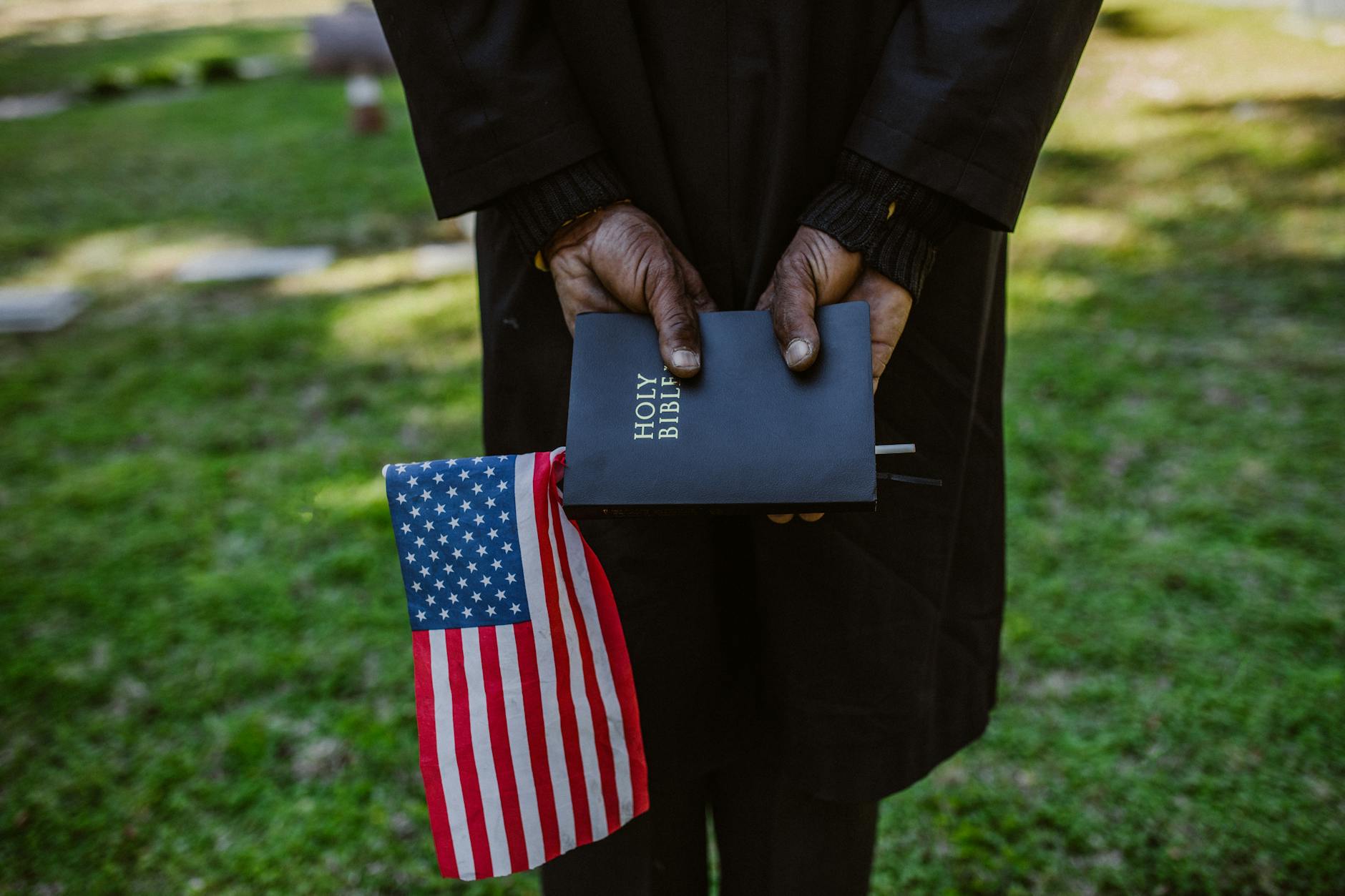
There is growing evidence that MAGA—the political movement centered on Donald Trump and his policy agenda—has developed characteristics that extend beyond traditional political organizing. While MAGA remains fundamentally a political movement with electoral and policy goals, it has acquired several attributes traditionally associated with religious movements: unwavering devotion to a central figure, a simplified moral worldview that divides followers and non-followers, ritual gatherings, and a narrative structure that positions believers as righteous and opponents as spiritually corrupt. The clearest example is the transformation of Trump rallies from standard campaign events into quasi-religious gatherings where Trump functions less as a candidate and more as a spiritual authority, with adherents traveling across states and waiting in line for hours much like religious pilgrims.
The distinction between a political movement and a religious movement is becoming increasingly blurred in American discourse. Sociologists and political analysts have identified that MAGA exhibits what Max Weber called “charismatic authority”—power derived from the perceived exceptional qualities of a leader rather than from institutions or legal frameworks. This differs from typical political movements, which tend to organize around ideas, parties, or policy platforms that can survive the departure or death of any single leader. The question is not whether MAGA is entirely a religion, but rather whether it has become a hybrid form of political organization that functions psychologically and socially like religion for many of its adherents.
Table of Contents
- How Does MAGA Function as a Belief System Rather Than a Policy Platform?
- The Role of Ritual and Community in MAGA’s Religious Characteristics
- The Demonization of Non-Believers in MAGA Theology
- Electoral Strategy Versus Spiritual Commitment—Where MAGA Differs From Pure Religion
- The Question of Voluntary Membership and Unquestioning Loyalty
- The Apocalyptic Dimension of MAGA Theology
- The Future of MAGA as a Religious-Political Hybrid
- Conclusion
How Does MAGA Function as a Belief System Rather Than a Policy Platform?
Traditional political movements are typically organized around specific policies or governance philosophies. The Republican Party, for example, has a platform that includes tax policy positions, trade policy, and regulatory frameworks that exist independently of any single leader. MAGA, by contrast, operates as a belief system that centers almost entirely on Trump’s character and worldview. When Trump changes positions—as he has on trade, military intervention, or spending—supporters follow rather than objecting based on policy consistency.
This pattern suggests that MAGA followers are pledging allegiance to Trump as a figure rather than to a coherent political philosophy. This is evident in how MAGA supporters interpret Trump’s statements. When Trump claimed without evidence that the 2020 election was stolen, the belief spread rapidly through MAGA communities not because evidence was presented, but because Trump stated it. The January 6, 2021 Capitol riot represented a moment when the movement’s religious character became impossible to ignore—supporters viewed storming the Capitol as a righteous act demanded by their leader, comparable to how some religious groups interpret divine commandments. The allegiance transcended legality and institutional respect, which are typically central to political movements even when they are oppositional.

The Role of Ritual and Community in MAGA’s Religious Characteristics
Religious movements are defined partly by their use of ritual—repeated practices that reinforce community identity and belief. maga has developed an elaborate ritual structure around Trump rallies, which occur with remarkable frequency and follow a consistent pattern: supporters gather hours early, wear movement apparel and symbols (hats, pins, clothing), engage in group chanting and singing, and experience Trump’s presence as transcendent. The rituals function identically to religious gatherings, creating emotional intensity and social bonding that goes far beyond standard political organizing. However, there is an important limitation to the religious comparison: MAGA still primarily organizes around electoral goals rather than theological or spiritual doctrines.
The movement supports candidates, funds campaigns, and participates in voting—outcomes that are measured in offices won and laws passed. This distinguishes MAGA from purely religious movements, which may be indifferent to electoral outcomes. Yet the hybrid nature is the problem: MAGA combines religious-style devotion with political ambitions, creating a movement whose participants experience politics as a spiritual undertaking. This creates psychological stakes that make ordinary political compromise feel like spiritual betrayal. When Republican politicians refuse to follow Trump, MAGA supporters view it not as a policy disagreement but as a loss of faith.
The Demonization of Non-Believers in MAGA Theology
Religious worldviews typically divide the world into the righteous and the unrighteous. MAGA has developed a sophisticated mythology of good and evil that functions theologically. The “deep state” becomes a demonic force conspiring against Trump. The mainstream media becomes the priestly class of a false religion.
Opponents of Trump aren’t simply political rivals—they are portrayed as existentially dangerous, corrupt, or demonic. This Manichean worldview is characteristic of religious movements, not political ones. A specific example is the QAnon conspiracy theory, which originated within MAGA communities and became a quasi-religious belief system predicting that Trump would expose a vast pedophilia ring run by Democratic elites. While QAnon remained fringe within the broader movement, it demonstrates how MAGA’s theological infrastructure—the division of the world into righteous Trump followers and corrupt elites—creates fertile ground for conspiracy theories that function like religious prophecy. Even MAGA supporters who reject QAnon’s specific claims share its underlying theological structure: a belief in Trump’s special knowledge, in hidden corruption among opponents, and in Trump’s eventual vindication.
Electoral Strategy Versus Spiritual Commitment—Where MAGA Differs From Pure Religion
The critical difference between MAGA and actual religious movements is that MAGA has electoral and policy objectives. A church doesn’t depend on winning elections to validate its existence; it exists to provide spiritual meaning and community. MAGA, however, is organized partly around winning power through voting. This means that MAGA cannot fully detach from political outcomes.
When Trump lost the 2020 election, the movement faced a theological crisis—how could a figure portrayed as chosen or destined lose? The movement’s response, claiming election fraud, demonstrates both its religious character and its continued need for political validation. The tradeoff is significant: by maintaining electoral ambitions, MAGA retains political relevance and power, but this also exposes its followers to repeated cycles of disappointment. A purely religious movement could continue indefinitely regardless of worldly outcomes; MAGA must periodically confront electoral reality. This is why the claims of election fraud were so important psychologically—they allowed followers to maintain faith in Trump’s destined power despite a measurable political loss.
📨 Get Free Accountability Coverage Alerts
Free · No spam · Unsubscribe anytime
The Question of Voluntary Membership and Unquestioning Loyalty
A crucial characteristic of religious movements is that membership typically involves some degree of subordination of individual judgment to collective belief. Within MAGA communities, there is intense pressure toward orthodoxy. Those who express doubts about Trump or his statements face social ostracism within MAGA circles. This enforcement of conformity is distinctly religious in character—it treats deviation from Trump loyalty as spiritual weakness or betrayal.
However, MAGA also demonstrates a significant limitation as a religion: it lacks formal membership or initiation. People can identify as MAGA supporters and also maintain critical distance from some Trump positions. This fluidity distinguishes it from traditional religions, which typically have clearer boundaries and more formal commitment structures. Yet the warning is important: for the most dedicated segments of MAGA—roughly 20-30% of Republicans who express absolute loyalty to Trump—the psychological and social functions are identical to those of religious movements. These followers prioritize loyalty to Trump over party loyalty, media trust, or institutional respect, which is precisely how religious adherents prioritize faith over institutional alternative sources of authority.

The Apocalyptic Dimension of MAGA Theology
Many religious movements are organized around apocalyptic narratives—beliefs that the world is approaching a final judgment or transformation. MAGA has increasingly developed an apocalyptic narrative structure: that American civilization is under threat from corruption, moral decay, and conspiracy, and that only Trump can prevent catastrophe. This narrative structure functions theologically to explain why compromise is impossible and why opposition must be absolute.
You do not negotiate with the forces of apocalyptic evil. The specific example of Trump’s claims about the 2020 election illustrates this apocalyptic character. When Trump asserted that the election was “stolen,” he was not making a falsifiable political claim; he was positioning himself as the sole figure who could restore order to a corrupted system. This narrative allows followers to interpret defeats as temporary setbacks in an ultimate cosmic struggle rather than as indicators that their movement lacks political support.
The Future of MAGA as a Religious-Political Hybrid
The critical question looking forward is whether MAGA can survive as a movement when divorced from Trump’s personal leadership. Religious movements often face crises when their founders die or lose authority; the movement must either establish formal institutions and doctrines that transcend the founder, or it must decline. For MAGA, Trump’s age and the succession question present a genuine test.
If MAGA followers are truly pledging allegiance to Trump as a person rather than to coherent political principles, the movement may fracture upon his exit. Alternatively, MAGA could crystallize into a more formal political faction within the Republican Party with specific policy positions and institutional structures. The trajectory suggests that MAGA will continue to function as a religious-political hybrid rather than resolving into one category or the other. This is unprecedented in American politics—previous political movements have either remained fundamentally political (organized around parties and policies) or become religious (organized around faith and theology), but MAGA maintains both dimensions simultaneously, which creates internal tensions that will shape American politics for years to come.
Conclusion
MAGA is becoming a religion in the sense that for many adherents, it functions psychologically and socially as religion does: it provides a comprehensive moral worldview, creates community and ritual, centers on devotion to an authority figure, divides the world into righteous and corrupt, and makes demands for loyalty that supersede institutional or legal constraints. However, MAGA remains politically functional in ways that pure religious movements are not—it participates in electoral politics, funds candidates, and organizes around specific policy objectives. This hybrid character is what makes MAGA distinctive and worth analyzing carefully.
The implications are significant for American institutions. Political movements that retain the psychological intensity and orthodoxy enforcement of religions while pursuing electoral power can generate both intense loyalty and, potentially, violent resistance when that power is denied. Understanding whether MAGA is becoming a religion is not merely an academic question—it shapes how political observers interpret MAGA followers’ behavior and how institutions respond to movements that combine political ambition with religious-style absolutism.
You Might Also Like
- Did MAGA Peak Too Early for 2028?
- Would Jesus Support Trump Style Politics?
- Why MAHA Is Confusing Voters Across America