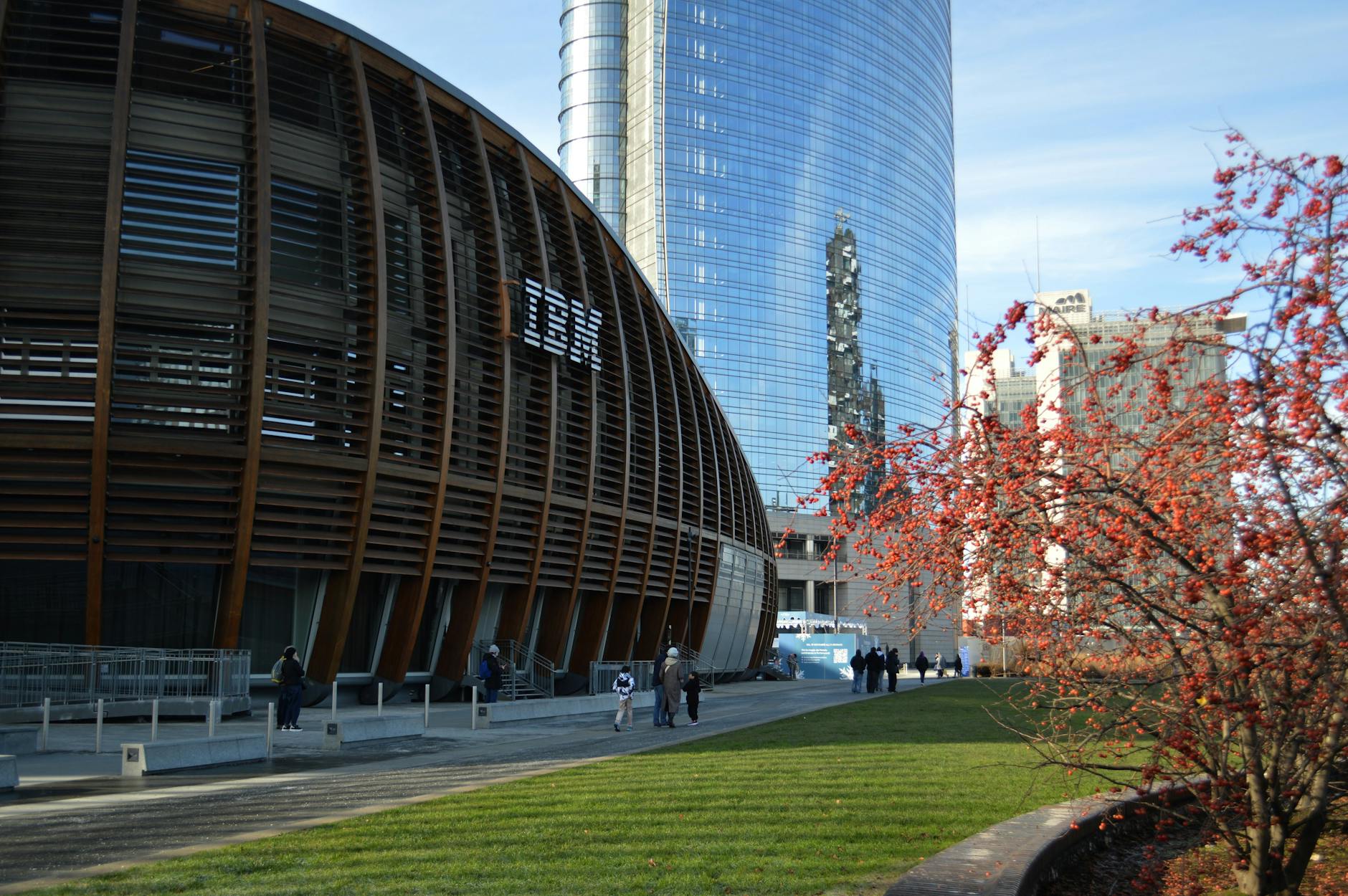
IBM suffered its worst single-day stock collapse in over 25 years on February 23, 2026, plunging 13.2% after Anthropic announced that its Claude Code tool could automate much of the complex analysis work behind COBOL modernization — a business segment that has kept IBM’s mainframe empire profitable for decades. More than $31 billion in market capitalization evaporated in a single session, dragging the Dow Jones Industrial Average down more than 800 points with it. For a company that has spent years positioning itself as an AI leader, the irony was brutal: artificial intelligence built by a competitor may have just kneecapped one of its most reliable revenue streams. The selloff extended beyond IBM.
Accenture and Cognizant, both of which generate significant consulting revenue from legacy system modernization projects, saw their shares decline in sympathy. IBM’s stock fell 27% across February 2026 overall, putting it on track for its worst monthly performance since at least 1968. Yet Wall Street analysts were far from unanimous that the panic was justified. The average price target for IBM remained at $324.95 — a staggering 41.7% above where the stock was actually trading at $229.32 as of February 24. This article breaks down what actually happened, why COBOL matters so much to IBM’s bottom line, whether Claude Code is truly an existential threat, and what investors and workers should realistically expect going forward.
Table of Contents
- What Caused IBM to Crash 13% in a Single Day Over COBOL Automation Fears?
- Is Claude Code Actually Capable of Replacing COBOL Modernization Work?
- The Error Rate Problem With AI-Generated Code
- What the Analyst Response Tells Us About the Overreaction
- Why COBOL Refuses to Die and What That Means for Workers
- The Dow Jones Collateral Damage
- Where IBM and COBOL Modernization Go From Here
- Conclusion
- Frequently Asked Questions
What Caused IBM to Crash 13% in a Single Day Over COBOL Automation Fears?
The trigger was specific and technical, but the market reaction was anything but measured. Anthropic announced that Claude Code could map dependencies across thousands of lines of COBOL, document complex workflows, and identify risks in legacy codebases that “would take human analysts months to surface.” In practical terms, this means the exploratory and analytical grunt work that consulting firms and IBM itself charge premium rates for — understanding what ancient COBOL systems actually do before anyone can even begin to modernize them — could potentially be handled by an AI tool at a fraction of the cost and time. Markets treated this as a direct shot at IBM’s mainframe business, which is deeply intertwined with COBOL. Roughly 95% of ATM transactions in the United States still run on COBOL. IBM holds a near-monopoly on the mainframe ecosystem through its IBM Z systems platform.
Mainframe hardware sales account for 23% of IBM’s overall revenue, while mainframe-related software represents approximately 29% of total software sales. When traders calculated what it would mean if even a portion of that modernization and maintenance revenue got automated away, they hit the sell button hard enough to wipe out $31 billion in a few hours. For comparison, IBM’s single-day drop was worse than anything the stock experienced during the 2008 financial crisis or the 2020 pandemic selloff. you have to go back to October 2000, during the dot-com bust, to find a comparable one-day decline. That context alone suggests the market may have been pricing in a worst-case scenario rather than a realistic assessment of near-term business impact.

Is Claude Code Actually Capable of Replacing COBOL Modernization Work?
Here is where the story gets more complicated than the stock chart suggests. VentureBeat published an analysis arguing that “translating COBOL isn’t the same as modernizing it,” and that distinction matters enormously. Migration from legacy mainframe systems requires far more than converting code from one language to another. It involves understanding decades of accumulated business logic, testing against real-world transaction flows, ensuring regulatory compliance, and managing the organizational change that comes with moving off a platform that has worked reliably for 40 or 50 years. IBM itself is not exactly unfamiliar with this space. The company launched “watsonx Code Assistant for Z” roughly three years ago, a tool specifically designed to help translate COBOL to Java.
If AI-powered COBOL translation were a simple, solved problem, IBM’s own tool would have already cannibalized its mainframe business. It hasn’t. Clients have had the option to migrate away from mainframes for years, and most have chosen not to. Evercore ISI analyst Amit Daryanani made this point directly: “Clients already had the option to migrate from the mainframe, yet they are sticking with the platform.” However, if Claude Code proves materially better than existing tools at the analysis and documentation phase — the part that typically consumes the most billable hours in modernization projects — that could genuinely compress the revenue IBM and its consulting partners extract from each engagement. The threat is not that COBOL disappears overnight. The threat is that the high-margin discovery work gets commoditized. That is a real risk, even if the market overreacted to it on day one.
The Error Rate Problem With AI-Generated Code
One fact that got buried under the panic selling deserves more attention. According to data from CodeRabbit, AI-generated code currently produces approximately 60% more errors than human-coded programming. That is not a minor footnote when you are talking about systems that process 95% of all ATM transactions in the country, handle airline reservations, and run government benefit disbursements. A COBOL migration error in a banking system is not a website bug that gets patched on Monday morning. It is a potential financial crisis for every customer who touches that system. This is the practical reality that separates a compelling product demo from a production-ready enterprise tool. Financial institutions operate under strict regulatory frameworks.
The Office of the Comptroller of the Currency, the Federal Reserve, and the FDIC all have expectations about how banks manage technology risk. Introducing AI-generated code into core transaction processing systems requires a level of validation and testing that dramatically slows down any theoretical speed advantage the AI provides. A bank’s chief technology officer is not going to swap out battle-tested COBOL for AI-translated Java without exhaustive parallel testing — a process that itself can take years. The 60% higher error rate also creates a paradox for modernization projects. If organizations need to spend more time reviewing and fixing AI-generated output, the labor savings may be far smaller than the headline capability suggests. This does not mean AI tools are useless for COBOL work. It means the gap between “this tool can analyze COBOL” and “this tool can safely replace the people who maintain COBOL” remains wide.

What the Analyst Response Tells Us About the Overreaction
Wall Street’s own analysts provided a striking counterpoint to the selloff. Jefferies maintained its Buy rating on IBM after the decline. The average analyst price target of $324.95 represented a 41.7% premium over the post-crash trading price of $229.32. When the people whose job it is to model IBM’s future cash flows are collectively saying the stock is worth 40% more than where it’s trading, that is a significant signal that the market moved faster than the fundamentals justified. The Motley Fool published a piece on February 27 titled “I’m Not Convinced Anthropic’s New COBOL Coding Tool Is an Actual Threat to IBM,” which argued that the structural advantages of IBM’s mainframe ecosystem — deep integration, decades of customization, regulatory inertia, and the sheer risk of migration — create barriers that no single AI tool can dissolve quickly.
This is not to say IBM faces zero competitive pressure from AI-driven modernization tools. But there is a meaningful difference between a long-term strategic challenge and the kind of existential, quarter-over-quarter revenue collapse that a 13% single-day stock drop implies. The tradeoff for investors is straightforward. If you believe COBOL modernization will remain a slow, cautious, human-intensive process for the next five to ten years, IBM at $229 looks like a gift relative to analyst targets. If you believe Claude Code and similar tools will rapidly compress the timeline and cost of mainframe migration, then IBM’s mainframe revenue base — more than half of its business when you combine hardware and related software — is genuinely at risk. The answer probably lies somewhere in between, which is exactly the kind of nuance that panic selling does not accommodate.
Why COBOL Refuses to Die and What That Means for Workers
The persistence of COBOL is one of the most underappreciated facts in technology. The language was created in 1959. It has survived every wave of technological disruption since — client-server computing, the internet, cloud, mobile, and now AI. The reason is not nostalgia or incompetence. It is that COBOL systems, running on IBM mainframes, process transactions with a reliability, speed, and throughput that modern systems still struggle to match at scale. When you withdraw cash from an ATM, the transaction likely touches COBOL code that has been running, maintained, and refined for decades. For the aging workforce of COBOL programmers — many of whom are in their 60s and 70s — the IBM crash raised understandable anxiety.
But the warning here cuts both directions. AI tools that can analyze and document COBOL systems may actually make these workers more productive rather than replace them, at least in the near term. The bottleneck in COBOL modernization has never been the lack of desire to modernize. It has been the lack of people who understand what the existing systems do well enough to safely change them. If AI can accelerate the documentation and analysis phase, the humans who understand the business logic become more valuable, not less, because they are the ones who validate whether the AI got it right. The longer-term risk is real, though. If AI tools improve their accuracy rates and begin handling not just analysis but actual code generation and testing with acceptable error rates, the demand for COBOL specialists will eventually decline. Workers in this space should be paying attention to how quickly AI code quality improves — and how quickly their employers start piloting these tools on non-critical systems.

The Dow Jones Collateral Damage
IBM’s 13.2% crash had an outsized impact on the broader market because of a quirk in how the Dow Jones Industrial Average is calculated. Unlike the S&P 500, which is weighted by market capitalization, the Dow is price-weighted. That means higher-priced stocks like IBM have a disproportionate effect on the index.
📨 Get Free Accountability Coverage Alerts
Free · No spam · Unsubscribe anytime
IBM’s decline on February 23 dragged the Dow down more than 800 points, creating a broader market narrative of tech sector weakness that had nothing to do with the actual fundamentals of the other 29 companies in the index. This is worth noting because it illustrates how a single stock, reacting to a single product announcement, can cascade into headline numbers that rattle retail investors across unrelated sectors. If you saw “Dow plunges 800 points” on February 23 and assumed the entire market was in trouble, you were seeing the IBM effect. The S&P 500 and Nasdaq, which are not price-weighted, told a less dramatic story.
Where IBM and COBOL Modernization Go From Here
The February 2026 crash will likely be remembered as either an inflection point or an overreaction, depending on what happens over the next 12 to 24 months. If Anthropic and other AI companies demonstrate that their tools can reliably handle end-to-end COBOL modernization — not just analysis but safe, production-quality code conversion with low error rates — then IBM’s mainframe revenue base will face genuine, accelerating pressure. The company would need to pivot more aggressively toward its own AI offerings and hybrid cloud business to compensate.
But if the pattern holds — if COBOL modernization remains the slow, painstaking, risk-averse process it has been for the last two decades — then IBM’s mainframe franchise will continue generating substantial revenue, and the February crash will look like a buying opportunity in hindsight. The most likely outcome is somewhere in between: AI tools will gradually reduce the cost and time of modernization projects, IBM will adapt its pricing and services, and the mainframe will continue its remarkably slow decline rather than falling off a cliff. For investors and workers alike, the key metric to watch is not whether AI can analyze COBOL — it clearly can — but whether anyone is willing to trust AI-generated code in systems where a single error can freeze millions of bank accounts.
Conclusion
IBM’s 13.2% crash on February 23, 2026 — its worst day since 2000 — was a dramatic market reaction to Anthropic’s Claude Code announcement and its potential to automate COBOL modernization work. The $31 billion wipeout reflected genuine fears about the future of IBM’s mainframe business, which accounts for roughly half of the company’s revenue when hardware and related software are combined. The collateral damage extended to consulting firms like Accenture and Cognizant, and even dragged the Dow Jones down 800 points due to the index’s price-weighted structure. Yet the analyst consensus tells a different story than the stock price.
With Jefferies maintaining its Buy rating and the average price target sitting 41.7% above the post-crash price, Wall Street professionals largely view the selloff as an overreaction. The 60% higher error rate in AI-generated code, the regulatory barriers to replacing mission-critical financial systems, and the decades-long track record of COBOL resisting displacement all suggest that the mainframe’s demise is not imminent. The real question is not whether AI will eventually transform COBOL modernization — it almost certainly will — but whether that transformation happens on a timeline of years or decades. For now, the market priced in the most dramatic scenario possible, and the coming quarters will determine whether that fear was prescient or premature.
Frequently Asked Questions
How much did IBM stock drop on February 23, 2026?
IBM shares fell 13.2% on February 23, 2026, marking the company’s worst single-day decline since October 2000. The stock dropped to around $229.32, wiping out more than $31 billion in market capitalization.
What is Claude Code and why did it affect IBM’s stock price?
Claude Code is an AI tool developed by Anthropic that can automate the exploration and analysis of COBOL codebases — mapping dependencies, documenting workflows, and identifying risks across thousands of lines of legacy code. Since IBM’s mainframe business depends heavily on COBOL maintenance and modernization revenue, the market treated this as a direct competitive threat.
Does IBM still make significant revenue from COBOL and mainframe systems?
Yes. Mainframe hardware sales account for approximately 23% of IBM’s overall revenue, and mainframe-related software represents about 29% of total software sales. Roughly 95% of ATM transactions in the United States still run on COBOL systems hosted on IBM Z mainframes.
Are analysts recommending selling IBM stock after the crash?
Most analysts did not join the panic. Jefferies maintained its Buy rating, and the average analyst price target remained at $324.95 — roughly 41.7% above the post-crash trading price. This suggests Wall Street professionals view the selloff as disproportionate to the actual near-term business risk.
How reliable is AI-generated code for replacing COBOL systems?
Current data suggests significant limitations. According to CodeRabbit, AI-generated code produces approximately 60% more errors than human-written code. For mission-critical financial and government systems where COBOL is most prevalent, this error rate presents serious regulatory and operational risks that limit how quickly AI tools can replace human programmers.
Did IBM already have its own AI tool for COBOL modernization?
Yes. IBM launched “watsonx Code Assistant for Z” approximately three years before the Claude Code announcement. That tool was designed to help translate COBOL to Java. The fact that IBM’s own AI tool has not cannibalized its mainframe business suggests that COBOL modernization involves far more complexity than code translation alone.
You Might Also Like
- Trump Claims Gas Is $1.99…Real Average Is $2.92…28 Out of 150,000 Stations Below $2
- Trump Blocked $16 Billion for Gateway Tunnel Until NY Agreed to Rename Penn Station
- Property Taxes Rose 11% Nationwide. Here’s How to Check If You’re Eligible for a Reassessment.