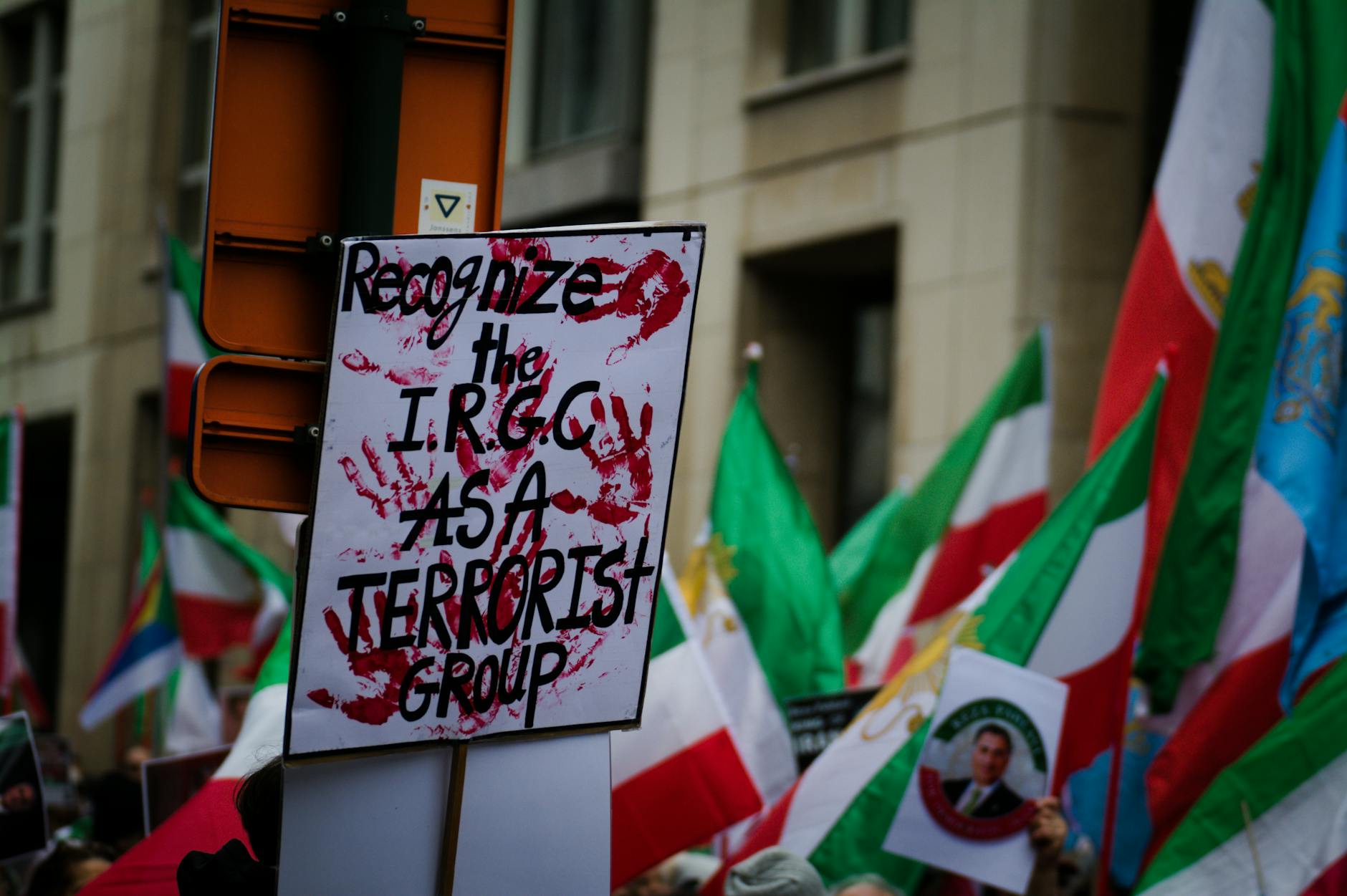
The Islamic Revolutionary Guard Corps, even if formally dissolved or degraded by military strikes, will not simply vanish. History and intelligence assessments make this plain: organizations with deep ideological roots, decades of institutional knowledge, and billions of dollars in assets do not evaporate when their headquarters are hit. They fragment, rebrand, and burrow into existing networks — financial, political, and militant — across the Middle East and beyond. The IRGC’s Quds Force alone has spent forty years building proxy relationships from Lebanon to Venezuela, and those relationships do not require a central command structure in Tehran to continue operating. Anyone who frames a potential military campaign against Iran as a clean endpoint is either uninformed or misleading the public.
This matters right now because the Trump administration has repeatedly signaled a willingness to use maximum pressure — and potentially kinetic action — against Iran’s military apparatus. Statements from senior officials suggest that dismantling the IRGC is a policy objective, not merely a rhetorical flourish. But the question no one in Washington seems eager to answer is what happens the day after. The United States designated the IRGC as a foreign terrorist organization in 2019, a first for a branch of a sovereign nation’s military, yet the organization continued to expand its influence in Iraq, Syria, and Yemen in the years that followed. This article examines why IRGC remnants will go underground, what that looks like in practice, where the financial infrastructure persists, and what realistic policy options exist for dealing with a decentralized but still dangerous network.
Table of Contents
- Why Won’t IRGC Remnants Simply Disappear After a Military Campaign?
- How IRGC Proxy Networks Operate Without Central Command
- The Financial Underground — Sanctions Evasion and Shadow Banking
- What Policy Options Actually Work Against Decentralized Threats?
- The Intelligence Gap — What We Don’t Know About IRGC Sleeper Networks
- Historical Precedents — What Happened When Other States Tried to Eliminate Entrenched Security Forces
- What Comes Next — The Post-IRGC Middle East Nobody Is Planning For
- Conclusion
- Frequently Asked Questions
Why Won’t IRGC Remnants Simply Disappear After a Military Campaign?
The short answer is structural. The IRGC is not a conventional military force that collapses when its generals are killed and its bases destroyed. It functions more like a hybrid between a state institution, a venture capital fund, and an international militant franchise. The Corps controls an estimated 20 to 40 percent of Iran’s economy through front companies, construction firms, telecommunications ventures, and import-export operations. Sanctions have pushed much of this activity into gray and black markets, which means the financial muscle already operates outside formal banking channels. Destroying a building in Tehran does not shut down a shell company in Dubai or a Hawala network running through Baghdad. Compare this to the de-Baathification of Iraq after 2003.
The United States dismantled Saddam Hussein’s military and party infrastructure on the assumption that removing the formal structure would neutralize the threat. Instead, tens of thousands of trained, connected, and now unemployed men funneled into an insurgency that eventually gave rise to ISIS. The IRGC scenario carries similar risks but on a larger and more sophisticated scale, because IRGC operatives are embedded in legitimate businesses, government ministries, and foreign proxy organizations simultaneously. They do not need to “go underground” in the dramatic, cinematic sense — many of them are already there. A 2023 report from the Foundation for Defense of Democracies documented over 200 IRGC-linked companies operating internationally, many of them in sectors like shipping, petrochemicals, and construction that provide both revenue and logistical cover. These entities have survived multiple rounds of U.S. and EU sanctions by rotating corporate identities, using front men, and exploiting jurisdictional gaps. The infrastructure for persistence already exists.

How IRGC Proxy Networks Operate Without Central Command
The IRGC’s proxy model was designed from the beginning to function with a degree of autonomy. Hezbollah in Lebanon, the Houthis in Yemen, Kata’ib Hezbollah and other Popular Mobilization Forces in Iraq, and various Shia militia groups in Syria all receive funding, training, and strategic direction from Tehran — but they also have their own leadership structures, local revenue streams, and political bases. Removing the IRGC’s central leadership would disrupt coordination, but it would not eliminate these organizations’ capacity to act. Consider Hezbollah’s evolution. What began as an IRGC project in 1982 became a self-sustaining political and military organization with its own fundraising networks spanning West Africa, South America, and the global Lebanese diaspora. U.S.
Treasury designations have identified Hezbollah-linked money laundering operations running through used car dealerships in Benin, diamond trading in Sierra Leone, and real estate in Paraguay. Even if every IRGC officer in Lebanon were removed tomorrow, Hezbollah’s financial and operational infrastructure would continue functioning. The same logic applies, to varying degrees, to every IRGC proxy. However, if the trump administration assumes that degrading IRGC command-and-control will automatically weaken these proxies, the result could be worse than the status quo. Without a central authority imposing strategic discipline, individual proxy leaders may act more aggressively and less predictably. Fragmentation does not mean weakness — it often means chaos, and chaos in the Middle East has a well-documented tendency to produce outcomes that are worse for U.S. interests than the problems they were meant to solve.
The Financial Underground — Sanctions Evasion and Shadow Banking
The IRGC has been operating under international sanctions for over a decade, which means its financial networks are already optimized for survival without access to the formal global banking system. The organization uses a combination of front companies, cryptocurrency transactions, trade-based money laundering, and complicit financial institutions in countries with weak enforcement regimes. A 2022 investigation by the Wall Street Journal detailed how Iranian oil revenues were being routed through Chinese intermediary banks and Malaysian shell companies, with the proceeds flowing back to IRGC-linked entities through informal value transfer systems. One specific example illustrates the scale: in 2020, the U.S. Department of Justice seized 92 domain names used by the IRGC to spread disinformation, but the underlying financial architecture that funded those operations — a network of companies registered in Turkey, the UAE, and Hong Kong — continued to operate.
Shutting down a website is easy. Shutting down a multinational money laundering network that has been adapting to enforcement pressure for decades is an entirely different problem. The cryptocurrency dimension adds another layer of complexity. Blockchain analytics firm Chainalysis has documented Iranian actors, including those linked to the IRGC, using decentralized exchanges and privacy coins to move funds outside the reach of traditional sanctions enforcement. As global financial systems become more decentralized, the tools available to sanctioned organizations for moving money will continue to expand, not contract.

What Policy Options Actually Work Against Decentralized Threats?
The honest answer is that no single policy tool is sufficient, and every available option involves significant tradeoffs. Military strikes can degrade physical infrastructure and eliminate key leaders, but they do not address the financial, ideological, or political networks that sustain an organization like the IRGC. Sanctions can restrict access to capital, but they impose costs on civilian populations and can be circumvented by sophisticated actors. Intelligence operations can disrupt specific plots, but they require sustained investment and cooperation with partner nations that have their own competing interests. The approach most likely to produce lasting results is a combination of financial warfare, intelligence sharing with regional and European partners, and targeted law enforcement actions against IRGC-linked networks in third countries. This is less dramatic than a bombing campaign, and it does not produce the kind of footage that plays well on cable news, but it is what actually worked against Al-Qaeda’s financial networks after 2001.
The Treasury Department’s Office of Terrorism and Financial Intelligence, working with the intelligence community, systematically mapped and disrupted Al-Qaeda funding channels over a period of years. A similar sustained effort against IRGC financial networks is possible but requires patience, resources, and political will that extends beyond a single administration. The tradeoff is time versus visibility. A military strike produces immediate, visible results but does not address the underground network. Financial and intelligence operations produce slower, less visible results but attack the infrastructure that allows the network to survive. The risk of choosing the dramatic option is that it creates the appearance of success while leaving the actual threat intact — or worse, driving it further underground where it becomes harder to monitor.
The Intelligence Gap — What We Don’t Know About IRGC Sleeper Networks
One of the most significant and least discussed risks is the existence of IRGC operatives and assets in Western countries that have not been identified by intelligence services. The IRGC’s Unit 840, which handles foreign operations including assassination plots, has demonstrated the ability to operate in Europe and on U.S. soil. In 2022, the Department of Justice charged an IRGC member with plotting to assassinate former National Security Advisor John Bolton. In 2023, federal prosecutors revealed an IRGC-linked plot to kill dissidents in the United States using criminal networks as intermediaries. These cases represent the plots that were detected.
The limitation that policymakers must confront is that disruption of the IRGC’s central command could activate sleeper operatives or pre-positioned assets as a retaliatory measure. Iran’s leadership has explicitly stated that any attack on Iranian soil will be met with asymmetric responses, and the IRGC’s global network provides the means to deliver on that threat. The intelligence community’s ability to detect and prevent such responses depends on human intelligence sources that may themselves be compromised or eliminated in the chaos of a military campaign. There is also the question of IRGC penetration of Iraqi and Syrian government institutions. Thousands of IRGC-trained officials hold positions in Iraq’s interior ministry, intelligence services, and military. These individuals would not be affected by strikes on Iranian territory, and their loyalty to the IRGC’s ideology and network may outlast the formal organization itself. Any realistic assessment of “dismantling” the IRGC must account for this embedded presence in allied governments.
📨 Get Free Accountability Coverage Alerts
Free · No spam · Unsubscribe anytime

Historical Precedents — What Happened When Other States Tried to Eliminate Entrenched Security Forces
The de-Baathification comparison is the most obvious, but not the only relevant precedent. When Israel assassinated key Hezbollah and Hamas leaders over the past two decades, the organizations experienced temporary disruption but ultimately adapted and, in several cases, grew stronger. The assassination of Hezbollah’s military commander Imad Mughniyeh in 2008 removed one of the most capable terrorist operatives in the world, but Hezbollah’s military capabilities continued to expand in the years that followed, as demonstrated by its intervention in the Syrian civil war.
Colombia’s decades-long campaign against the FARC offers another instructive case. Despite killing senior leaders, dismantling cocaine processing labs, and spending billions in U.S.-funded military aid, the FARC’s remnants splintered into dissident factions that continue to operate in drug trafficking and extortion. The lesson is consistent across every case: ideologically motivated organizations with established revenue streams and local support bases are not eliminated by decapitation strikes. They evolve.
What Comes Next — The Post-IRGC Middle East Nobody Is Planning For
The most consequential failure in current policy discussions is the absence of a credible plan for what the Middle East looks like after a major military confrontation with Iran. If the IRGC is degraded but not eliminated — which is the most likely outcome of any conceivable military campaign — the result is a fragmented network of well-armed, well-funded, and ideologically motivated groups operating without central coordination. This is not a hypothetical scenario. It is what happened in Libya after Gaddafi, in Iraq after Saddam, and in Syria after the state’s authority collapsed in multiple provinces.
The Trump administration’s focus on maximum pressure assumes that sufficient economic and military pain will produce regime change or capitulation. Neither outcome is guaranteed, and both carry risks that are not being publicly discussed with the seriousness they deserve. A realistic policy must account for the probability that IRGC remnants will persist, adapt, and continue to pose threats to U.S. interests for years or decades after any military action. Planning for that reality is not defeatism — it is the minimum standard of strategic competence.
Conclusion
The IRGC is not a building that can be demolished or an army that can be defeated on a conventional battlefield. It is a financial, political, and military network that has spent four decades preparing for exactly the kind of pressure the United States is threatening to apply. Its proxy relationships, shadow banking infrastructure, embedded operatives in regional governments, and ideological commitment to its revolutionary mission all ensure that remnants of the organization will survive any plausible military campaign. History offers no examples of a comparable organization being permanently eliminated through force alone.
Policymakers, journalists, and the public should demand specific answers about what happens after the strikes. Who monitors the fragmented networks? Who tracks the money as it moves through new channels? Who manages the proxy organizations that will continue to operate independently? Until those questions have credible answers, any talk of “dismantling” the IRGC should be understood as aspirational rhetoric, not a serious policy objective. The remnants will not disappear. They will adapt. And the United States needs a strategy for that reality, not just a plan for the first seventy-two hours.
Frequently Asked Questions
Has the IRGC ever been formally designated as a terrorist organization?
Yes. In April 2019, the Trump administration designated the IRGC as a Foreign Terrorist Organization under U.S. law, marking the first time the United States applied that label to a component of a foreign government’s military. The designation remains in effect and imposes criminal penalties on anyone who provides material support to the IRGC.
How much of Iran’s economy does the IRGC control?
Estimates vary, but most analysts place IRGC economic control between 20 and 40 percent of Iran’s GDP. The organization operates in construction, telecommunications, oil and gas, mining, and import-export sectors through a network of subsidiaries, front companies, and charitable foundations known as bonyads.
Could a military strike eliminate the IRGC’s leadership entirely?
It is extremely unlikely. The IRGC’s senior leadership operates with extensive security protocols, including the use of underground facilities, communication discipline, and redundant command structures specifically designed to survive decapitation strikes. Even the January 2020 killing of Qassem Soleimani, the most senior IRGC commander ever killed by the United States, did not disrupt the organization’s operations for more than a few weeks.
What is the difference between the IRGC and Iran’s regular military?
Iran maintains two separate military forces. The Artesh is a conventional military responsible for territorial defense. The IRGC is an ideological force tasked with protecting the Islamic Revolution, including through unconventional warfare, proxy operations, and domestic political enforcement. The IRGC has its own ground forces, navy, air force, and intelligence apparatus, and it reports directly to the Supreme Leader rather than the president.
Are IRGC operatives present in the United States?
U.S. law enforcement and intelligence agencies have identified and prosecuted multiple cases involving IRGC-linked operatives or agents on U.S. soil, including assassination plots and sanctions evasion schemes. The full extent of IRGC presence in the United States is not publicly known.
You Might Also Like
- Pentagon Budget Will Need Emergency Supplemental Funding for Extended Iran Operations
- Who Actually Profits From the Iran War — A Look at the Money
- When Does Operation Epic Fury Actually End? Trump Says “As Long as Necessary”