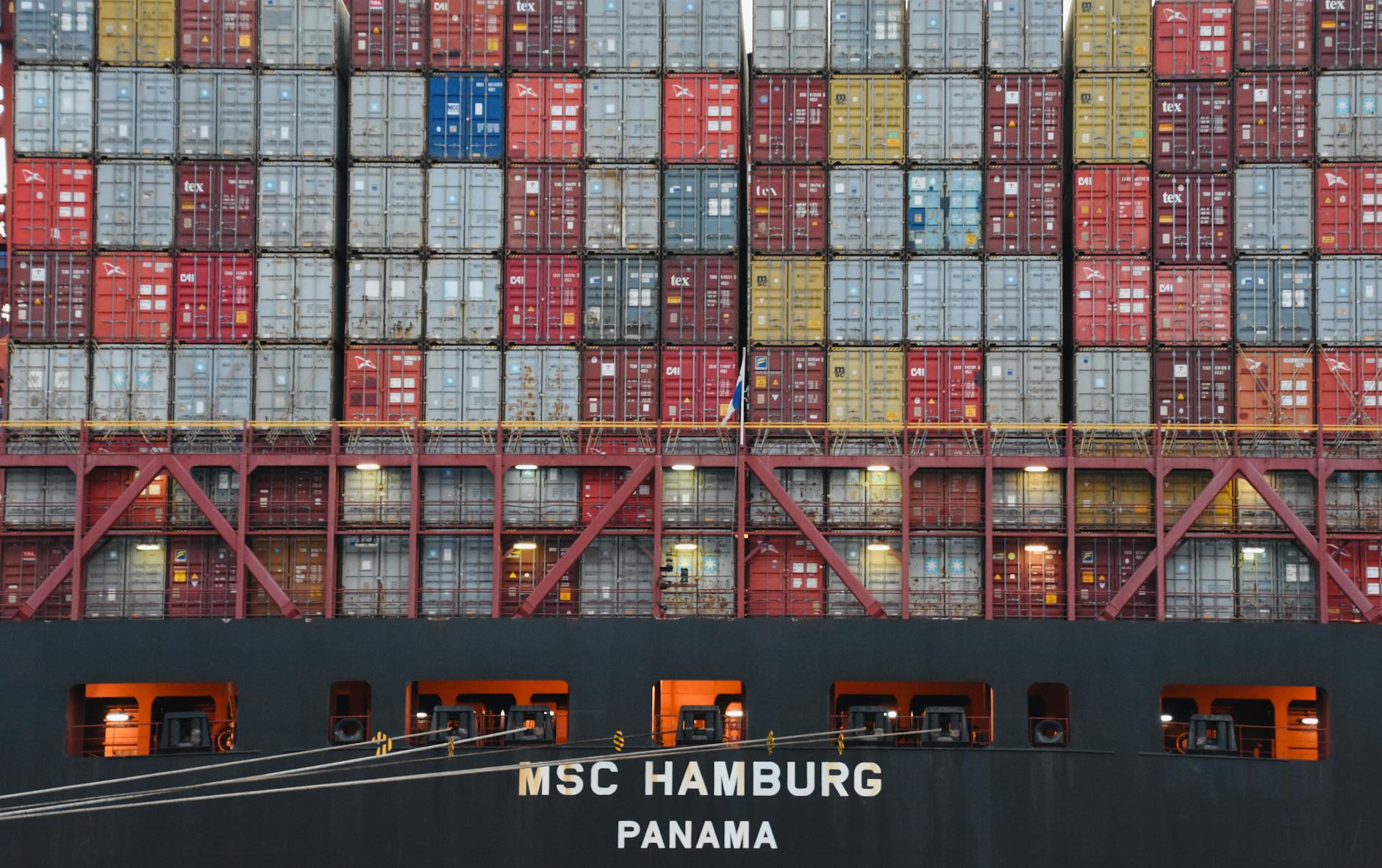
The global container shipping industry is now locked into a costly detour around the southern tip of Africa, adding weeks to transit times and billions of dollars in annual costs that will inevitably reach consumers. Since Houthi militia attacks on commercial vessels in the Red Sea began in late 2023, the majority of container traffic has abandoned the Suez Canal in favor of the Cape of Good Hope route — a diversion that adds roughly 3,500 to 11,000 extra nautical miles and 10 to 14 additional days per voyage, according to J.P. Morgan. The financial toll is staggering: an estimated $15 to $20 billion annual hit to global trade, with Asia-Europe freight rates settling at 25 to 35 percent above pre-crisis levels even after initial spikes have cooled. What briefly looked like a temporary disruption has hardened into something far more permanent. In mid-February 2026, Maersk tested the waters by sending its ME11 service back through the Red Sea and Suez Canal.
That experiment lasted barely two weeks. When the 2026 Iran conflict escalated in late February and Tehran closed the Strait of Hormuz in March, every major carrier abandoned return plans and reinstated Cape diversions. CMA CGM and Hapag-Lloyd suspended all Suez Canal and Strait of Hormuz transits on March 1, 2026, and the rest of the industry followed. The Cape of Good Hope route is no longer a workaround — it is rapidly becoming the new normal for global shipping flows. This article breaks down exactly how much this rerouting costs in dollars, time, and carbon emissions, who is absorbing those costs right now, and what it means for American consumers and businesses watching prices creep upward on everything from electronics to furniture. We will also examine the collapse of Suez Canal traffic, the financial damage to major carriers like Maersk, and why the environmental consequences of this crisis are being largely ignored.
Table of Contents
- Why Are Container Ships Rerouting Around Africa Instead of Using the Suez Canal?
- How Much Does the Cape of Good Hope Detour Actually Cost?
- The Carrier Financial Fallout — Maersk’s Warning Shot
- The Capacity Crunch — Why Longer Routes Mean Fewer Available Ships
- The Environmental Cost Nobody Is Talking About
- Maersk’s Failed Return and What It Revealed
- The New Normal — What Comes Next for Global Shipping
- Conclusion
- Frequently Asked Questions
Why Are Container Ships Rerouting Around Africa Instead of Using the Suez Canal?
The short answer is that the Red Sea and its surrounding waterways have become too dangerous and too expensive to transit. Houthi militia attacks on commercial shipping, which began in late 2023 as a response to the Israel-Gaza conflict, forced most carriers to abandon the Suez Canal route through 2024 and 2025. Even after the last confirmed Houthi attack on a vessel — the *Minervagracht* in late September 2025 — carriers remained deeply reluctant to return. As of early January 2026, Suez Canal traffic was still 60 percent below the corresponding week in 2023, the pre-crisis baseline, according to BIMCO. Container ship transits specifically fell 86 percent in the fourth quarter of 2025 compared with 2023, making containers the hardest-hit sector by a wide margin. The situation deteriorated further in early 2026. On February 28, Houthis threatened to escalate and resume Red Sea attacks in response to the broadening iran conflict. Days later, following Israeli and U.S.
strikes on Iran, Tehran closed the Strait of Hormuz — one of the world’s most critical oil and trade chokepoints. This compounded the disruption beyond anything the shipping industry had planned for. Carriers that had been cautiously testing Suez returns immediately reversed course. By early March 2026, maritime traffic across the entire Middle East was deeply disrupted, with Windward reporting only five total vessel crossings through the Strait of Hormuz, far below the typical baseline of dozens per day. For comparison, the Suez Canal normally handles about 12 to 15 percent of global trade. Bulker transits through Suez are down 55 percent, crude tanker transits down 32 percent, and product tanker transits down 19 percent versus 2023 levels. But it is container shipping — the sector that moves consumer goods, electronics, auto parts, and retail inventory — that has been effectively locked out entirely. The industry is not gradually returning. It is digging in for a prolonged reroute.

How Much Does the Cape of Good Hope Detour Actually Cost?
The per-unit economics are brutal. Rerouting around Africa adds $200 to $400 per TEU (twenty-foot equivalent unit, the standard measure of container capacity) in fuel, crew, and operational expenses, according to DocShipper. For a single round trip between the Far East and North Europe, the additional fuel cost alone can reach $1 million. Multiply that across thousands of voyages per year and the numbers become enormous — the crisis is contributing to an estimated $15 to $20 billion annual hit to global trade, per Container News. However, the direct shipping costs are only part of the equation. war risk insurance premiums remain elevated at $150,000 to $300,000 per voyage, even though they have come down from their peaks when Houthi attacks were at their most frequent. These premiums do not disappear just because attacks pause — insurers price in the possibility of resumption, and the March 2026 escalation validated those concerns.
The combined effect of fuel, crew overtime, extended vessel deployment, and insurance means that Asia-Europe freight rates have stabilized at 25 to 35 percent above pre-crisis levels, after initial spikes of 40 to 60 percent in early 2024. Here is the limitation that often gets overlooked in cost discussions: these figures represent averages across the industry, and actual costs vary enormously depending on the specific trade lane. A vessel traveling from Singapore to Rotterdam adds far more distance via the Cape than one traveling from Mumbai to Mombasa. The 3,500 to 11,000 nautical mile range in additional distance reflects this spread. Shippers on certain intra-Asian or Asia-to-East-Africa routes may see minimal disruption, while those on the core Asia-to-Europe corridor bear the heaviest burden. If your supply chain runs through the Mediterranean, you are paying a steep premium. If it runs primarily through the Pacific, the direct shipping cost impact may be modest — though secondary effects on vessel availability and port congestion still matter.
The Carrier Financial Fallout — Maersk’s Warning Shot
The rerouting crisis is not just an abstract macroeconomic problem. It is hitting the balance sheets of the world’s largest shipping companies in concrete, measurable ways. Maersk, the Danish conglomerate that operates one of the world’s largest container fleets, reported a $153 million loss in its Ocean division for the fourth quarter of 2025 — its first quarterly loss in years. The company attributed the loss directly to the costs of navigating Cape diversions and the uncertainty around when (or whether) Suez transits would resume. More telling than the quarterly loss was Maersk’s 2026 guidance: the company projected a range from a $1.5 billion loss to a $1.0 billion profit.
That is a $2.5 billion spread, reflecting what management described as deep uncertainty about the trajectory of the crisis. When one of the most sophisticated logistics companies on the planet cannot narrow its annual forecast to within $2.5 billion, it signals that the industry is operating without reliable assumptions about one of its most fundamental variables — which route ships will take between Asia and Europe. For consumers, the carrier-level pain matters because shipping companies pass costs downstream. When Maersk, CMA CGM, and Hapag-Lloyd face higher fuel bills and reduced vessel utilization, those costs flow through freight contracts to importers, then to retailers, and ultimately to checkout prices. The 25 to 35 percent elevation in freight rates is not being absorbed by carriers out of goodwill. It is being distributed across the supply chain, and the longer the rerouting persists, the more deeply those higher costs embed themselves into baseline pricing rather than being treated as temporary surcharges.

The Capacity Crunch — Why Longer Routes Mean Fewer Available Ships
One of the most underappreciated consequences of the Africa reroute is its effect on effective shipping capacity. The rerouting implies an approximately 9 percent reduction in effective global container shipping capacity, according to ING Think. This is not because ships have been destroyed or retired — it is because the same fleet is spending roughly 30 percent more time in transit on Asia-Europe routes, which means each vessel completes fewer round trips per year. A ship that used to make six annual rotations between Shanghai and Rotterdam via Suez might now complete only four or five via the Cape. The tradeoff for the industry is painful either way. Carriers can deploy more vessels on affected routes to maintain schedule frequency, but that strips capacity from other trade lanes — potentially disrupting Pacific or transatlantic routes that were previously unaffected.
Alternatively, they can maintain fleet distribution and accept longer transit times, which means retailers and manufacturers must hold more inventory to compensate for the lag, tying up working capital. Neither option is free. The capacity reduction functions like a hidden tax on the entire global logistics system, even on routes that never go anywhere near the Red Sea. For American importers specifically, the capacity squeeze matters because it tightens the global pool of available vessels. Even if your goods ship from Vietnam to Los Angeles across the Pacific and never touch the Suez corridor, you are competing for vessel space and port slots with cargo that has been rerouted onto longer journeys. Port congestion in transshipment hubs like Singapore and Colombo has increased as Cape-routed vessels require different scheduling patterns. The crisis is systemic, not corridor-specific.
The Environmental Cost Nobody Is Talking About
The carbon footprint of the rerouting crisis is massive and largely absent from public debate. From mid-December 2023 to mid-April 2024 alone — just the first four months of large-scale diversions — an estimated 13.6 million additional tonnes of CO2 were emitted due to rerouting, according to Dockflow. A single Shanghai-to-Hamburg voyage via the Cape emits 38 percent more CO2 than the same voyage via Suez, owing to the additional fuel burned over thousands of extra nautical miles. The EU’s emissions trading system has already reflected this reality. Permits surged approximately 33 percent as longer voyages increased the carbon liability for shipping companies operating in European waters. This creates an ironic feedback loop: the rerouting raises shipping emissions, which raises the cost of carbon permits, which raises the cost of shipping further, which gets passed to consumers.
For policymakers who have spent years trying to decarbonize the shipping industry, the crisis has erased years of incremental progress in a matter of months. The limitation here is that environmental accounting in shipping is notoriously complex. The 13.6 million tonne figure covers only one four-month period, and actual cumulative emissions through early 2026 are certainly far higher but have not been comprehensively tallied. Slower steaming — where vessels reduce speed to save fuel — can partially offset the per-voyage increase, but it further reduces effective capacity and extends transit times. There is no clean solution. Every mitigation creates its own set of downstream problems.
📨 Get Free Accountability Coverage Alerts
Free · No spam · Unsubscribe anytime

Maersk’s Failed Return and What It Revealed
In mid-February 2026, Maersk made a deliberate, calculated attempt to reintegrate the Suez Canal route by sending its ME11 service back through the Red Sea. The move was widely watched across the industry as a bellwether — if the world’s second-largest container carrier deemed it safe enough to return, others would likely follow. For a brief window, it appeared that the crisis might be winding down. Over 100 days had passed since the last confirmed Houthi attack on a commercial vessel, and some analysts were cautiously optimistic about a normalization of traffic patterns by mid-2026.
That optimism evaporated within days. The Iran conflict escalation in late February, Houthi threats on February 28, and Tehran’s closure of the Strait of Hormuz in March sent the entire industry scrambling back to the Cape route. The failed return attempt revealed something important: the shipping industry’s recovery from this crisis is not linear. It is binary — carriers are either all-in on Suez or all-out, and the geopolitical conditions required for a return are far more demanding than simply the absence of attacks. As long as the broader Middle East security situation remains volatile, no major carrier will risk its vessels, crews, or insurance ratings on a Suez transit.
The New Normal — What Comes Next for Global Shipping
Multiple analysts and maritime publications now describe the Cape of Good Hope route as the “new normal” for global shipping flows. The Conversation and Maritime Executive have both published assessments arguing that even if Middle East hostilities subside, the reputational and insurance barriers to a rapid Suez return are substantial. Carriers have invested in adjusting schedules, repositioning vessels, and renegotiating contracts around the Cape route. Unwinding those adjustments requires confidence that the Suez corridor will remain safe not just for weeks, but for years — confidence that no carrier currently has.
For American consumers and businesses, the practical implication is that the elevated shipping costs and longer lead times of the past two years are not temporary surcharges waiting to snap back. They are becoming structural features of global trade. Companies that depend on just-in-time inventory from Asian suppliers need to build larger buffers. Retailers should expect continued pressure on margins from freight costs that remain well above 2023 levels. And policymakers should understand that the billions in additional costs generated by this rerouting crisis are, in effect, a tax on global commerce — one imposed not by any government, but by the collapse of maritime security in one of the world’s most critical trade corridors.
Conclusion
The rerouting of container ships around Africa represents one of the most significant disruptions to global trade in decades. The numbers are unambiguous: 10 to 14 extra days per voyage, $200 to $400 in added costs per container, a 9 percent reduction in effective global shipping capacity, 13.6 million additional tonnes of CO2 emitted in just four months, and a $15 to $20 billion annual drag on global trade. Maersk’s $153 million quarterly loss and its $2.5 billion guidance spread tell the story of an industry operating under profound uncertainty. The Suez Canal, which once carried 12 to 15 percent of world trade, has seen container transits collapse by 86 percent. There is no quick fix on the horizon.
The brief February 2026 attempt by Maersk to return to the Suez route failed within weeks when the Iran conflict escalated and the Strait of Hormuz closed. Every major carrier has now suspended Suez transits and committed to Cape diversions for the foreseeable future. For consumers, this means higher prices on imported goods are not a temporary blip but an ongoing cost embedded in supply chains. For businesses, it means rethinking inventory strategies, supplier diversification, and logistics planning around a world where the shortest route between Asia and Europe is no longer available. The shipping industry adapted to the Suez Canal over 150 years. Adapting away from it is proving far more expensive and disruptive than anyone anticipated.
Frequently Asked Questions
How long does it take for a container ship to travel from Asia to Europe via the Cape of Good Hope?
The Cape route adds approximately 10 to 14 extra days compared to the Suez Canal route, bringing total transit times for Asia-to-Europe voyages to roughly 40 to 45 days depending on the specific ports involved. This represents a roughly 30 percent increase in transit time on these key trade lanes.
Why haven’t shipping companies returned to the Suez Canal even when Houthi attacks paused?
Even after more than 100 days without a confirmed Houthi attack in late 2025, Suez Canal traffic remained 60 percent below 2023 levels. Carriers require sustained confidence in route safety before committing vessels and crews. War risk insurance premiums of $150,000 to $300,000 per voyage also discourage return. Maersk’s brief February 2026 test of the Suez route was abandoned within weeks when the Iran conflict escalated, reinforcing carrier caution.
How does the shipping reroute affect prices for American consumers?
The $200 to $400 per container increase in shipping costs, combined with the 25 to 35 percent elevation in Asia-Europe freight rates, flows through supply chains to importers, retailers, and ultimately consumers. The longer these elevated costs persist, the more likely they become embedded in baseline product pricing rather than treated as temporary surcharges.
What is the environmental impact of ships rerouting around Africa?
The detour generates significantly more carbon emissions. A Shanghai-to-Hamburg voyage via the Cape produces 38 percent more CO2 than via Suez. In just the first four months of large-scale diversions (December 2023 to April 2024), an estimated 13.6 million additional tonnes of CO2 were emitted. EU emissions trading permits surged approximately 33 percent as a result.
Could the Suez Canal route reopen soon?
As of March 2026, all major carriers have suspended Suez transits following Iran’s closure of the Strait of Hormuz and renewed Houthi threats. Maritime analysts increasingly describe the Cape route as the “new normal.” A return to Suez would require sustained geopolitical stability across the Red Sea, Gulf of Aden, and Strait of Hormuz — conditions that do not currently exist and that no major carrier is willing to bet on in the near term.
You Might Also Like
- The Mines Iran Placed in the Strait of Hormuz Before the War Are Still There
- Commercial Ships Are Refusing to Enter the Persian Gulf Without Military Escort
- The VIX Volatility Index Spiked to Levels Not Seen Since the 2022 Russia-Ukraine Crisis