
The bombing campaign against Iran that began on February 28, 2026, destroyed military installations, killed senior officials, and decapitated the regime’s leadership — but the real threat to regional stability is not the craters left behind. It is the power vacuum now consuming Tehran from within. The assassination of Supreme Leader Ali Khamenei during the US-Israeli airstrikes, confirmed by Iranian state media on March 1, has triggered a succession crisis that analysts at the International Crisis Group warn could produce outcomes “worse” than the war itself — including sectarian fragmentation, a military junta, or the unraveling of control over Iran’s enriched uranium stockpile.
On March 8, the Assembly of Experts named Mojtaba Khamenei, the dead Supreme Leader’s son, as his successor — a move that effectively converted Iran’s anti-monarchical theocracy into hereditary rule. The appointment was rushed through an online meeting held on March 3 under heavy pressure from the Islamic Revolutionary Guard Corps. Mossad publicly alleged on X that Mojtaba had burned his father’s will, suggesting the succession was contested behind closed doors. This article examines why this internal fracture poses a longer-term danger than the airstrikes, how the IRGC’s grip on power complicates any transition, what the pre-war protest movement reveals about the regime’s fragility, and what credible analysts say about the possible futures now facing Iran and the wider region.
Table of Contents
- Why Is Iran’s Internal Power Struggle Potentially More Dangerous Than the Bombing Campaign?
- The IRGC Problem — Why Military Power Won’t Translate to Political Stability
- Mojtaba Khamenei’s Succession and the Legitimacy Crisis
- What the December Protests Revealed About Iran’s Breaking Point
- The Nuclear Dimension — Why Fragmentation Poses Unique Risks
- The Information War Around the Succession
- What Comes Next — The Possible Futures
- Conclusion
- Frequently Asked Questions
Why Is Iran’s Internal Power Struggle Potentially More Dangerous Than the Bombing Campaign?
Bombs destroy infrastructure. Power vacuums destroy states. The Brookings Institution noted before the strikes that a long-range bombing campaign would “make a big bang” but stands “little chance of transforming iran into a stable and responsible power.” That assessment now looks prophetic. While the military operation achieved its tactical objectives — eliminating key figures and degrading Iran’s defense capabilities — it simultaneously removed the one person who held the regime’s rival factions together. Ali Khamenei, for all his authoritarian brutality, was the arbitrational center of a system built on competing power centers: the IRGC, the clerical establishment, the presidency, and the intelligence apparatus. without him, those factions have no referee.
The danger is not abstract. Iran is a multi-ethnic state with significant Kurdish, Baloch, Arab, Azeri, and Turkmen populations, many of whom have long-standing grievances against the central government. The International Crisis Group has explicitly warned of the risk of sectarian violence among these communities in a scenario where central authority fractures. Compare this to post-Saddam Iraq or post-Gaddafi Libya — both cases where removing a strongman produced not freedom but prolonged chaos. Iran is larger, more heavily armed, and sits on a nuclear threshold. The internal struggle is more dangerous than the bombing because the bombing had a defined scope. The power struggle has none.
The IRGC Problem — Why Military Power Won’t Translate to Political Stability
The irgc is not just a military force. It is a sprawling economic and political empire that controls construction firms, telecommunications companies, oil interests, and import-export networks worth tens of billions of dollars. Even in a scenario where the theocratic structure collapses entirely, the IRGC will not disappear. It has the guns, the money, and the organizational capacity to dominate whatever comes next. this is the core limitation of any optimistic scenario about post-war Iran: the entity most likely to fill the vacuum is the same entity that has spent decades crushing dissent.
However, the IRGC itself is not monolithic. It is an “increasingly powerful but fragmented military apparatus,” according to analysts studying the current crisis. Different commanders control different regions and economic interests. Without a Supreme Leader who commands genuine religious and political authority to mediate between them, the IRGC could fracture into competing fiefdoms — each backed by armed forces and revenue streams. If that happens, Iran’s trajectory looks less like a democratic transition and more like a military junta at best, or warlordism at worst. The assumption that removing the regime’s head automatically benefits reformists or the Iranian people ignores the structural reality of where the actual power sits.
Mojtaba Khamenei’s Succession and the Legitimacy Crisis
The elevation of Mojtaba Khamenei to Supreme Leader on March 8 was designed to project continuity. Iranian state media staged what amounted to a coronation, instantly bestowing the title of “Ayatollah” on a man whose clerical credentials are thin and whose primary qualification is his last name. The Assembly of Experts, the body constitutionally responsible for selecting the Supreme Leader, held its deliberations in an online meeting on March 3 — hardly the image of a deliberate, legitimate process of governance. The IRGC’s heavy hand in the proceedings was an open secret. The Mossad allegation that Mojtaba burned his father’s will — posted publicly on X — may be intelligence warfare, propaganda, or fact. Regardless of its truth, it signals that external actors are actively working to deepen internal divisions.
The allegation implies that Ali Khamenei may not have wanted his son as successor, and that the will contained instructions or preferences that contradicted the IRGC’s chosen outcome. For a regime that was founded in 1979 explicitly as an alternative to the Pahlavi monarchy’s hereditary rule, the spectacle of a son inheriting his father’s throne is a legitimacy crisis of the first order. As the Eurasia Review noted, this is a “doomed succession” that further undermines the regime’s already-crumbling authority among ordinary Iranians. Analysts note that Mojtaba lacks his father’s decades of accumulated authority — the network of personal loyalties, the institutional knowledge, the ability to impose discipline across rival factions. Ali Khamenei spent 35 years consolidating power. His son inherited the title but not the substance.

What the December Protests Revealed About Iran’s Breaking Point
The war did not begin in a vacuum. Before the first bomb fell, Iran was already fracturing from below. Nationwide protests erupted on December 28, 2025, driven by an economic collapse that had made daily life unbearable for millions. The Iranian rial had crashed to approximately 145,000 tomans per US dollar. Inflation hit 42 percent in December 2025, with food prices surging 72 percent and health and medical goods rising 50 percent year-on-year. The regime’s response was unrestrained violence. By February 5, 2026, the US-based Human Rights Activists News Agency (HRANA) had confirmed 7,015 deaths — at least 6,508 of them protesters — with an additional 11,744 cases still under review. On January 8, 2026, security forces launched a crackdown that some observers described as “Iran’s Babi Yar,” the deadliest act of state repression since the 1979 Islamic Revolution.
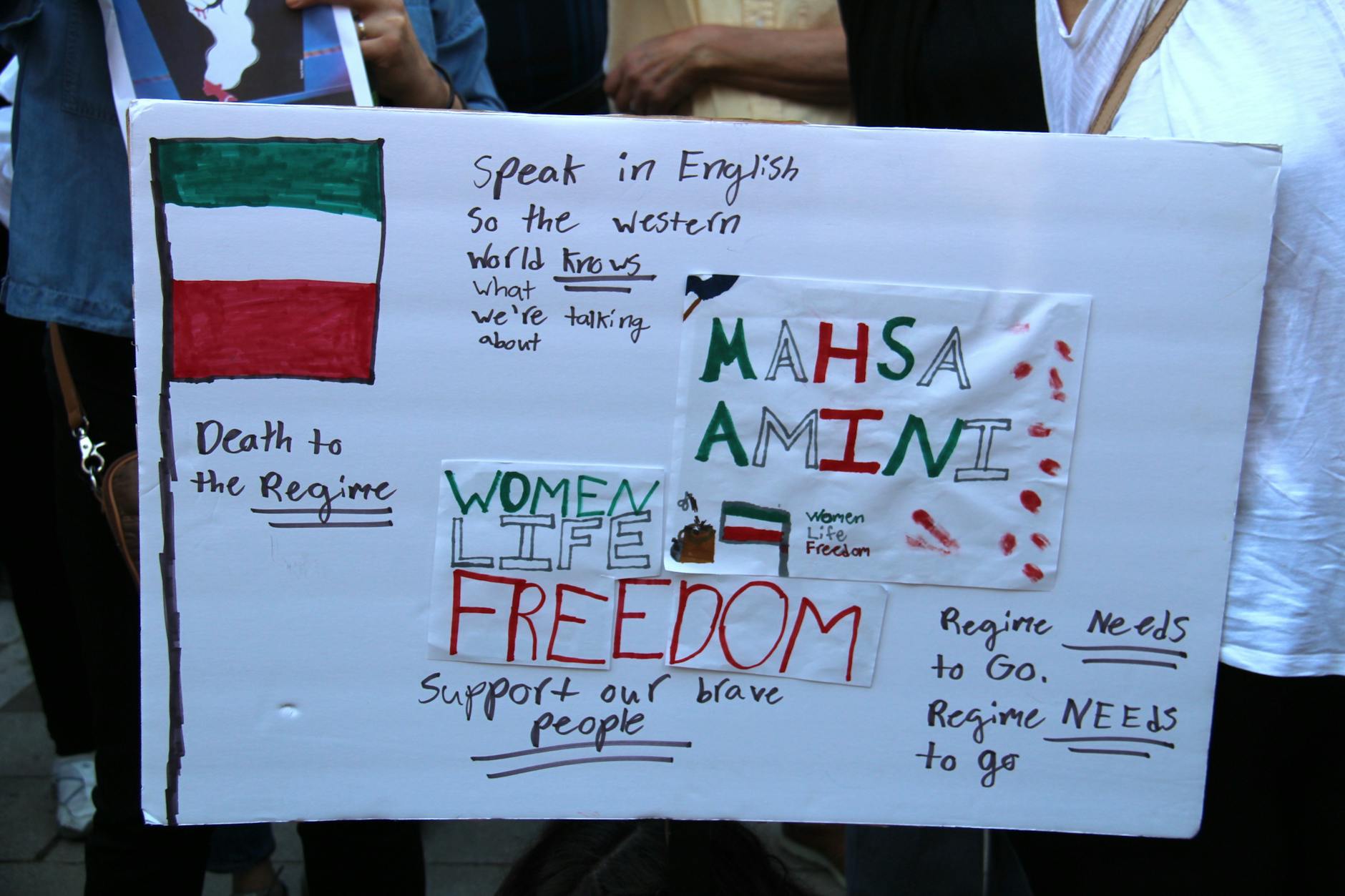
To put the scale in perspective: the 2022 Mahsa Amini protests, which drew global attention and widespread condemnation, resulted in roughly 500 confirmed deaths over several months. The December 2025 crackdown killed more than ten times that number. This matters for the current power struggle because it reveals a tradeoff the regime can no longer manage. The economic crisis demands reform and opening. The IRGC’s interests demand continued control over the economy. The protests demonstrated that the population’s tolerance has been exhausted. Mojtaba inherits a country where the tools of repression have been used to their maximum, the economy is in freefall, and a foreign military campaign is destroying what remains of the infrastructure. There is no good option available to him — only degrees of bad.
The Nuclear Dimension — Why Fragmentation Poses Unique Risks
One danger that separates Iran’s power struggle from other post-authoritarian transitions is the nuclear question. Iran possesses significant quantities of enriched uranium, and the International Crisis Group has explicitly flagged “the urgent need to secure Iran’s enriched uranium” as a critical concern in any scenario where central authority weakens. A unified, hostile Iran with nuclear ambitions is a problem with known parameters. A fragmenting Iran where control over nuclear materials becomes uncertain is a different category of risk entirely.
This is not a hypothetical. In the aftermath of the Soviet Union’s collapse, the security of nuclear weapons and materials across former Soviet states became one of the defining security challenges of the 1990s. The Nunn-Lugar Cooperative Threat Reduction Program spent billions of dollars over decades to address it. Iran’s stockpile is smaller, but the political environment is arguably more volatile — active war, internal power struggle, sectarian tensions, and no cooperative framework in place. The limitation of the current military campaign is that it was designed to degrade Iran’s nuclear capabilities through force, but force cannot secure materials in a country where the chain of command itself is disintegrating.
📨 Get Free Accountability Coverage Alerts
Free · No spam · Unsubscribe anytime
The Information War Around the Succession
The Mossad post on X about Mojtaba burning his father’s will is one example of a broader information campaign being waged alongside the military one. External actors — including Israel, the United States, and various Iranian exile groups — each have incentives to amplify divisions within the Iranian leadership. Some of this is genuine intelligence.
Some of it is designed to sow confusion and distrust among IRGC factions. For ordinary Iranians trapped between bombs and blackouts, as CNN reported, the information environment is nearly impossible to navigate. Internet shutdowns, state media propaganda, and foreign-sourced claims create a fog that makes it difficult to know who is actually in charge, what decisions are being made, and whether any path to stability exists. The danger is that in such an environment, rumors and disinformation can trigger real-world violence — factional clashes, ethnic tensions, or score-settling — faster than any institution can respond.
What Comes Next — The Possible Futures
The International Crisis Group’s blunt assessment — that “some of Iran’s possible futures could well be worse” than the current war — is not alarmism. It is a recognition that the bombing campaign set forces in motion that no external actor can control. The best-case scenario involves Mojtaba consolidating enough authority to negotiate a ceasefire and begin some form of managed transition.
The worst case involves the IRGC splintering, ethnic and sectarian conflicts igniting across the country, and nuclear materials falling outside any coherent chain of custody. What is clear is that the strikes achieved regime decapitation without regime replacement — a pattern that has produced catastrophic results in Iraq, Libya, and Afghanistan. The bombing made a big bang. The power struggle will determine whether anything stable emerges from the wreckage, and right now, the signs are not encouraging.
Conclusion
The assassination of Ali Khamenei and the rushed succession of his son Mojtaba have created a leadership crisis that may prove more consequential than the military campaign itself. The IRGC’s fragmented grip on power, the regime’s shattered legitimacy after killing thousands of its own protesters, the nuclear security question, and the economic collapse that preceded the war all compound into a situation where the internal dynamics pose deeper and longer-term dangers than the external ones. The Brookings Institution and the International Crisis Group have both warned, from different angles, that bombing alone cannot produce stability — and that the aftermath may be worse than what came before.
For those watching this crisis unfold, the key metric is not how many military targets are destroyed. It is whether any coherent authority emerges in Tehran capable of controlling the IRGC, securing nuclear materials, and preventing the kind of sectarian fragmentation that consumed Iraq for a generation. The power struggle inside Iran is not a sideshow to the war. It is the main event, and its outcome will shape the Middle East for decades.
Frequently Asked Questions
Who is Mojtaba Khamenei?
Mojtaba Khamenei is the son of the late Supreme Leader Ali Khamenei. He was named the new Supreme Leader of Iran on March 8, 2026, by the Assembly of Experts after his father was killed during US-Israeli airstrikes on February 28. He was instantly granted the title of “Ayatollah,” though analysts question whether he has the clerical credentials or political authority to hold the position.
How did Ali Khamenei die?
Ali Khamenei was assassinated on February 28, 2026, during US-Israeli airstrikes around Tehran that targeted high-ranking Iranian officials. His death was confirmed by Iranian state media on March 1, 2026. The strikes were part of the broader 2026 Iran war that began that same day.
Why were there protests in Iran before the war?
Nationwide protests erupted on December 28, 2025, driven by severe economic crisis. Inflation reached 42 percent, food prices rose 72 percent year-on-year, and the rial collapsed to roughly 145,000 tomans per US dollar. The regime’s crackdown killed at least 7,015 people according to HRANA, with thousands more cases under review.
What role does the IRGC play in the power struggle?
The Islamic Revolutionary Guard Corps pressured the Assembly of Experts into selecting Mojtaba Khamenei and holds extensive military and economic power across Iran. Analysts warn that even if the theocratic system collapses, the IRGC will remain a dominant force, creating the risk of military rule rather than democratic transition.
What is the concern about Iran’s nuclear materials?
The International Crisis Group has flagged the urgent need to secure Iran’s enriched uranium in any scenario where central authority weakens. A fragmenting chain of command raises the risk of nuclear materials falling outside coherent control, a danger that military strikes alone cannot address.
You Might Also Like
- Trump’s Iran War Could Push Dozens of Countries Closer to China and Russia
- Trump Pulled Out of the Iran Nuclear Deal in 2018 — 8 Years Later He’s Bombing Tehran
- The Iran War Could Slow U.S. Military Aid to Ukraine at a Critical Moment