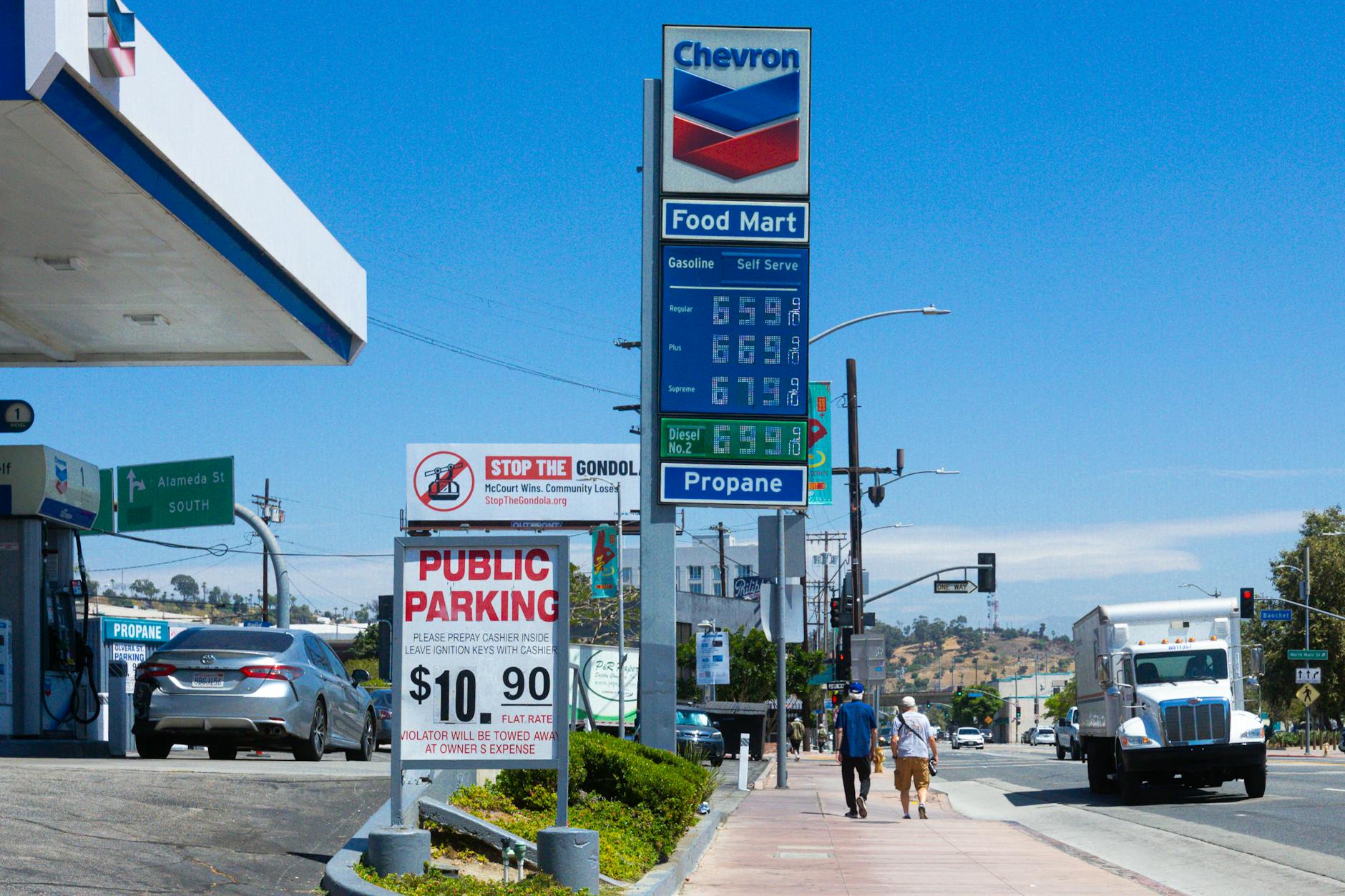
Yes, drivers could face another significant gas price spike before June arrives. The national average gas price currently sits at $4.50-$4.55 per gallon as of mid-May 2026, and traders are actively forecasting prices could exceed $5.00-$5.60 per gallon before the month ends. For a driver filling a 15-gallon tank at current prices, that’s already costing roughly $68, but if prices climb to $5.50 per gallon—well within the projected range—that same fill-up would cost nearly $83, an increase of about 22% in a matter of weeks.
The primary culprit is the ongoing closure of the Strait of Hormuz, which has disrupted approximately 20 million barrels per day of oil and refined fuels since early March 2026. This blockade has created a cascading effect on global energy markets and U.S. gasoline supplies. With American gasoline inventories having fallen for 11 consecutive weeks heading into peak summer demand season, the conditions are ripe for additional price increases before June.
Table of Contents
- How the Strait of Hormuz Blockade Created the Current Gas Price Crisis
- Regional Price Disparities Reveal the Uneven Impact of Energy Disruptions
- Wholesale Futures and Retail Prices: Why the Pump Price Lags the Market
- June Outlook and Likelihood of Another Price Spike Before Summer
- Eleven Weeks of Inventory Declines Point to Sustained Upward Price Pressure
- Energy Information Administration Forecasts vs. Current Reality
- What Comes Next: Timeline for Potential Relief and Continued Risk
- Conclusion
How the Strait of Hormuz Blockade Created the Current Gas Price Crisis
The Strait of Hormuz blockade isn’t a theoretical supply-chain disruption—it’s an active, ongoing crisis affecting real people at the pump. The closure since early March 2026 has eliminated approximately 20 million barrels per day of oil and refined fuels from global markets. To put that in perspective, the entire United States consumes roughly 20 million barrels of petroleum per day, meaning the blockade has essentially removed the equivalent of America’s entire daily oil consumption from available global supply. This disruption has forced global oil inventories to contract sharply. Energy analysts expect inventories to fall by 8.5 million barrels per day during the second quarter of 2026—the period that includes June.
When supply shrinks while demand remains constant or grows, prices rise. Brent crude oil has climbed to around $106 per barrel, directly feeding into the wholesale gasoline futures prices, which stood at $3.60-$3.70 per gallon on May 15, 2026. The gap between wholesale futures prices and what drivers pay at the pump is critical to understand. Retail gasoline prices typically run roughly $0.85-$0.95 higher than wholesale futures. If wholesale futures are at $3.65 per gallon, retailers will price gasoline at the pump somewhere between $4.50-$4.60 per gallon—which is exactly where we are now. As wholesale prices climb, retail prices follow within days or weeks, creating the potential for rapid increases at the pump.

Regional Price Disparities Reveal the Uneven Impact of Energy Disruptions
Gas prices are not uniform across the United States, and the regional variations reveal which drivers face the steepest financial pressure. California leads the nation at $6.15 per gallon, followed by Washington at $5.77 per gallon, and Hawaii at $5.64 per gallon. Meanwhile, other states experience lower prices due to proximity to refineries, lower state taxes, and reduced environmental regulations on fuel blending. The disparity between California’s $6.15 per gallon and the national average of $4.50-$4.55 is not incidental—it represents real economic strain for California residents. A driver in California paying $6.15 per gallon for a 15-gallon fill-up is spending $92.25, compared to a national-average driver spending approximately $68.
Over a month, assuming weekly fill-ups, that California driver spends roughly $369 more than the national-average driver. For low-income households, this difference can mean cutting back on groceries, delaying medical appointments, or struggling with transportation costs. The limitation of using “national average” figures is that they obscure these regional realities. Policymakers and media outlets frequently cite the national average, but that number provides little comfort to drivers in high-cost states who are experiencing significantly steeper price increases. A $0.85 per gallon increase to the national average—pushing it from $4.50 to $5.35—translates to a $12.75 additional cost per fill-up nationally, but in California, an equivalent percentage increase would push prices from $6.15 to over $7.00 per gallon.
Wholesale Futures and Retail Prices: Why the Pump Price Lags the Market
Understanding the relationship between wholesale gasoline futures and retail pump prices is essential to predicting when consumers will see spikes. On May 15, 2026, wholesale gasoline futures jumped 2.67% in a single day to $3.60-$3.70 per gallon. This wholesale market reflects what refineries and distributors are willing to pay for gasoline that will be delivered weeks in the future, based on their expectations about supply and demand. The retail prices drivers pay at the pump lag wholesale futures by approximately one to three weeks. When wholesale prices spike, gas stations don’t immediately reprize every gallon in their underground tanks—they continue selling their existing inventory at existing prices while gradually adjusting posted prices upward.
However, once inventory turns over and new supplies arrive at higher wholesale prices, pump prices climb noticeably. Traders expecting peak supply constraints before the end of May are actively pricing that expectation into June and July contracts, which means retailers are preparing for higher pump prices in the coming weeks. A critical warning: if geopolitical events worsen or the Strait of Hormuz closure extends beyond current expectations, wholesale prices could spike even more dramatically. Conversely, if the blockade is resolved and shipping traffic resumes before the end of May, wholesale prices could stabilize or decline, potentially relieving some upward pressure on pump prices. The uncertainty itself is a cost—consumers cannot plan confidently around gas expenses when the supply situation remains fluid.
June Outlook and Likelihood of Another Price Spike Before Summer
Traders and energy analysts are explicitly forecasting that gas prices could exceed $5.00-$5.60 per gallon before June concludes. The reasoning is straightforward: the Strait of Hormuz is expected to remain closed until late May, with shipping traffic beginning to normalize in June. That timing overlap—between continued supply constraints in late May and early June, combined with the beginning of peak summer driving season—creates the perfect conditions for a price spike. The seasonal demand factor cannot be ignored. Summer driving season typically begins around Memorial Day (May 26 in 2026), when families take vacations, road trips increase, and overall gasoline consumption climbs.
Historically, this seasonal demand increase has added $0.20-$0.40 per gallon to pump prices compared to late winter or early spring. If seasonal demand pushes prices upward at the same time that geopolitical supply constraints are still active, the combination could easily push prices toward the $5.00-$5.60 forecast range. For comparison, the national average hit a four-year high of $3.75 per gallon on wholesale futures on May 4, 2026. If that wholesale price climbs another $0.20-$0.30 per gallon before June, the corresponding retail price spike would push national average pump prices from the current $4.50-$4.55 toward $5.00 or higher. This is not speculation about supply and demand theory—this is a plausible scenario based on current wholesale pricing trends and expected supply disruptions.
📨 Get Free Accountability Coverage Alerts
Free · No spam · Unsubscribe anytime
Eleven Weeks of Inventory Declines Point to Sustained Upward Price Pressure
U.S. gasoline inventories have fallen for 11 consecutive weeks heading into peak summer demand, a critical metric that signals potential sustained price pressure. This inventory decline is not seasonal—inventories typically build during this period as refiners prepare for summer demand. The fact that inventories are contracting instead suggests that global supply disruptions (primarily the Strait of Hormuz closure) are draining available supplies faster than refineries can replenish them. The limitation and warning here is important: inventory data lags current reality by several days.
The most recent inventory figures are always 3-7 days old when published, meaning the true inventory situation may already be worse than the latest reported numbers. If the Strait of Hormuz remains disrupted longer than expected, the next inventory report could show an even steeper decline, setting the stage for another rapid pump price increase. Additionally, the combination of depleting inventories and approaching summer demand season creates a compounding problem. Refineries cannot simply increase production overnight—capacity constraints exist, maintenance schedules are already planned, and the feedstock (crude oil) is also constrained by the Strait blockade. If refineries cannot boost output while inventories are falling and demand is rising, prices will rise to ration the available supply among consumers.

Energy Information Administration Forecasts vs. Current Reality
The U.S. Energy Information Administration (EIA) forecasts an average gas price of $3.88 per gallon for the full year 2026. However, this forecast was made before or during the Strait of Hormuz blockade intensified, and it clearly underestimates the actual price environment consumers are experiencing. In May 2026, pump prices are already running $0.62-$0.67 per gallon higher than the EIA’s annual average forecast.
The discrepancy highlights a critical limitation of energy forecasting: models based on historical patterns and expected conditions perform poorly when unprecedented disruptions occur. The Strait of Hormuz blockade is not a typical supply disruption—it’s removing 20 million barrels per day from markets, which is roughly equivalent to Saudi Arabia’s entire production capacity disappearing. EIA models, which are grounded in historical data, were not calibrated for a scenario of this magnitude. Consumers should treat the $3.88 EIA forecast with skepticism and instead prepare for the possibility that 2026 average prices will exceed $4.50 per gallon, especially if the blockade extends beyond late May.
What Comes Next: Timeline for Potential Relief and Continued Risk
The near-term outlook depends almost entirely on the Strait of Hormuz situation. If the blockade is resolved by late May or early June, shipping traffic could resume and supply constraints could ease by mid-to-late June. In that scenario, wholesale prices might stabilize or gradually decline through July and August. However, this is not the baseline scenario traders are pricing in—the baseline is a blockade extending at least through late May, with resumption of shipping traffic beginning in June.
The forward-looking concern is that even if the Strait blockade ends, global oil inventories will take weeks or months to rebuild to normal levels. During that rebuilding period, oil prices will remain elevated, keeping gasoline prices higher than they would be under normal supply conditions. Drivers should prepare for the possibility that prices elevated above $5.00 per gallon could persist through June and July, especially in high-cost states like California. Year-over-year, gasoline prices in May 2026 are 43.6% higher than May 2025 prices—a substantial increase that reflects the duration and severity of the current supply disruption.
Conclusion
The answer to whether drivers will see another gas price spike before June is almost certainly yes. With wholesale gasoline futures up 2.67% on May 15 alone and traders forecasting prices exceeding $5.00-$5.60 per gallon before June ends, pump prices will likely rise further in the coming weeks. The Strait of Hormuz blockade has eliminated 20 million barrels per day of global supply, American gasoline inventories have fallen for 11 consecutive weeks, and peak summer driving season is beginning—all of these factors converge to create conditions favorable for additional price increases.
Consumers should monitor wholesale gasoline futures prices as an early indicator of coming retail price changes, expect larger increases in high-cost states like California, and prepare household budgets for sustained elevated fuel costs through at least June and likely into July. The EIA’s forecast of $3.88 per gallon for 2026 should be treated as a floor, not a ceiling. Until the Strait of Hormuz blockade is resolved and global inventories begin rebuilding, upward pressure on prices will persist.
You Might Also Like
- Oil Prices Today: What Rising Crude Prices Could Mean for Gas
- Oil Prices Today: Could Middle East Conflict Push Gas Prices Higher?
- Gas Prices Today: Will Prices Drop Before the Fourth of July?